
度洛西汀治疗骨关节炎(DOA)研究:度洛西汀对终末期髋、膝关节骨关节炎疼痛和功能的影响——一项实用型富集随机对照试验。
Duloxetine in OsteoArthritis (DOA) study: effects of duloxetine on pain and function in end-stage hip and knee OA - a pragmatic enriched randomized controlled trial.
机构信息
Department of Orthopedics, University of Groningen, University Medical Center Groningen, P.O. Box 30001, Groningen, RB, 9700, The Netherlands.
Department of Rehabilitation Medicine, University of Groningen, University Medical Center Groningen, P.O. Box 30001, Groningen, RB, 9700, The Netherlands.
出版信息
BMC Musculoskelet Disord. 2022 Feb 5;23(1):115. doi: 10.1186/s12891-022-05034-0.
BACKGROUND
Some osteoarthritis (OA) patients experience inadequate pain relief from analgesics like acetaminophen and nonsteroidal anti-inflammatory drugs. This could be the result of experienced non-nociceptive centralized pain. Placebo-controlled randomized trials (RCT) have proven the effectiveness of duloxetine for OA and several chronic pain conditions where central sensitization (CS) is one of the key underlying pain mechanisms.
OBJECTIVES
Assess the efficacy of an 8-week duloxetine treatment compared to usual care in end-stage knee and hip OA patients with a level of centralized pain.
DESIGN
Pragmatic, enriched, open-label RCT.
METHODS
Patients were randomized to duloxetine or to care-as-usual. Primary outcome was pain in the index joint, measured with the pain domain of the Knee injury and Osteoarthritis Outcome Score (KOOS) or the Hip disability and Osteoarthritis Outcome Score (HOOS). The intention-to-treat principle was used, with mixed-model repeated measures to analyze the effect.
RESULTS
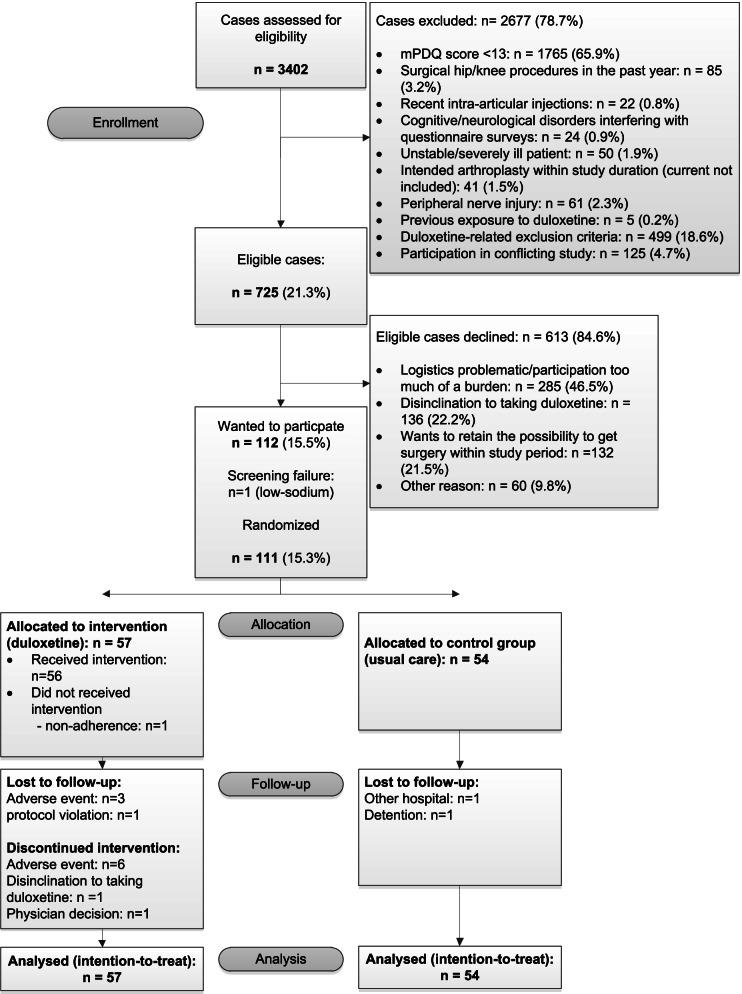
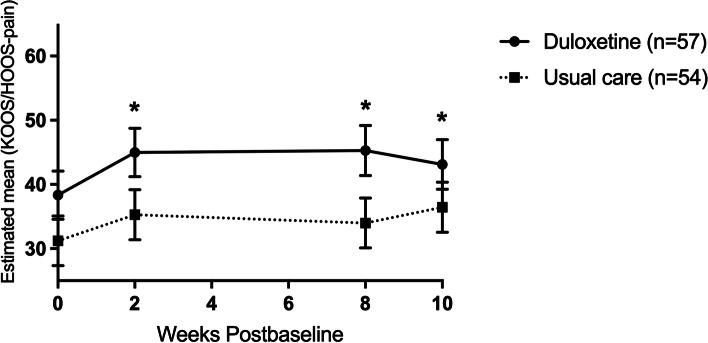
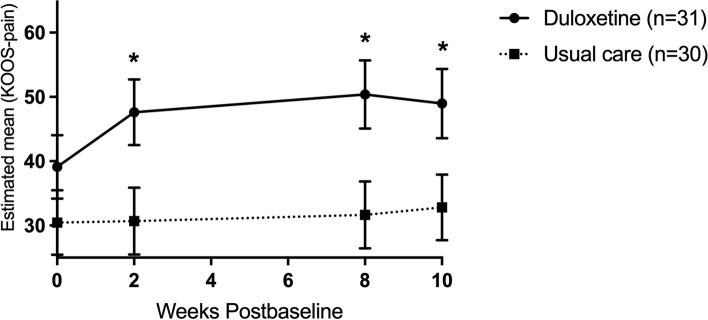
One hundred eleven patients were randomized. Nearly 44% felt much to very much better after duloxetine usage compared to 0% in the care-as-usual group (p < 0.001). The duloxetine group scored 11.3 points (95%CI: 5.8, 16.8) better on the pain domain of the KOOS/HOOS (p < 0.001). Knee patients improved significantly more than hip patients (18.7 [95%CI: 11.3, 26.1] versus 6.0 [95%CI: - 2.6, 14.5] points better).
CONCLUSIONS
Adding duloxetine treatment seems to be beneficial for end-stage knee OA patients with neuropathic-like symptoms (at risk of CS). End stage Hip OA patients seem to be nonresponsive to duloxetine.
TRIAL REGISTRATION
Dutch Trial Registry with number NTR 4744 (15/08/2014) and in the EudraCT database with number 2013-004313-41 .
背景
一些骨关节炎(OA)患者在使用扑热息痛和非甾体抗炎药等镇痛药后,疼痛缓解效果不理想。这可能是由于经历了非伤害性中枢性疼痛。安慰剂对照随机试验(RCT)已证明度洛西汀对 OA 和几种慢性疼痛疾病的有效性,其中中枢敏化(CS)是关键的潜在疼痛机制之一。
目的
评估 8 周度洛西汀治疗与终末期膝和髋 OA 患者的常规护理相比,在有中枢性疼痛程度的患者中的疗效。
设计
实用、丰富、开放标签 RCT。
方法
患者随机分为度洛西汀组或常规护理组。主要结局是使用膝关节损伤和骨关节炎结果评分(KOOS)或髋关节残疾和骨关节炎结果评分(HOOS)的指数关节疼痛。采用意向治疗原则,采用混合模型重复测量分析效果。
结果
111 名患者被随机分配。与常规护理组 0%相比,近 44%的患者在使用度洛西汀后感觉好多了(p<0.001)。度洛西汀组在 KOOS/HOOS 的疼痛域得分提高了 11.3 分(95%CI:5.8,16.8)(p<0.001)。膝部患者的改善明显优于髋部患者(18.7 [95%CI:11.3,26.1] 比 6.0 [95%CI:-2.6,14.5] 分更好)。
结论
添加度洛西汀治疗似乎对有神经样症状(有 CS 风险)的终末期膝 OA 患者有益。终末期髋 OA 患者似乎对度洛西汀无反应。
试验注册
荷兰试验注册处,编号 NTR 4744(2014 年 8 月 15 日)和欧洲药品管理局临床试验数据库,编号 2013-004313-41。

 Zotero 插件