
三种不同方案的胶原交联术后圆锥角膜的角膜混浊与密度测定
Corneal Haze and Densitometry in Keratoconus after Collagen Cross-Linking by Three Different Protocols.
作者信息
Badawi Amani E
机构信息
Department of Ophthalmology, Mansoura Ophthalmic Center, Faculty of Medicine, Mansoura University, Mansoura, Egypt.
出版信息
J Curr Ophthalmol. 2022 Jan 6;33(4):422-430. doi: 10.4103/joco.joco_145_21. eCollection 2021 Oct-Dec.
PURPOSE
To evaluate postoperative corneal haze and corneal densitometry following three different corneal cross-linking (CXL) protocols; standard, accelerated, and trans-epithelial (TE).
METHODS
The study recruited 104 eyes (53 patients) with progressive keratoconus divided into three groups: Group I were subjected to standard CXL, Group II to TE-CXL, and Group III to accelerated CXL (A-CXL) (10 mW/cm for 9 min). Subjective and objective corneal haze measures were evaluated before and 3, 6, and 12 months post-CXL using slit-lamp biomicroscopy and Pentacam Sheimpflug camera.
RESULTS
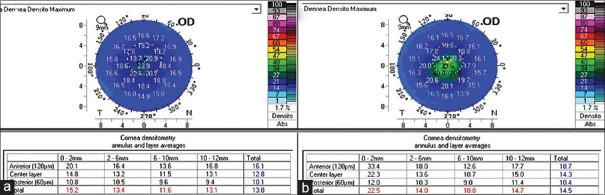
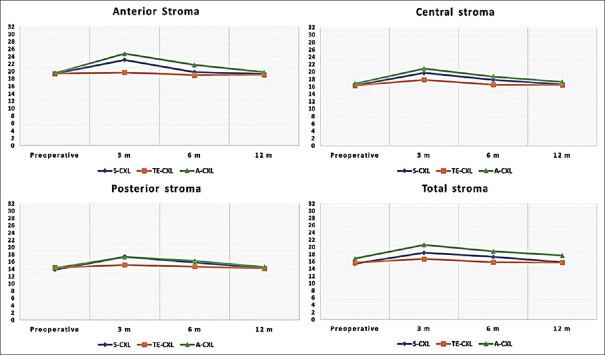
There was a significant difference in corneal densitometry between the three groups at 3 and 6 months post-CXL ( < 0.0001). By the 12 month, a significant statistical difference was observed only in zones (0-2 mm) and (2-6 mm) in both the anterior and the central layers. In Group I, the densitometry value of the preoperative anterior stromal layer (anterior 120 μm) was 19.42 ± 1.81. Then, it peaked at 23.12 ± 1.21 at 3 months ( < 0.0001), reached 19.82 ± 1.19 at 6 months ( = 0.007), and decreased to 19.33 ± 3.23 ( > 0.05) at 12 months. In Group II, the preoperative densitometry value of the anterior layer was 19.41 ± 1.21, peaked at 19.72 ± 1.12 at 3 months ( = 0.02), reached 19.04 ± 1.18 at 6 months ( = 0.052), and increased to 19.13 ± 1.37 at 12 months ( = 0.84). In Group III, the preoperative densitometry value of the anterior stromal layer was 19.53 ± 2.23. Then, it peaked at 24.80 ± 1.08 at 3 months ( < 0.0001), decreased to 21.75 ± 1.11 at 6 months ( < 0.0001), and reached 19.77 ± 2.26 at 12 months ( = 0.047). There was no significant correlation between the visual acuity changes and the total corneal densitometry.
CONCLUSION
The TE-CXL group showed a better and earlier recovery from the haze, while the A-CXL group showed a delay in recovering and persistent increased corneal densitometry, mainly in the anterior 120 μ.
目的
评估三种不同的角膜交联(CXL)方案,即标准方案、加速方案和经上皮(TE)方案术后的角膜混浊及角膜密度测量情况。
方法
该研究纳入了104只眼(53例患者)的进行性圆锥角膜,分为三组:第一组接受标准CXL,第二组接受TE-CXL,第三组接受加速CXL(A-CXL)(10 mW/cm,持续9分钟)。在CXL术前以及术后3、6和12个月,使用裂隙灯生物显微镜和Pentacam Scheimpflug相机评估主观和客观的角膜混浊情况。
结果
CXL术后3个月和6个月时,三组之间的角膜密度测量存在显著差异(<0.0001)。到12个月时,仅在前层和中央层的(0-2 mm)和(2-6 mm)区域观察到显著的统计学差异。在第一组中,术前前基质层(前120μm)的密度测量值为19.42±1.81。然后,在3个月时达到峰值23.12±1.21(<0.0001),6个月时为19.82±1.19(=0.007),12个月时降至19.33±3.23(>0.05)。在第二组中,前层术前密度测量值为19.41±1.21,3个月时达到峰值19.72±1.12(=0.02),6个月时为19.04±1.18(=0.052),12个月时升至19.13±1.37(=0.84)。在第三组中,前基质层术前密度测量值为19.53±2.23。然后,在3个月时达到峰值24.80±1.08(<0.0001),6个月时降至21.75±1.11(<0.0001),12个月时为19.77±2.26(=0.047)。视力变化与总角膜密度测量之间无显著相关性。
结论
TE-CXL组角膜混浊恢复更好且更早,而A-CXL组恢复延迟且角膜密度持续增加,主要在前120μm处。



 Zotero 插件