
铋剂药物逆转革兰氏阴性菌 Tet(X)介导的替加环素耐药性。
Bismuth Drugs Reverse Tet(X)-Conferred Tigecycline Resistance in Gram-Negative Bacteria.
机构信息
College of Veterinary Medicine, Yangzhou Universitygrid.268415.c, Yangzhou, Jiangsu, China.
Jiangsu Co-innovation Center for Prevention and Control of Important Animal Infectious Diseases and Zoonoses, Joint International Research Laboratory of Agriculture and Agri-Product Safety, the Ministry of Education of China, Yangzhou Universitygrid.268415.c, Yangzhou, Jiangsu, China.
出版信息
Microbiol Spectr. 2022 Feb 23;10(1):e0157821. doi: 10.1128/spectrum.01578-21. Epub 2022 Feb 9.
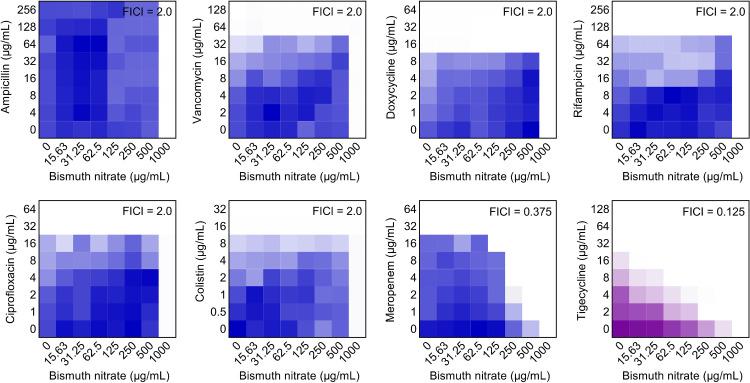
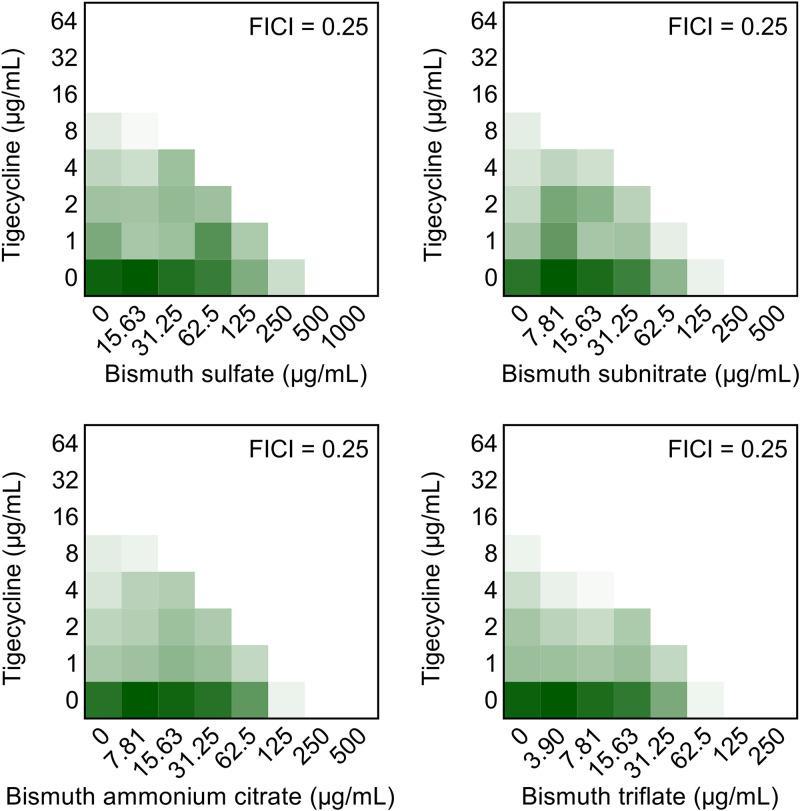
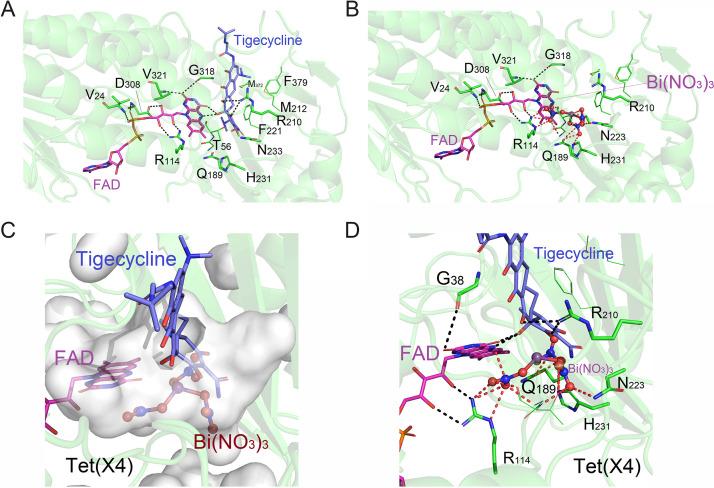
Antibiotic resistance has caused a serious threat to public health and human safety. Recently, the emergence of novel resistance gene (X4) and its variants threatens the clinical utility of tigecycline, one of the last-line antibiotics for multidrug-resistant (MDR) bacterial infections. It is highly promising to develop effective antibiotic adjuvants to restore the clinical efficacy of existing drugs and extend their life spans. Metal compounds, such as silver, have been widely used as potential antimicrobial agents for decades. However, the potentiating effect of metallo-agents on the existing antibiotics is not fully understood. Here, we found that five bismuth drugs, especially bismuth nitrate [Bi(NO)], commonly used in clinical treatment of stomach-associated diseases, effectively boost the antibacterial activity of tigecycline against (X)-positive bacteria by inhibiting the enzymatic activity of Tet(X) protein. Furthermore, the combination of Bi(NO) and tigecycline prevents the development of higher-level resistance in Tet(X)-expressing Gram-negative bacteria. Using molecular docking and dynamics simulation assays, we revealed that Bi(NO) can competitively bind to the active center of Tet(X4) protein, while the bismuth atom targets the Tet(X4) protein in a noncompetitive manner and changes the structure of the primary binding pocket. These two mechanisms of action both antagonize the enzymatic activity of Tet(X4) resistance protein on tigecycline. Collectively, these findings indicate the high potential of bismuth drugs as novel Tet(X) inhibitors to treat (X4)-positive bacteria-associated infections in combination with tigecycline. Recently, high-level tigecycline resistance mediated by (X4) and its variants represents a serious challenge for global public health. Antibiotic adjuvant strategy that enhances the activity of the existing antibiotics by using nonantibiotic drugs offers a distinct approach to combat the antibiotic resistance crisis. In this study, we found that bismuth drugs involve bismuth nitrate, a compound previously approved for treatment of stomach-associated diseases, remarkably potentiates tigecycline activity against (X)-positive bacteria. Mechanistic studies showed that bismuth drugs effectively suppress the enzymatic activity of Tet(X) resistance protein. Specifically, bismuth nitrate targets the active center of Tet(X4) protein, while bismuth binds to the resistance protein in a noncompetitive manner. Our data open up a new horizon for the treatment of infections caused by (X)-bearing superbugs.
抗生素耐药性对公众健康和人类安全构成了严重威胁。最近,新型耐药基因(X4)及其变体的出现威胁到替加环素的临床应用,替加环素是治疗多重耐药(MDR)细菌感染的最后一线抗生素之一。开发有效的抗生素佐剂来恢复现有药物的临床疗效并延长其使用寿命具有广阔的前景。金属化合物,如银,几十年来一直被广泛用作潜在的抗菌剂。然而,金属佐剂对现有抗生素的增效作用尚不完全清楚。在这里,我们发现五种铋药物,特别是临床上用于治疗与胃相关疾病的硝酸铋[Bi(NO)],通过抑制 Tet(X) 蛋白的酶活性,有效增强替加环素对(X)阳性细菌的抗菌活性。此外,Bi(NO) 和替加环素的联合使用可防止 Tet(X) 表达的革兰氏阴性细菌产生更高水平的耐药性。通过分子对接和动力学模拟实验,我们揭示了 Bi(NO) 可以竞争性地结合到 Tet(X4) 蛋白的活性中心,而铋原子以非竞争性的方式靶向 Tet(X4) 蛋白并改变主要结合口袋的结构。这两种作用机制都拮抗 Tet(X4) 耐药蛋白对替加环素的酶活性。总的来说,这些发现表明铋药物作为新型 Tet(X) 抑制剂具有很大的潜力,可与替加环素联合用于治疗(X4)阳性菌相关感染。最近,(X4)及其变体介导的高水平替加环素耐药性对全球公共健康构成了严重挑战。通过使用非抗生素药物增强现有抗生素活性的抗生素佐剂策略为应对抗生素耐药性危机提供了一种独特的方法。在这项研究中,我们发现铋药物涉及硝酸铋,一种以前被批准用于治疗与胃相关疾病的化合物,可显著增强替加环素对(X)阳性细菌的活性。机制研究表明,铋药物可有效抑制 Tet(X) 耐药蛋白的酶活性。具体来说,硝酸铋靶向 Tet(X4) 蛋白的活性中心,而铋以非竞争性方式与耐药蛋白结合。我们的数据为治疗携带(X)的超级细菌引起的感染开辟了新的视野。



 Zotero 插件