
探讨Artemin及其同源受体GFRα3在骨关节炎疼痛中的作用。
Investigating the Role of Artemin and Its Cognate Receptor, GFRα3, in Osteoarthritis Pain.
作者信息
Minnema Laura, Gupta Ankita, Mishra Santosh K, Lascelles B Duncan X
机构信息
Translational Research in Pain Program, Department of Clinical Sciences, College of Veterinary Medicine, North Carolina State University, Raleigh, NC, United States.
Department of Clinical Sciences, College of Veterinary Medicine, North Carolina State University, Raleigh, NC, United States.
出版信息
Front Neurosci. 2022 Jan 27;16:738976. doi: 10.3389/fnins.2022.738976. eCollection 2022.
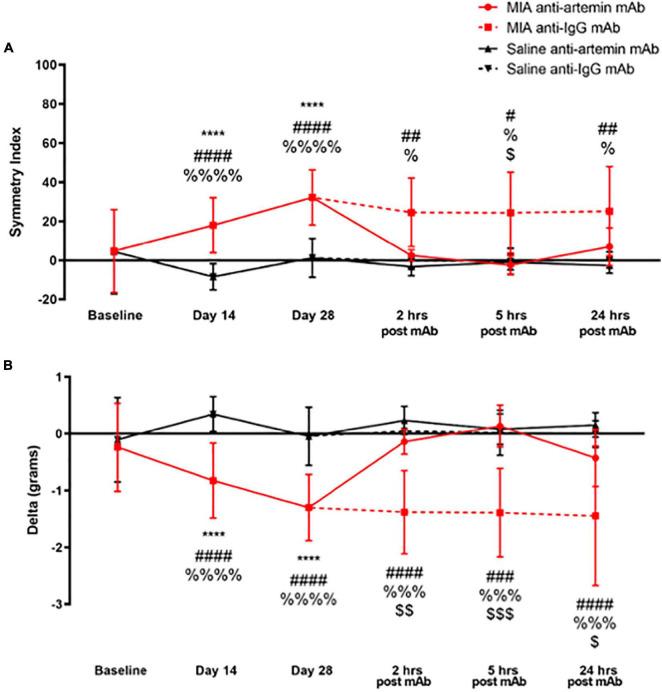
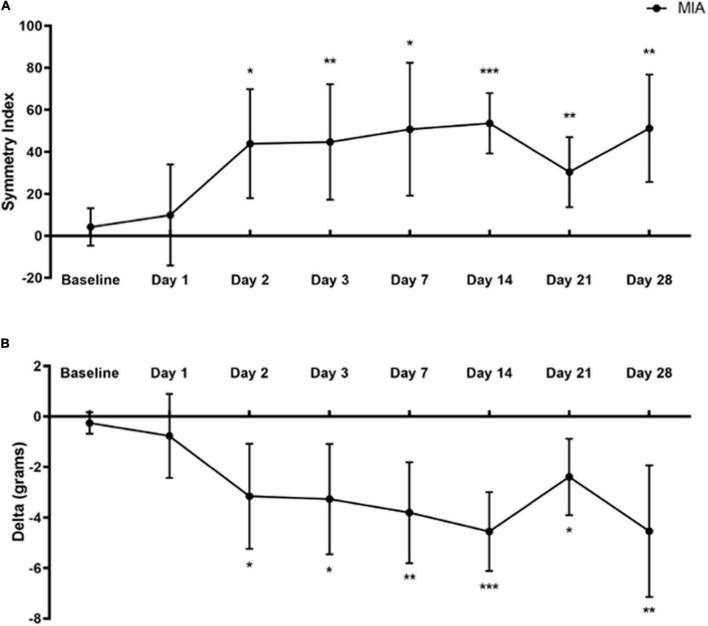
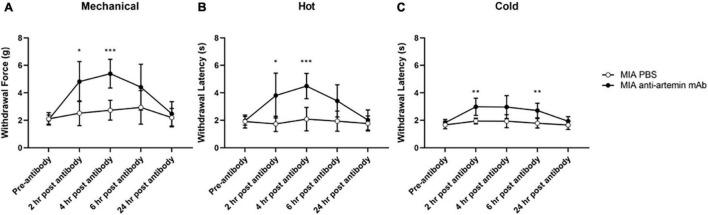
Osteoarthritis (OA) associated pain (OA-pain) is a significant global problem. OA-pain limits limb use and mobility and is associated with widespread sensitivity. Therapeutic options are limited, and the available options are often associated with adverse effects. The lack of therapeutic options is partly due to a lack of understanding of clinically relevant underlying neural mechanisms of OA-pain. In previous work in naturally occurring OA-pain in dogs, we identified potential signaling molecules (artemin/GFRα3) that were upregulated. Here, we use multiple approaches, including cellular, mouse genetic, immunological suppression in a mouse model of OA, and clinically relevant measures of sensitivity and limb use to explore the functional role of artemin/GFRα3 signaling in OA-pain. We found the monoiodoacetate (MIA)-induced OA-pain in mice is associated with decreased limb use and hypersensitivity. Exogenous artemin induces mechanical, heat, and cold hypersensitivity, and systemic intraperitoneal anti-artemin monoclonal antibody administration reverses this hypersensitivity and restores limb use in mice with MIA-induced OA-pain. An artemin receptor GFRα3 expression is increased in sensory neurons in the MIA model. Our results provide a molecular basis of arthritis pain linked with artemin/GFRα3 signaling and indicate that further work is warranted to investigate the neuronal plasticity and the pathways that drive pain in OA.
骨关节炎(OA)相关疼痛(OA疼痛)是一个重大的全球性问题。OA疼痛限制肢体使用和活动能力,并与广泛的敏感性相关。治疗选择有限,且现有选择往往伴有不良反应。治疗选择匮乏部分归因于对OA疼痛临床相关潜在神经机制缺乏了解。在之前对犬类自然发生的OA疼痛的研究中,我们鉴定出上调的潜在信号分子(Artemin/GFRα3)。在此,我们采用多种方法,包括细胞、小鼠遗传学、OA小鼠模型中的免疫抑制,以及敏感性和肢体使用的临床相关测量,以探究Artemin/GFRα3信号在OA疼痛中的功能作用。我们发现,小鼠单碘乙酸盐(MIA)诱导的OA疼痛与肢体使用减少和超敏反应相关。外源性Artemin诱导机械性、热和冷超敏反应,全身性腹腔注射抗Artemin单克隆抗体可逆转这种超敏反应,并恢复MIA诱导的OA疼痛小鼠的肢体使用。在MIA模型中,感觉神经元中Artemin受体GFRα3的表达增加。我们的结果为与Artemin/GFRα3信号相关的关节炎疼痛提供了分子基础,并表明有必要进一步研究神经元可塑性以及OA中驱动疼痛的途径。



 Zotero 插件