
钠-葡萄糖共转运蛋白 2 抑制剂在不同肾功能水平患者中的尿糖排泄:系统评价和荟萃分析。
The Urinary Glucose Excretion by Sodium-Glucose Cotransporter 2 Inhibitor in Patients With Different Levels of Renal Function: A Systematic Review and Meta-Analysis.
机构信息
Department of Endocrinology and Metabolism, Peking University People's Hospital, Beijing, China.
Department of Endocrinology and Metabolism, Beijing Airport Hospital, Beijing, China.
出版信息
Front Endocrinol (Lausanne). 2022 Jan 27;12:814074. doi: 10.3389/fendo.2021.814074. eCollection 2021.
OBJECTIVE
Previous evidence suggested that sodium-glucose cotransporter 2 inhibitor (SGLT2i)-mediated urinary glucose excretion (UGE) appeared to be reduced with a decrease in glomerular filtration rate. Thus, we conducted a systematic review and meta-analysis to compare SGLT2i-mediated UGE among individuals with different levels of renal function.
METHODS
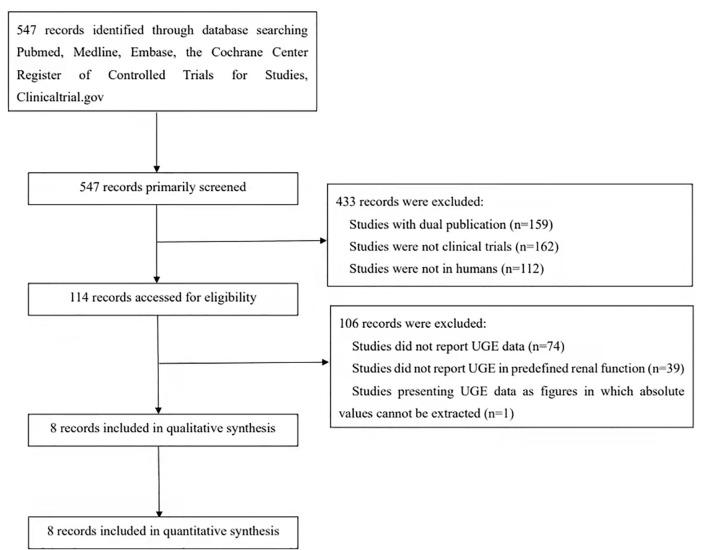
We conducted systematic searches in PubMed, Medline, Embase, Cochrane Central Register of Controlled Trials, and ClinicalTrial.gov from inception to May 2021. Clinical studies of SGLT2i with reports of UGE changes in predefined different levels of renal function were included. The results were expressed as pooled effect sizes with 95% confidence interval (CI). A random-effects model was used to calculate the pooled effect sizes.
RESULTS
In total, eight eligible studies were included. Significant differences were observed in the post-treatment UGE level among subgroups stratified by renal function (0.001 for subgroup difference), which were gradually decreased along with the severity of impaired renal function. Consistently, changes in UGE before and after SGLT2i treatment were also decreased along with the severity of impaired renal function [67.52 g/day (95%CI: 55.58 to 79.47 g/day) for individuals with normal renal function, 52.41 g/day (95%CI: 38.83 to 65.99 g/day) for individuals with mild renal function impairment, 35.11 g/day (95%CI: 19.79 to 50.43 g/day) for individuals with moderate renal function impairment, and 13.53 g/day (95%CI: 7.20 to 19.86 g/day) for individuals with severe renal function impairment; 0.001 for subgroup differences].
CONCLUSIONS
SGLT2i-mediated UGE was renal function dependent, which was decreased with the extent of renal function impairment.
目的
先前的证据表明,钠-葡萄糖共转运蛋白 2 抑制剂(SGLT2i)介导的尿糖排泄(UGE)似乎随着肾小球滤过率的降低而减少。因此,我们进行了系统评价和荟萃分析,以比较不同肾功能水平个体之间 SGLT2i 介导的 UGE。
方法
我们从建库到 2021 年 5 月在 PubMed、Medline、Embase、Cochrane 中央对照试验注册库和 ClinicalTrials.gov 进行了系统检索。纳入了报告 SGLT2i 治疗前后 UGE 变化的不同肾功能水平预设的 SGLT2i 临床研究。结果以 95%置信区间(CI)表示为汇总效应大小。采用随机效应模型计算汇总效应大小。
结果
共纳入 8 项符合条件的研究。肾功能亚组之间的治疗后 UGE 水平存在显著差异(亚组差异 0.001),随着肾功能损害程度的加重而逐渐降低。一致的是,SGLT2i 治疗前后 UGE 的变化也随着肾功能损害的严重程度而降低[肾功能正常者为 67.52 g/天(95%CI:55.58 至 79.47 g/天),肾功能轻度损害者为 52.41 g/天(95%CI:38.83 至 65.99 g/天),肾功能中度损害者为 35.11 g/天(95%CI:19.79 至 50.43 g/天),肾功能重度损害者为 13.53 g/天(95%CI:7.20 至 19.86 g/天);亚组差异 0.001]。
结论
SGLT2i 介导的 UGE 依赖于肾功能,随着肾功能损害程度的增加而减少。


 Zotero 插件