
中国人群中母体多不饱和脂肪酸与脐带血和胎盘端粒长度的关联
Associations of Maternal Polyunsaturated Fatty Acids With Telomere Length in the Cord Blood and Placenta in Chinese Population.
作者信息
Liu Xuanyi, Shi Qiaoyu, Fan Xiuqin, Chen Hang, Chen Na, Zhao Yurong, Qi Kemin
机构信息
Key Laboratory of Major Diseases in Children, Laboratory of Nutrition and Development, Ministry of Education, Beijing Pediatric Research Institute, Beijing Children's Hospital, Capital Medical University, National Center for Children's Health, Beijing, China.
Department of Obstetrics and Gynecology, Fuxing Hospital, Capital Medical University, Beijing, China.
出版信息
Front Nutr. 2022 Jan 28;8:779306. doi: 10.3389/fnut.2021.779306. eCollection 2021.
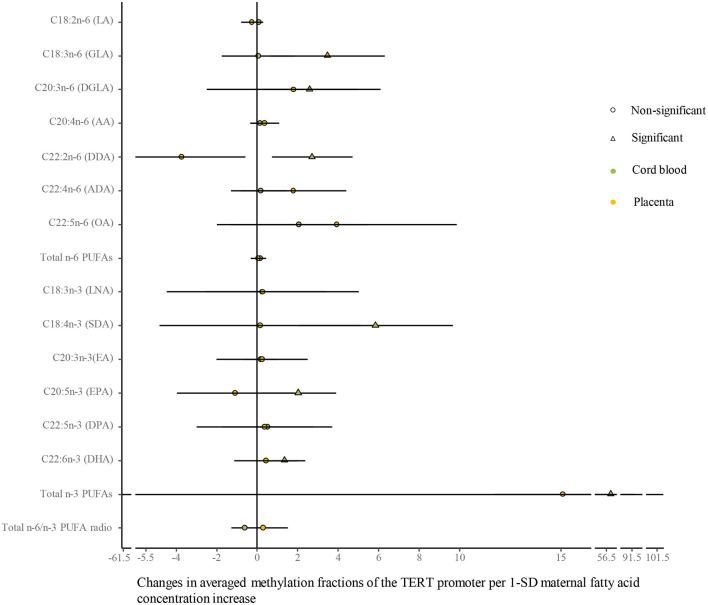
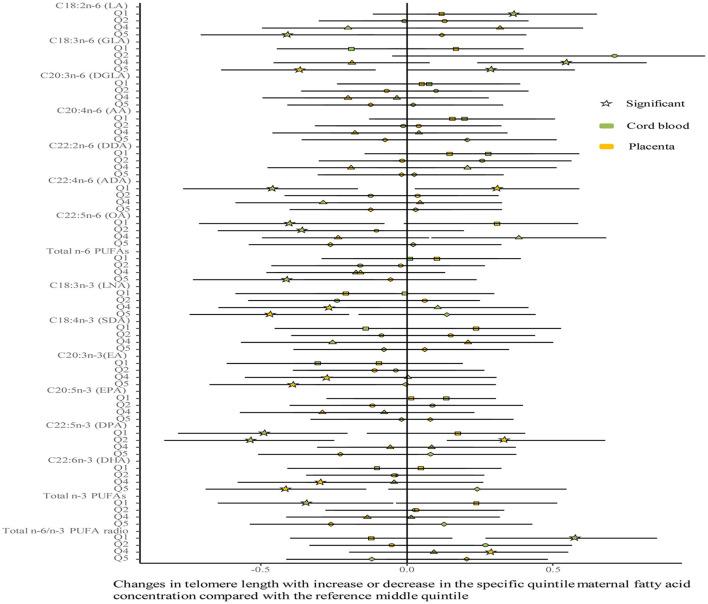
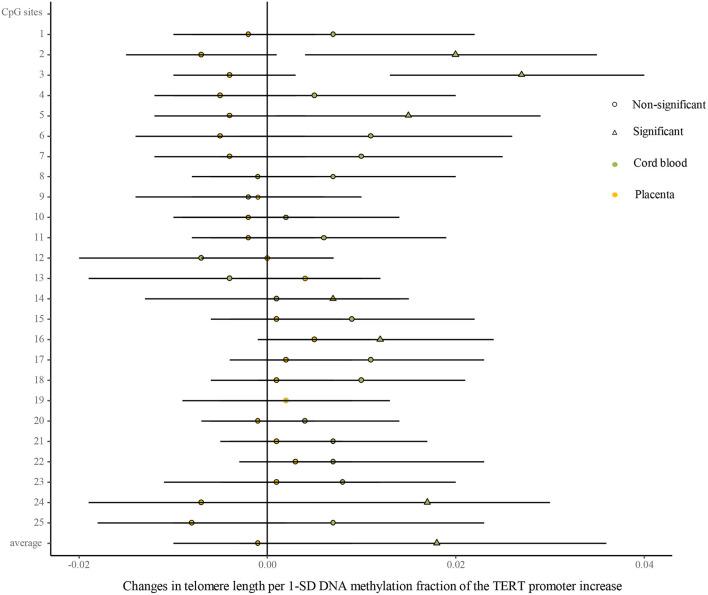
Few studies have investigated the correlation between maternal polyunsaturated fatty acids (PUFAs) and telomeres in offspring, and the underlying influential mechanisms. In this study, we assessed the associations of maternal PUFAs with telomere length (TL) and DNA methylation of the telomerase reverse transcriptase (TERT) promoter in the cord blood and the placenta. A total of 274 pregnant women and their newborn babies were enrolled in this study. Maternal blood before delivery, the cord blood, and the placenta at birth were collected. Fatty acids in maternal erythrocytes and cord blood cells were measured by gas chromatography (GC). TL in the cord blood and the placenta was determined using real-time quantitative PCR (qPCR) by calculating the product ratio of telomeric DNA to the single-copy gene β-globin. The TERT promoter methylation was analyzed by DNA bisulfite sequencing. The associations of maternal fatty acids with TL were analyzed by univariate and multivariate regression. We found that low concentrations of docosapentaenoci acid (DPA, C22: 5n-3) and total n-3 PUFAs, adrenic acid (ADA, C22: 4n-6), and osbond acid (OA, C22: 5n-6) and high concentrations of linoleic acid (LA, C18: 2n-6) in maternal erythrocytes were associated with the shortened TL in cord blood cells (estimated difference in univariate analysis -0.36 to -0.46 for extreme quintile compared with middle quintile), and that low concentrations of cord blood docosahexaenoic acid (DHA, C22: 6n-3) were related to the shortened TL in cord blood cells. Differently, high concentrations of α-linolenic acid (LNA, C18: 3n-3), eicosatrienoic acid (EA, C20: 3n-3), DHA, and γ-linoleic acid (GLA, C18:3n-6) in maternal erythrocytes were associated with the shortened TL in the placenta (estimated difference in univariate analysis -0.36 to -0.45 for higher quintiles compared with the middle quintile). Further examination demonstrated that the concentrations of DHA and total n-3 PUFAs in maternal erythrocytes had positive associations with DNA methylation of the TERT promoter in the cord blood instead of the placenta. These data suggest that maternal PUFAs are closely correlated to infant TL and the TERT promoter methylation, which are differently affected by maternal n-3 PUFAs between the cord blood and the placenta. Therefore, keeping higher levels of maternal n-3 PUFAs during pregnancy may help to maintain TL in the offspring, which is beneficial to long-term health.
很少有研究调查母体多不饱和脂肪酸(PUFAs)与后代端粒之间的相关性以及潜在的影响机制。在本研究中,我们评估了母体PUFAs与脐带血和胎盘中端粒长度(TL)以及端粒酶逆转录酶(TERT)启动子DNA甲基化之间的关联。本研究共纳入了274名孕妇及其新生儿。收集了分娩前的母体血液、脐带血和出生时的胎盘。通过气相色谱法(GC)测量母体红细胞和脐带血细胞中的脂肪酸。使用实时定量PCR(qPCR)通过计算端粒DNA与单拷贝基因β-珠蛋白的产物比率来测定脐带血和胎盘中的TL。通过DNA亚硫酸氢盐测序分析TERT启动子甲基化。通过单变量和多变量回归分析母体脂肪酸与TL之间的关联。我们发现母体红细胞中低浓度的二十二碳五烯酸(DPA,C22:5n-3)和总n-3 PUFAs、肾上腺酸(ADA,C22:4n-6)和奥斯邦酸(OA,C22:5n-6)以及高浓度的亚油酸(LA,C18:2n-6)与脐带血细胞中TL缩短有关(单变量分析中,极端五分位数与中间五分位数相比,估计差异为-0.36至-0.46),并且脐带血中低浓度的二十二碳六烯酸(DHA,C22:6n-3)与脐带血细胞中TL缩短有关。不同的是,母体红细胞中高浓度的α-亚麻酸(LNA,C18:3n-3)、二十碳三烯酸(EA,C20:3n-3)、DHA和γ-亚麻酸(GLA,C18:3n-6)与胎盘中TL缩短有关(单变量分析中,较高五分位数与中间五分位数相比,估计差异为-0.36至-0.45)。进一步检查表明,母体红细胞中DHA和总n-3 PUFAs的浓度与脐带血而非胎盘中TERT启动子的DNA甲基化呈正相关。这些数据表明母体PUFAs与婴儿TL和TERT启动子甲基化密切相关,脐带血和胎盘之间母体n-3 PUFAs对其影响不同。因此,孕期保持较高水平的母体n-3 PUFAs可能有助于维持后代的TL,这对长期健康有益。



 Zotero 插件