
里沙鲁单抗显示出高疗效,并在第 52 周持续改善应答。
Risankizumab shows high efficacy and maintenance in improvement of response until week 52.
机构信息
Department of Medical Sciences, Section of Dermatology, University of Turin, Torino, Italy.
Section of Dermatology, Department of Clinical Medicine and Surgery, University of Naples Federico II, Naples, Italy.
出版信息
Dermatol Ther. 2022 May;35(5):e15378. doi: 10.1111/dth.15378. Epub 2022 Feb 28.
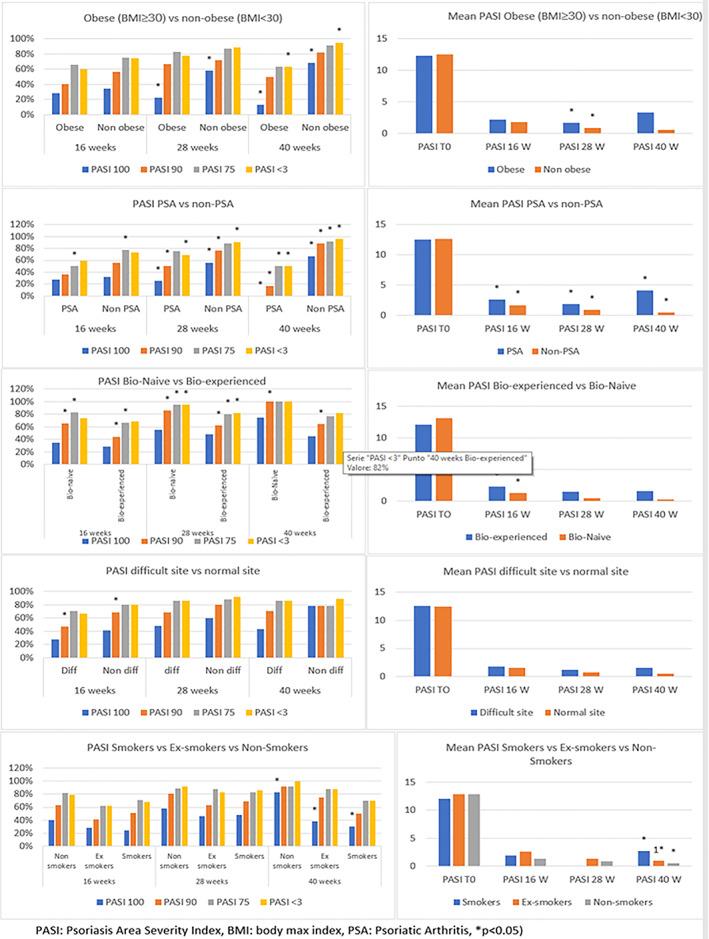
Risankizumab has been recently approved for moderate-to-severe plaque psoriasis; however, real-life studies are scarce. Analysis of possible predictor factors of treatment response are limited to body mass index (BMI) and previous biologic experience. Our objectives were to evaluate the effectiveness and safety of Risankizumab and to investigate on possible predictor factors response. We retrospectively analyzed 166 patients from two centers in Italy who undergone Risankizumab for psoriasis. The proportion of patients achieving a 100%, 90%, 75% of improvement in Psoriasis Area Severity Index (PASI) and PASI <3 were collected at weeks 16, 28, 40, and 52. Study population was analyzed in subgroups to investigate possible predictors of response to Risankizumab since week 40. At the time of analysis 165, 103, 30, and 11 patients had completed 16, 28, 40, and 52 weeks of treatment, respectively. The mean PASI score decreased from 12.5 ± 5.1 at baseline to 1.9 ± 2.4 at week 16. Similar reductions were observed when considering PASI <3, PASI 75, PASI 90, and PASI 100. Previous biologics failure, different smoking habits, obesity, and joint involvement resulted in a lower response to risankizumab. In particular, significant differences in mean PASI at any time-points was observed between psoriatic arthritis (PSA) and non-PSA patients: 2.7 versus 1.7 (p = 0.036), 1.9 versus 0.4 (p = 0.006), and 4.1 versus 0.5 (p = 0.016) at 16, 28, and 40 weeks, respectively. No difference in response to risankizumab occurred in the case of involvement of difficult-to-treat areas. In this population, Risankizumab was effective and safe. Smoking habits, joint involvement, obese status, and previous biologic experience may negatively affect treatment response, while difficult body sites involvement have minor impact.
里萨鲁单抗最近被批准用于中重度斑块型银屑病;然而,真实世界的研究很少。对治疗反应的可能预测因素的分析仅限于体重指数(BMI)和以前的生物治疗经验。我们的目的是评估里萨鲁单抗的有效性和安全性,并研究可能的预测因素反应。我们回顾性分析了来自意大利两个中心的 166 名接受里萨鲁单抗治疗的银屑病患者。在第 16、28、40 和 52 周时,收集达到银屑病面积严重程度指数(PASI)改善 100%、90%、75%和 PASI<3 的患者比例。在第 40 周时,对研究人群进行亚组分析,以研究里萨鲁单抗治疗反应的可能预测因素。在分析时,分别有 165、103、30 和 11 名患者完成了 16、28、40 和 52 周的治疗。基线时,平均 PASI 评分从 12.5±5.1 降至第 16 周的 1.9±2.4。当考虑 PASI<3、PASI 75、PASI 90 和 PASI 100 时,也观察到类似的降低。以前生物制剂治疗失败、不同的吸烟习惯、肥胖和关节受累导致对里萨鲁单抗的反应降低。特别是,在 PSA 和非 PSA 患者之间,在任何时间点的平均 PASI 都有显著差异:16、28 和 40 周时分别为 2.7 比 1.7(p=0.036)、1.9 比 0.4(p=0.006)和 4.1 比 0.5(p=0.016)。在治疗反应方面,在治疗困难部位受累的情况下,里萨鲁单抗没有差异。在该人群中,里萨鲁单抗有效且安全。吸烟习惯、关节受累、肥胖状态和以前的生物治疗经验可能会对治疗反应产生负面影响,而困难部位的受累则影响较小。

 Zotero 插件