
横纹肌肉瘤中蛋白质和微小RNA的纳米串数字分子分析
NanoString Digital Molecular Profiling of Protein and microRNA in Rhabdomyosarcoma.
作者信息
Ahmed Atif A, Farooqi Midhat S, Habeebu Sultan S, Gonzalez Elizabeth, Flatt Terrie G, Wilson Ashley L, Barr Frederic G
机构信息
Department of Pathology and Laboratory Medicine, Children's Mercy Hospital, Kansas City, MO 64108, USA.
Department of Pathology and Laboratory Medicine, Children's Mercy Hospital/University of Missouri, Kansas City, MO 64108, USA.
出版信息
Cancers (Basel). 2022 Jan 21;14(3):522. doi: 10.3390/cancers14030522.
PURPOSE
Rhabdomyosarcoma (RMS) exhibits a complex prognostic algorithm based on histologic, biologic and clinical parameters. The embryonal (ERMS) and spindle cell-sclerosing RMS (SRMS) histologic subtypes warrant further studies due to their heterogenous genetic background and variable clinical behavior. NanoString digital profiling methods have been previously highlighted as robust novel methods to detect protein and microRNA expression in several cancers but not in RMS.
METHODS/PATIENTS: To identify prognostic biomarkers, we categorized 12 ERMS and SRMS tumor cases into adverse ( = 5) or favorable ( = 7) prognosis groups and analyzed their signaling pathways and microRNA profiles. The digital spatial profiling of protein and microRNA analysis was performed on formalin-fixed, paraffin-embedded (FFPE) tumor tissue using NanoString technology.
RESULTS
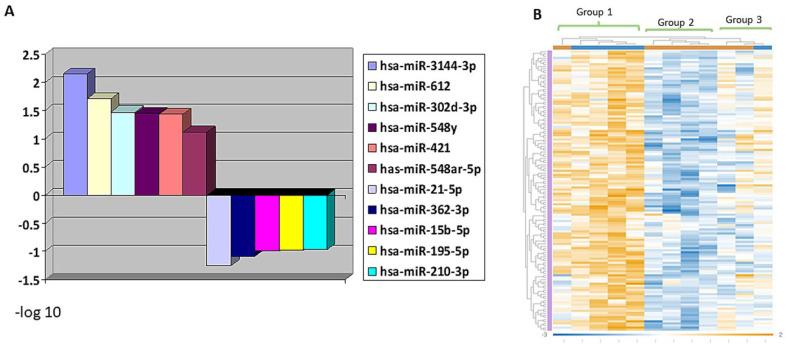
The detectable expression of several component members of the PI3K/AKT, MAPK and apoptosis signaling pathways was highlighted in RMS, including INPP4B, Pan-AKT, MET, Pan-RAS, EGFR, phospho-p90 RSK, p44/42 ERK1/2, BAD, BCL-XL, cleaved caspase-9, NF1, PARP and p53. Compared to cases with favorable prognosis, the adverse-prognosis tumor samples had significantly increased expression of INPP4B, which was confirmed with traditional immunohistochemistry. The analysis of microRNA profiles revealed that, out of 798 microRNAs assessed, 228 were overexpressed and 134 downregulated in the adverse prognosis group. Significant over-expression of oncogenic/tumor suppressor miR-3144-3p, miR-612, miR-302d-3p, miR-421, miR-548ar-5p and miR-548y ( < 0.05) was noted in the adverse prognosis group.
CONCLUSION
This study highlights the utility of NanoString digital profiling methods in RMS, where it can detect distinct molecular signatures with the expression of signaling pathways and microRNAs from FFPE tumor tissue that may help identify prognostic biomarkers of interest. The overexpression of INPP4B and miR-3144-3p, miR-612, miR-302d-3p, miR-421, miR-548y and miR-548ar-5p may be associated with worse overall survival in ERMS and SRMS.
目的
横纹肌肉瘤(RMS)基于组织学、生物学和临床参数呈现出复杂的预后算法。胚胎型(ERMS)和梭形细胞硬化型RMS(SRMS)组织学亚型因其异质性遗传背景和多变的临床行为,值得进一步研究。NanoString数字分析方法此前已被视为检测多种癌症中蛋白质和微小RNA表达的强大新方法,但尚未用于RMS。
方法/患者:为了识别预后生物标志物,我们将12例ERMS和SRMS肿瘤病例分为预后不良(n = 5)或预后良好(n = 7)组,并分析其信号通路和微小RNA谱。使用NanoString技术对福尔马林固定、石蜡包埋(FFPE)肿瘤组织进行蛋白质和微小RNA的数字空间分析。
结果
RMS中突出显示了PI3K/AKT、MAPK和凋亡信号通路的几个组成成员的可检测表达,包括INPP4B、泛AKT、MET、泛RAS、EGFR、磷酸化p90 RSK、p44/42 ERK1/2、BAD、BCL-XL、裂解的caspase-9、NF1、PARP和p53。与预后良好的病例相比,预后不良的肿瘤样本中INPP4B的表达显著增加,这通过传统免疫组织化学得到证实。微小RNA谱分析显示,在评估的798种微小RNA中,228种在预后不良组中过表达,134种下调。在预后不良组中,致癌/肿瘤抑制性miR-3144-3p、miR-612、miR-302d-3p、miR-421、miR-548ar-5p和miR-548y有显著过表达(P < 0.05)。
结论
本研究强调了NanoString数字分析方法在RMS中的实用性,该方法可以从FFPE肿瘤组织中检测到具有信号通路和微小RNA表达的独特分子特征,这可能有助于识别感兴趣的预后生物标志物。INPP4B以及miR-3144-3p、miR-612、miR-302d-3p、miR-421、miR-548y和miR-548ar-5p的过表达可能与ERMS和SRMS中较差的总生存期相关。


 Zotero 插件