
多胺氧化酶触发 HO 介导的亚精胺提高番茄幼苗耐盐碱性氧化应激。
Polyamine Oxidase Triggers HO-Mediated Spermidine Improved Oxidative Stress Tolerance of Tomato Seedlings Subjected to Saline-Alkaline Stress.
机构信息
College of Horticulture, Northwest A&F University, Yangling, Xianyang 712100, China.
College of Horticulture, Shenyang Agricultural University, Shenyang 110866, China.
出版信息
Int J Mol Sci. 2022 Jan 30;23(3):1625. doi: 10.3390/ijms23031625.
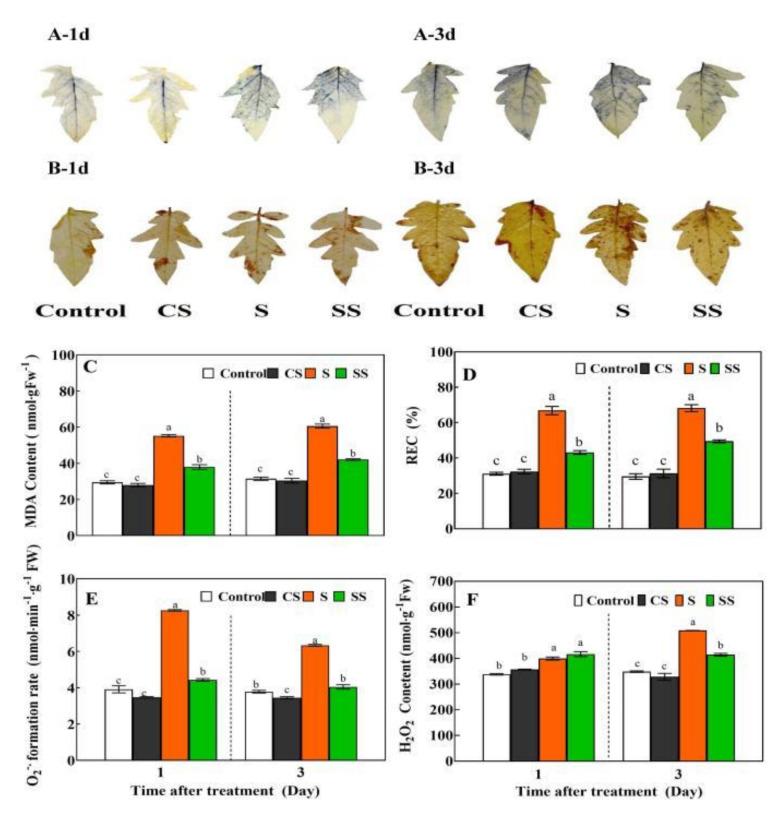
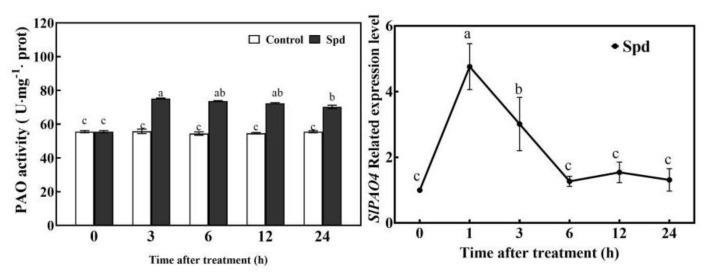
Saline-alkaline stress is one of several major abiotic stresses in crop production. Exogenous spermidine (Spd) can effectively increase tomato saline-alkaline stress resistance by relieving membrane lipid peroxidation damage. However, the mechanism through which exogenous Spd pre-treatment triggers the tomato antioxidant system to resist saline-alkaline stress remains unclear. Whether HO and polyamine oxidase (PAO) are involved in Spd-induced tomato saline-alkaline stress tolerance needs to be determined. Here, we investigated the role of PAO and HO in exogenous Spd-induced tolerance of tomato to saline-alkaline stress. Results showed that Spd application increased the expression and activities of superoxide dismutase (SOD), catalase (CAT), ascorbate peroxidase (APX), glutathione reductase (GR), and the ratio of reduced ascorbate (AsA) and glutathione (GSH) contents under saline-alkaline stress condition. Exogenous Spd treatment triggered endogenous HO levels, gene expression, as well as PAO activity under normal conditions. Inhibiting endogenous PAO activity by 1,8-diaminooctane (1,8-DO, an inhibitor of polyamine oxidase) significantly reduced HO levels in the later stage. Moreover, inhibiting endogenous PAO or silencing the gene increased the peroxidation damage of tomato leaves under saline-alkaline stress. These findings indicated that exogenous Spd treatment stimulated gene expression and increased PAO activity, which mediated the elevation of HO level under normal conditions. Consequently, the downstream antioxidant system was activated to eliminate excessive ROS accumulation and relieve membrane lipid peroxidation damage and growth inhibition under saline-alkaline stress. In conclusion, PAO triggered HO-mediated Spd-induced increase in the tolerance of tomato to saline-alkaline stress.
盐碱性胁迫是作物生产中几种主要非生物胁迫之一。外源亚精胺(Spd)可以通过缓解膜脂过氧化损伤有效提高番茄的耐盐碱性。然而,外源 Spd 预处理触发番茄抗氧化系统抵抗盐碱性胁迫的机制尚不清楚。HO 和多胺氧化酶(PAO)是否参与 Spd 诱导的番茄耐盐碱性胁迫还需要确定。在这里,我们研究了 PAO 和 HO 在外源 Spd 诱导番茄耐盐碱性中的作用。结果表明,Spd 处理增加了超氧化物歧化酶(SOD)、过氧化氢酶(CAT)、抗坏血酸过氧化物酶(APX)、谷胱甘肽还原酶(GR)和还原型抗坏血酸(AsA)和谷胱甘肽(GSH)含量的表达和活性在盐碱性胁迫条件下。外源 Spd 处理在正常条件下触发内源性 HO 水平、基因表达和 PAO 活性。1,8-二氨基辛烷(1,8-DO,多胺氧化酶抑制剂)抑制内源性 PAO 活性可显著降低后期的 HO 水平。此外,抑制内源性 PAO 或沉默基因增加了盐碱性胁迫下番茄叶片的过氧化损伤。这些发现表明,外源 Spd 处理刺激基因表达并增加 PAO 活性,从而在正常条件下介导 HO 水平的升高。因此,下游抗氧化系统被激活以消除过量的 ROS 积累并缓解膜脂过氧化损伤和生长抑制在盐碱性胁迫下。总之,PAO 触发了 HO 介导的 Spd 诱导的番茄对盐碱性胁迫的耐受性增加。





 Zotero 插件