
科兴新冠疫苗、辉瑞疫苗、腺病毒载体新冠疫苗加强免疫后针对新冠病毒刺突受体结合域 IgG 抗体应答的比较:一项前瞻性、纵向基于人群的研究。
Comparison of SARS-CoV-2 anti-spike receptor binding domain IgG antibody responses after CoronaVac, BNT162b2, ChAdOx1 COVID-19 vaccines, and a single booster dose: a prospective, longitudinal population-based study.
机构信息
The Emmes Company, Rockville, MD, USA.
Biochemistry Laboratory, Etik Hospital, Nicosia, Cyprus.
出版信息
Lancet Microbe. 2022 Apr;3(4):e274-e283. doi: 10.1016/S2666-5247(21)00305-0. Epub 2022 Feb 9.
BACKGROUND
Vaccination is an efficient strategy to control the COVID-19 pandemic. In north Cyprus, vaccine distribution started with CoronaVac followed by BNT162b2, and ChAdOx1 vaccines. An option to obtain a third booster dose with BNT162b2 or CoronaVac was later offered to people fully inoculated with CoronaVac. There are few simultaneous and comparative real-world antibody data for these three vaccines as well as boosters after CoronaVac vaccination. Our study was aimed at evaluating antibody responses after these vaccination schemes.
METHODS
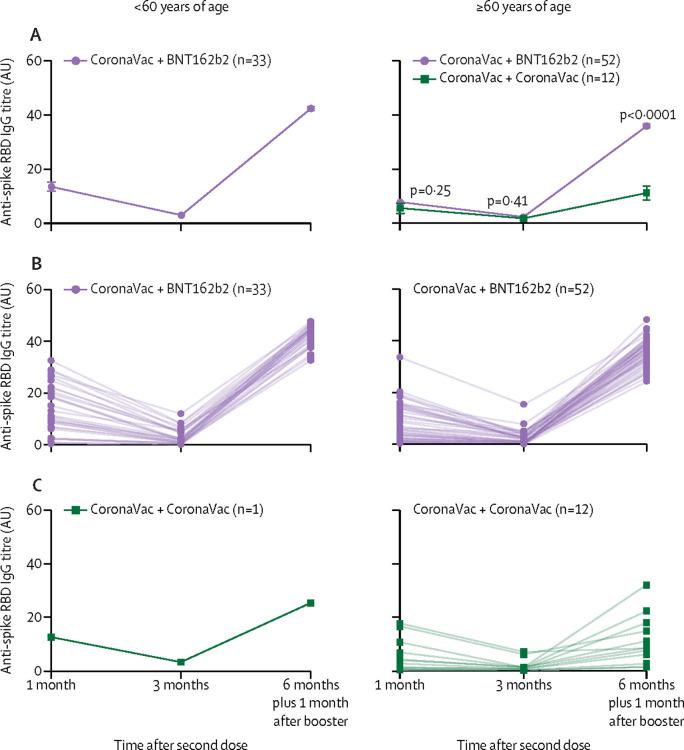
We did a prospective, longitudinal population-based study to measure SARS-CoV-2 anti-spike receptor binding domain (RBD) IgG concentrations, assessed by assaying blood samples collected, in participants in north Cyprus who had received the BNT162b2, ChAdOx1, or CoronaVac vaccine at 1 month and 3 months after the second dose. Participants were recruited when they voluntarily came to the laboratory for testing after vaccination, solicited from health-care access points, or from the general population. We also evaluated antibody responses 1 month after a booster dose of BNT162b2 or CoronaVac after primary CoronaVac regimen. Demographics, baseline characteristics, vaccination reactions, and percentage of antibody responders were collected by phone interviews or directly from the laboratory summarised by vaccine and age group. Antibody levels were compared between groups over time by parametric and non-parametric methods.
FINDINGS
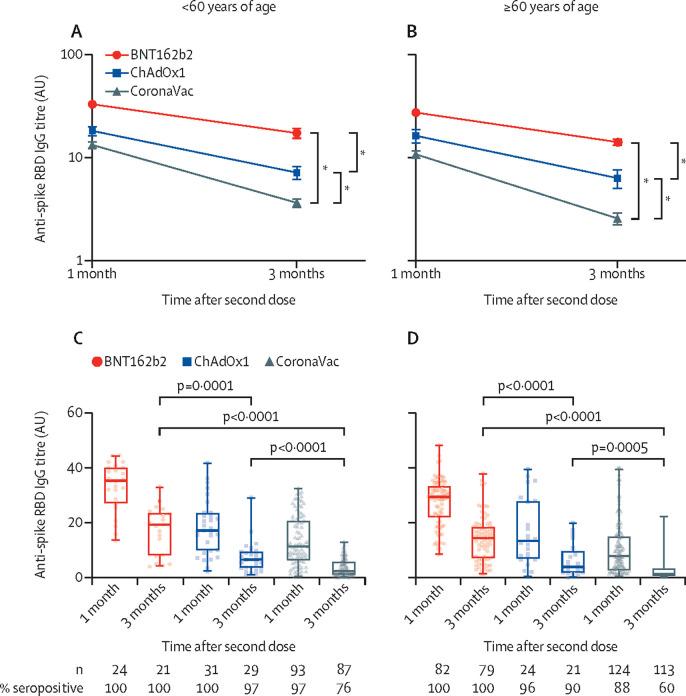
Recruitment, follow-up, and data collection was done between March 1 and Sept 30, 2021. BNT162b2 induced the highest seropositivity and anti-spike RBD IgG antibody titres, followed by ChAdOx1, and then by CoronaVac. In addition, the rate of decline of antibodies was fastest with CoronaVac, followed by ChAdOx1, and then by BNT162b2. For the older age group, the rate of seropositivity at 3 months after the second dose was 100% for BNT162b2, 90% for ChAdOx1, and 60% for CoronaVac. In the multivariate repeated measures model, lower antibody titres were also significantly associated with male sex, older age, and time since vaccination. Boosting a two-dose CoronaVac regimen at 6 months with a single BNT162b2 dose led to significantly increased titres of IgG compared with boosting with CoronaVac; for the 60 years and older age group, the geometric mean fold rise in antibody titre after the booster relative to 1 month post-baseline was 7·9 (95% CI 5·8-10·8) in the BNT162b2 boost group versus 2·8 (1·6-5·0) in the CoronaVac group.
INTERPRETATION
These longitudinal data can help shape vaccination strategies. Given the low antibody titres and fast decline in the CoronaVac group in individuals 60 years or older, more potent vaccine options could be considered as the primary vaccination or booster dose in these high-risk populations to sustain antibody responses for longer.
FUNDING
Crowdfunded in north Cyprus.
背景
接种疫苗是控制 COVID-19 大流行的有效策略。在北塞浦路斯,疫苗接种工作首先使用科兴疫苗,随后使用辉瑞疫苗和腺病毒载体疫苗。之后,那些已完全接种科兴疫苗的人又可以选择接种第三剂辉瑞疫苗或科兴疫苗作为加强针。目前,有关这三种疫苗以及科兴疫苗接种后的加强针的同时期和对比性的真实世界抗体数据很少。我们的研究旨在评估这些接种方案后的抗体反应。
方法
我们进行了一项前瞻性、纵向的基于人群的研究,以测量北塞浦路斯的参与者在接种第二剂疫苗后 1 个月和 3 个月时,通过检测血液样本中 SARS-CoV-2 刺突受体结合域(RBD)IgG 浓度来评估接种 BNT162b2、ChAdOx1 或科兴疫苗后的抗体反应。当参与者在接种疫苗后自愿到实验室进行检测、从医疗保健点或从一般人群中招募时,我们就进行招募。我们还评估了在完成科兴疫苗接种方案后,接种 BNT162b2 或科兴疫苗加强针后 1 个月的抗体反应。通过电话访谈或直接从实验室收集人口统计学、基线特征、接种反应和抗体应答者百分比等信息,按疫苗和年龄组进行总结。通过参数和非参数方法比较组间随时间的抗体水平。
发现
招募、随访和数据收集于 2021 年 3 月 1 日至 9 月 30 日进行。BNT162b2 诱导的血清阳性率和抗刺突 RBD IgG 抗体滴度最高,其次是 ChAdOx1,然后是科兴疫苗。此外,科兴疫苗的抗体下降速度最快,其次是 ChAdOx1,然后是 BNT162b2。对于年龄较大的人群,第二剂后 3 个月的血清阳性率为 BNT162b2 组 100%,ChAdOx1 组 90%,科兴疫苗组 60%。在多变量重复测量模型中,较低的抗体滴度也与男性、年龄较大和接种时间有关。在 6 个月时用一剂 BNT162b2 加强两剂科兴疫苗接种方案,与用科兴疫苗加强相比,显著增加 IgG 滴度;对于 60 岁及以上的年龄组,与基线后 1 个月相比,加强针后抗体滴度的几何平均倍数升高分别为 BNT162b2 组 7.9(95%CI 5.8-10.8),科兴疫苗组 2.8(1.6-5.0)。
结论
这些纵向数据可以帮助制定疫苗接种策略。鉴于 60 岁及以上人群中科兴疫苗组的抗体滴度较低且下降速度较快,在这些高危人群中,作为初级疫苗接种或加强针,可以考虑更有效的疫苗选择,以维持更长时间的抗体反应。
资助
北塞浦路斯众筹。
 Zotero 插件