
使用基于多变量病变和连接组学方法预测双侧脑瘫儿童的沟通障碍:一项多中心前瞻性队列研究方案
Prediction of Communication Impairment in Children With Bilateral Cerebral Palsy Using Multivariate Lesion- and Connectome-Based Approaches: Protocol for a Multicenter Prospective Cohort Study.
作者信息
Hu Jie, Zhang Jingjing, Yang Yanli, Liang Ting, Huang Tingting, He Cheng, Wang Fuqin, Liu Heng, Zhang Tijiang
机构信息
Department of Radiology, Medical Imaging Center of Guizhou Province, The Affiliated Hospital of Zunyi Medical University, Zunyi, China.
Department of Diagnostic Radiology, The First Affiliated Hospital of Xi'an Jiaotong University, Xi'an, China.
出版信息
Front Hum Neurosci. 2022 Jan 31;16:788037. doi: 10.3389/fnhum.2022.788037. eCollection 2022.
BACKGROUND
Bilateral cerebral palsy (BCP) is the most common type of CP in children and is often accompanied by different degrees of communication impairment. Several studies have attempted to identify children at high risk for communication impairment. However, most prediction factors are qualitative and subjective and may be influenced by rater bias. Individualized objective diagnostic and/or prediction methods are still lacking, and an effective method is urgently needed to guide clinical diagnosis and treatment. The aim of this study is to develop and validate an objective, individual-based model for the prediction of communication impairment in children with BCP by the time they enter school.
METHODS
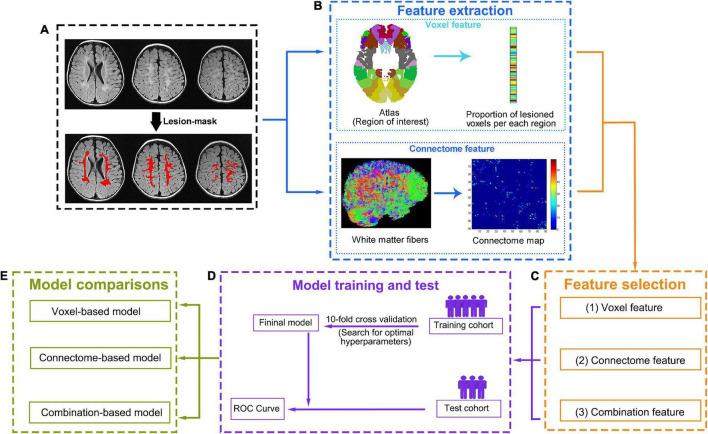
A multicenter prospective cohort study will be conducted in four Chinese hospitals. A total of 178 children with BCP will undergo advanced brain magnetic resonance imaging (MRI) at baseline (corrected age, before the age of 2 years). At school entry, communication performance will be assessed by a communication function classification system (CFCS). Three-quarters of children with BCP will be allocated as a training cohort, whereas the remaining children will be allocated as a test cohort. Multivariate lesion- and connectome-based approaches, which have shown good predictive ability of language performance in stroke patients, will be applied to extract features from MR images for each child with BCP. Multiple machine learning models using extracted features to predict communication impairment for each child with BCP will be constructed using data from the training cohort and externally validated using data from the test cohort. Prediction accuracy across models in the test cohort will be statistically compared.
DISCUSSION
The findings of the study may lead to the development of several translational tools that can individually predict communication impairment in children newly diagnosed with BCP to ensure that these children receive early, targeted therapeutic intervention before they begin school.
TRIAL REGISTRATION
The study has been registered with the Chinese Clinical Trial Registry (ChiCTR2100049497).
背景
双侧脑瘫(BCP)是儿童脑瘫最常见的类型,常伴有不同程度的沟通障碍。多项研究试图识别有沟通障碍高风险的儿童。然而,大多数预测因素是定性的且主观的,可能会受到评估者偏差的影响。个性化的客观诊断和/或预测方法仍然缺乏,迫切需要一种有效的方法来指导临床诊断和治疗。本研究的目的是开发并验证一种基于个体的客观模型,用于预测BCP儿童入学时的沟通障碍。
方法
将在四家中国医院进行一项多中心前瞻性队列研究。总共178名BCP儿童将在基线时(矫正年龄,2岁之前)接受高级脑磁共振成像(MRI)检查。入学时,将通过沟通功能分类系统(CFCS)评估沟通表现。四分之三的BCP儿童将被分配为训练队列,其余儿童将被分配为测试队列。基于病变和连接组的多变量方法在中风患者的语言表现预测能力方面已显示出良好效果,将应用该方法从每个BCP儿童的MR图像中提取特征。将使用训练队列的数据构建多个使用提取特征预测每个BCP儿童沟通障碍的机器学习模型,并使用测试队列的数据进行外部验证。将对测试队列中各模型的预测准确性进行统计学比较。
讨论
该研究的结果可能会促成几种转化工具的开发,这些工具可以单独预测新诊断为BCP的儿童的沟通障碍,以确保这些儿童在入学前接受早期、有针对性的治疗干预。
试验注册
该研究已在中国临床试验注册中心注册(ChiCTR2100049497)。

 Zotero 插件