
肿瘤相关巨噬细胞在癌症中的作用:癌症纳米免疫治疗的最新进展。
Tumor-associated macrophages in cancer: recent advancements in cancer nanoimmunotherapies.
机构信息
Department of Radiology, Seoul National University Hospital, Seoul National University College of Medicine, 101, Daehak-ro, Jongno-gu, Seoul, 03080, South Korea.
Center for Nanoparticle Research, Institute for Basic Science (IBS), Seoul, 00826, Republic of Korea.
出版信息
J Exp Clin Cancer Res. 2022 Feb 19;41(1):68. doi: 10.1186/s13046-022-02272-x.
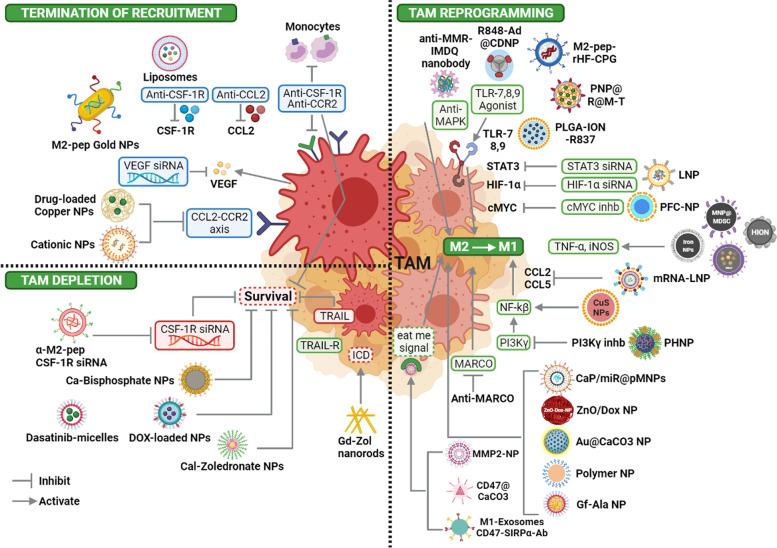
Cancer immunotherapy has emerged as a novel cancer treatment, although recent immunotherapy trials have produced suboptimal outcomes, with durable responses seen only in a small number of patients. The tumor microenvironment (TME) has been shown to be responsible for tumor immune escape and therapy failure. The vital component of the TME is tumor-associated macrophages (TAMs), which are usually associated with poor prognosis and drug resistance, including immunotherapies, and have emerged as promising targets for cancer immunotherapy. Recently, nanoparticles, because of their unique physicochemical characteristics, have emerged as crucial translational moieties in tackling tumor-promoting TAMs that amplify immune responses and sensitize tumors to immunotherapies in a safe and effective manner. In this review, we mainly described the current potential nanomaterial-based therapeutic strategies that target TAMs, including restricting TAMs survival, inhibiting TAMs recruitment to tumors and functionally repolarizing tumor-supportive TAMs to antitumor type. The current understanding of the origin and polarization of TAMs, their crucial role in cancer progression and prognostic significance was also discussed in this review. We also highlighted the recent evolution of chimeric antigen receptor (CAR)-macrophage cell therapy.
癌症免疫疗法已经成为一种新的癌症治疗方法,尽管最近的免疫疗法试验的结果并不理想,只有少数患者出现了持久的反应。肿瘤微环境(TME)被证明是肿瘤免疫逃逸和治疗失败的原因。TME 的重要组成部分是肿瘤相关巨噬细胞(TAMs),它们通常与预后不良和耐药性有关,包括免疫疗法,并已成为癌症免疫疗法的有前途的靶点。最近,由于其独特的物理化学特性,纳米颗粒已成为处理促进肿瘤的 TAMs 的关键转化部分,以安全有效的方式放大免疫反应并使肿瘤对免疫疗法敏感。在这篇综述中,我们主要描述了目前针对 TAMs 的基于纳米材料的治疗策略,包括限制 TAMs 的存活、抑制 TAMs 向肿瘤的募集以及功能上使肿瘤支持性 TAMs 向抗肿瘤类型重新极化。本文还讨论了 TAMs 的起源和极化、它们在癌症进展中的关键作用以及预后意义的最新认识。我们还强调了嵌合抗原受体(CAR)-巨噬细胞细胞疗法的最新进展。






 Zotero 插件