
生殖健康和生育的早期编程:新的神经内分泌机制及其在生殖医学中的意义。
Early programming of reproductive health and fertility: novel neuroendocrine mechanisms and implications in reproductive medicine.
机构信息
Instituto Maimónides de Investigación Biomédica de Cordoba (IMIBIC), Cordoba, Spain.
Department of Cell Biology, Physiology and Immunology, University of Cordoba, Cordoba, Spain.
出版信息
Hum Reprod Update. 2022 May 2;28(3):346-375. doi: 10.1093/humupd/dmac005.
BACKGROUND
According to the Developmental Origins of Health and Disease (DOHaD) hypothesis, environmental changes taking place during early maturational periods may alter normal development and predispose to the occurrence of diverse pathologies later in life. Indeed, adverse conditions during these critical developmental windows of high plasticity have been reported to alter the offspring developmental trajectory, causing permanent functional and structural perturbations that in the long term may enhance disease susceptibility. However, while solid evidence has documented that fluctuations in environmental factors, ranging from nutrient availability to chemicals, in early developmental stages (including the peri-conceptional period) have discernible programming effects that increase vulnerability to develop metabolic perturbations, the impact and eventual mechanisms involved, of such developmental alterations on the reproductive phenotype of offspring have received less attention.
OBJECTIVE AND RATIONALE
This review will summarize recent advances in basic and clinical research that support the concept of DOHaD in the context of the impact of nutritional and hormonal perturbations, occurring during the periconceptional, fetal and early postnatal stages, on different aspects of reproductive function in both sexes. Special emphasis will be given to the effects of early nutritional stress on the timing of puberty and adult gonadotropic function, and to address the underlying neuroendocrine pathways, with particular attention to involvement of the Kiss1 system in these reproductive perturbations. The implications of such phenomena in terms of reproductive medicine will also be considered.
SEARCH METHODS
A comprehensive MEDLINE search, using PubMed as main interface, of research articles and reviews, published mainly between 2006 and 2021, has been carried out. Search was implemented using multiple terms, focusing on clinical and preclinical data from DOHaD studies, addressing periconceptional, gestational and perinatal programming of reproduction. Selected studies addressing early programming of metabolic function have also been considered, when relevant.
OUTCOMES
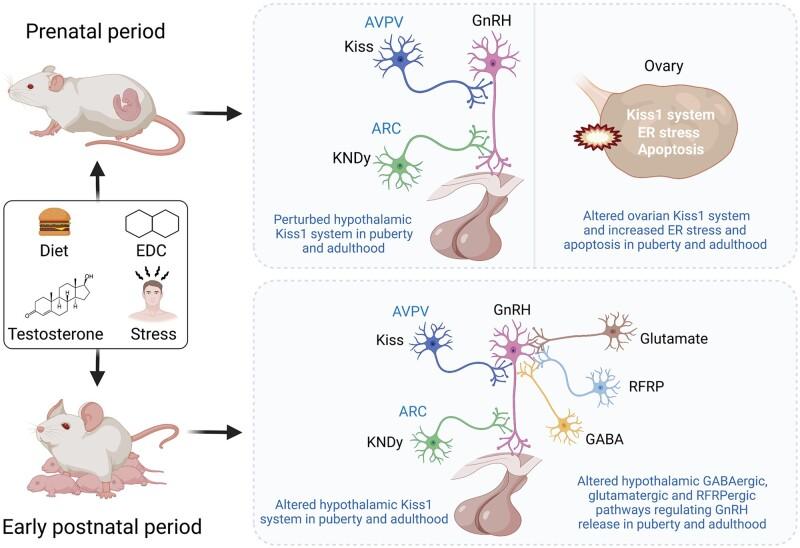
A solid body of evidence, from clinical and preclinical studies, has documented the impact of nutritional and hormonal fluctuations during the periconceptional, prenatal and early postnatal periods on pubertal maturation, as well as adult gonadotropic function and fertility. Furthermore, exposure to environmental chemicals, such as bisphenol A, and maternal stress has been shown to negatively influence pubertal development and gonadotropic function in adulthood. The underlying neuroendocrine pathways and mechanisms involved have been also addressed, mainly by preclinical studies, which have identified an, as yet incomplete, array of molecular and neurohormonal effectors. These include, prominently, epigenetic regulatory mechanisms and the hypothalamic Kiss1 system, which likely contribute to the generation of reproductive alterations in conditions of early nutritional and/or metabolic stress. In addition to the Kiss1 system, other major hypothalamic regulators of GnRH neurosecretion, such as γ-aminobutyric acid and glutamate, may be targets of developmental programming.
WIDER IMPLICATIONS
This review addresses an underdeveloped area of reproductive biology and medicine that may help to improve our understanding of human reproductive disorders and stresses the importance, and eventual pathogenic impact, of early determinants of puberty, adult reproductive function and fertility.
背景
根据健康与疾病的发育起源(DOHaD)假说,早期成熟阶段发生的环境变化可能会改变正常发育,并使多种病理学在以后的生活中更容易发生。事实上,已有研究报道,在这些高可塑性的关键发育窗口期内,不良条件会改变后代的发育轨迹,导致永久性的功能和结构扰动,从而长期增加患病易感性。然而,尽管有确凿的证据表明,早期发育阶段(包括围孕期)的环境因素波动,从营养供应到化学物质,具有明显的编程效应,增加了代谢紊乱的易感性,但这种发育改变对后代生殖表型的影响及其潜在机制,在生殖功能的不同方面都得到了重视。
目的和理由
本综述将总结基础和临床研究的最新进展,支持 DOHaD 概念,即在围孕期、胎儿期和新生儿早期发生的营养和激素紊乱,对两性生殖功能的不同方面的影响。特别强调早期营养压力对青春期和成年性腺激素功能时间的影响,并探讨潜在的神经内分泌途径,特别关注 Kiss1 系统在这些生殖紊乱中的作用。还将考虑这些现象在生殖医学方面的意义。
搜索方法
使用 MEDLINE 进行全面搜索,主要使用 PubMed 作为主要界面,搜索了 2006 年至 2021 年期间发表的研究文章和综述,使用了多个术语,重点关注 DOHaD 研究中的临床和临床前数据,涉及围孕期、妊娠期和围生期的生殖编程。还考虑了与早期代谢功能编程相关的选定研究。
结果
来自临床和临床前研究的大量证据表明,围孕期、产前和新生儿早期的营养和激素波动会影响青春期成熟以及成年性腺激素功能和生育能力。此外,接触环境化学物质,如双酚 A 和母体应激,已被证明会对青春期发育和成年期性腺激素功能产生负面影响。涉及的潜在神经内分泌途径和机制也已得到解决,主要是通过临床前研究,这些研究确定了一系列尚未完全确定的分子和神经激素效应物。其中包括表观遗传调控机制和下丘脑 Kiss1 系统,它们可能是早期营养和/或代谢应激产生生殖改变的原因。除了 Kiss1 系统外,其他主要的 GnRH 神经分泌的下丘脑调节剂,如 γ-氨基丁酸和谷氨酸,也可能是发育编程的靶点。
更广泛的影响
本综述涉及生殖生物学和医学的一个欠发达领域,可能有助于提高我们对人类生殖障碍的理解,并强调青春期、成年生殖功能和生育力的早期决定因素的重要性和潜在的发病影响。


 Zotero 插件