
有自杀风险的青春期前青少年多种精神疾病及常见性状的全基因组多基因评分关联研究
Association of Genome-Wide Polygenic Scores for Multiple Psychiatric and Common Traits in Preadolescent Youths at Risk of Suicide.
作者信息
Joo Yoonjung Yoonie, Moon Seo-Yoon, Wang Hee-Hwan, Kim Hyeonjin, Lee Eun-Ji, Kim Jong Hun, Posner Jonathan, Ahn Woo-Young, Choi Incheol, Kim Jae-Won, Cha Jiook
机构信息
Department of Psychology, Seoul National University, Seoul, Republic of Korea.
Institute of Data Science, Korea University, Seoul, Republic of Korea.
出版信息
JAMA Netw Open. 2022 Feb 1;5(2):e2148585. doi: 10.1001/jamanetworkopen.2021.48585.
IMPORTANCE
Suicide is the second leading cause of death among youths worldwide, but no available means exist to identify the risk of suicide in this population.
OBJECTIVE
To assess whether genome-wide polygenic scores for psychiatric and common traits are associated with the risk of suicide among preadolescent children and to investigate whether and to what extent the interaction between early life stress (a major environmental risk factor) and polygenic factors is associated with suicidal thoughts and behaviors among youths.
DESIGN, SETTING, AND PARTICIPANTS: This cohort study analyzed the genotype-phenotype data of 11 869 preadolescent children aged 9 to 10 years from the Adolescent Brain and Cognitive Development study. Data were collected from September 1, 2016, to October 21, 2018, and analyzed from August 1, 2020, to January 3, 2021. Using machine learning approaches, genome-wide polygenic scores of 24 complex traits were estimated to investigate their phenome-wide associations and utility for assessing risk of suicidal thoughts and behaviors (suicidal ideation [active, passive, and overall] and suicide attempt).
MAIN OUTCOMES AND MEASURES
Genome-wide polygenic scores were used to measure 24 traits, including psychiatric disorders, cognitive capacity, and personality and psychological characteristics. The Child Behavior Checklist was used to measure early life stress, and the Family Environment Scale was used to assess family environment. Suicidal ideation and suicide attempts were derived from the computerized version of the Kiddie Schedule for Affective Disorders and Schizophrenia.
RESULTS
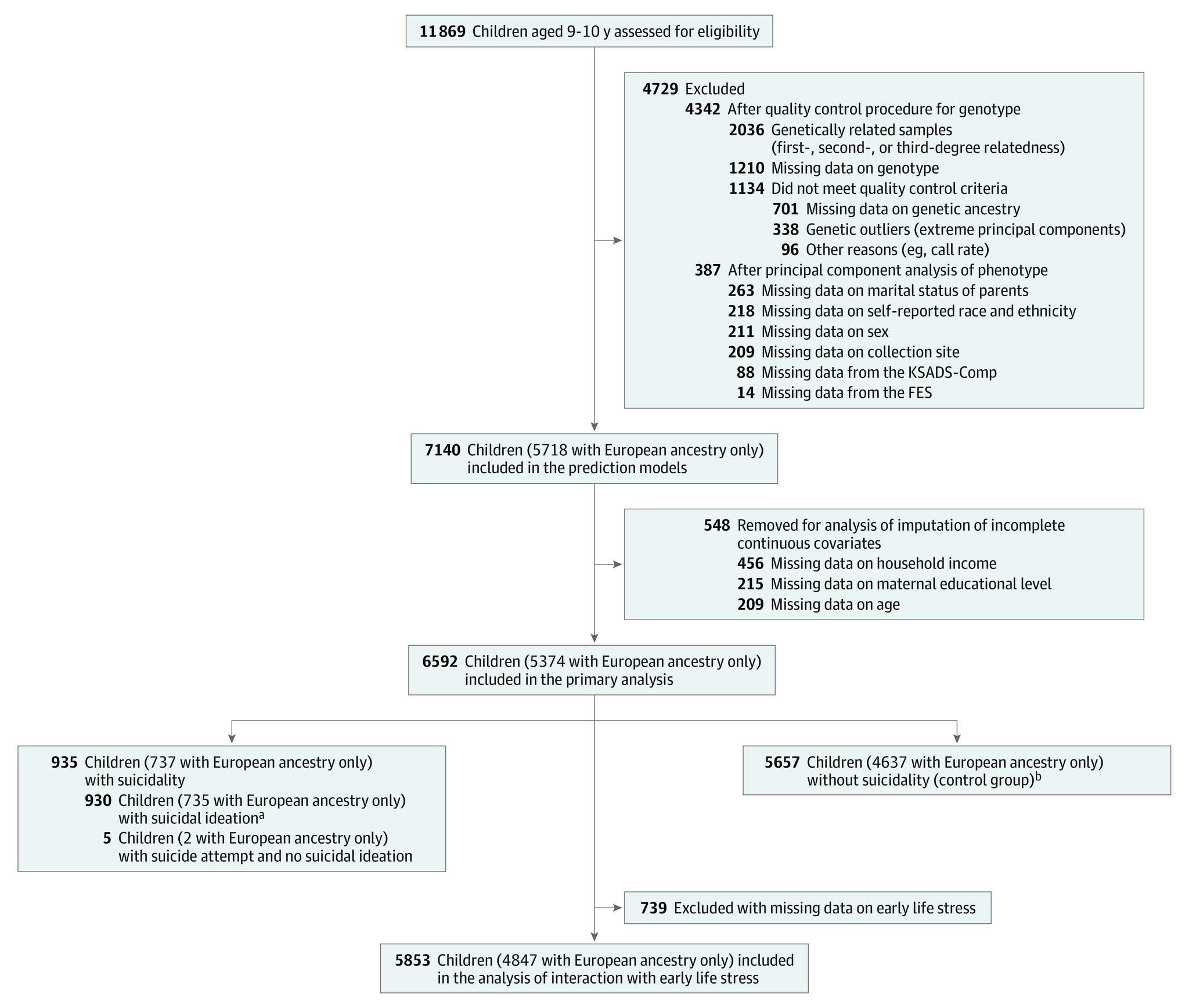
Among 11 869 preadolescent children in the US, complete data for phenotypic outcomes, genotypes, and covariates were available for 7140 participants in the multiethnic cohort (mean [SD] age, 9.9 [0.6] years; 3588 girls [50.3%]), including 925 participants with suicidal ideation and 63 participants with suicide attempts. Among those 7140 participants, 729 had African ancestry (self-reported race or ethnicity: 569 Black, 71 Hispanic, and 89 other), 276 had admixed American ancestry (self-reported race or ethnicity: 265 Hispanic, 3 White, and 8 other), 150 had East Asian ancestry (self-reported race or ethnicity: 67 Asian, 18 Hispanic, and 65 other), 5718 had European ancestry (self-reported race or ethnicity: 7 Asian, 39 Black, 1142 Hispanic, 3934 White, and 596 other), and 267 had other ancestries (self-reported race or ethnicity: 70 Asian, 13 Black, 126 Hispanic, 48 White, and 10 other). Three genome-wide polygenic scores were significantly associated (false discovery rate P < .05) with suicidal thoughts and behaviors among all participants: attention-deficit/hyperactivity disorder (odds ratio [OR], 1.12; 95% CI, 1.05-1.21; P = .001), schizophrenia (OR, 1.50; 95% CI, 1.17-1.93; P = .002), and general happiness (OR, 0.89; 95% CI, 0.83-0.96; P = .002). In the analysis including only children with European ancestry, 3 additional genome-wide polygenic scores with false discovery rate significance were associated with suicidal thoughts and behaviors: autism spectrum disorder (OR, 1.18; 95% CI, 1.06-1.31; P = .002), major depressive disorder (OR, 1.12; 95% CI, 1.04-1.21; P = .003), and posttraumatic stress disorder (OR, 1.12; 95% CI, 1.04-1.21; P = .004). A significant interaction between genome-wide polygenic scores and environment was found, with genetic risk factors for autism spectrum disorder and the level of early life stress associated with increases in the risk of overall suicidal ideation and overall suicidal thoughts and behaviors (OR, 1.20; 95% CI, 1.07-1.35; P = .002). A machine learning model using multitrait genome-wide polygenic scores and additional self-reported questionnaire data (Child Behavior Checklist and Family Environment Scale) produced a moderately accurate estimate of overall suicidal thoughts and behaviors (area under the receiver operating characteristic curve [AUROC], 0.77; 95% CI, 0.73-0.81; accuracy, 0.67) and suicidal ideation (AUROC, 0.76; 95% CI, 0.72-0.80; accuracy, 0.66) among children with European ancestry only. Among all children in the multiethnic cohort, the integrated model also outperformed the baseline model in estimating the risk of overall suicidal thoughts and behaviors (AUROC, 0.71; 95% CI, 0.67-0.75; accuracy, 0.68) and suicidal ideation (AUROC, 0.75; 95% CI, 0.71-0.78; accuracy, 0.67).
CONCLUSIONS AND RELEVANCE
In this cohort study of preadolescent youths in the US, higher genome-wide polygenic scores for psychiatric disorders, such as attention-deficit/hyperactivity disorder, autism spectrum disorder, posttraumatic stress disorder, and schizophrenia, were significantly associated with a greater risk of suicidal ideation and suicide attempt. The findings and quantitative models from this study may help to identify children with a high risk of suicide, potentially assisting with early screening, intervention, and prevention.
重要性
自杀是全球青少年中第二大死因,但尚无可用方法来识别该人群的自杀风险。
目的
评估精神疾病和常见特征的全基因组多基因评分是否与青春期前儿童的自杀风险相关,并调查早期生活压力(一种主要的环境风险因素)与多基因因素之间的相互作用是否以及在何种程度上与青少年的自杀念头和行为相关。
设计、设置和参与者:这项队列研究分析了来自青少年大脑与认知发展研究的11869名9至10岁青春期前儿童的基因型-表型数据。数据收集于2016年9月1日至2018年10月21日,并于2020年8月1日至2021年1月3日进行分析。使用机器学习方法,估计了24种复杂性状的全基因组多基因评分,以研究它们在全表型范围内的关联以及评估自杀念头和行为(自杀意念[主动、被动和总体]以及自杀未遂)风险的效用。
主要结局和测量指标
全基因组多基因评分用于测量24种性状,包括精神疾病、认知能力以及人格和心理特征。儿童行为量表用于测量早期生活压力,家庭环境量表用于评估家庭环境。自杀意念和自杀未遂源自情感障碍和精神分裂症儿童定式检查的计算机版本。
结果
在美国的11869名青春期前儿童中,多民族队列中的7140名参与者(平均[标准差]年龄为9.9[0.6]岁;3588名女孩[50.3%])可获得表型结局、基因型和协变量的完整数据,其中包括925名有自杀意念的参与者和63名有自杀未遂的参与者。在这7140名参与者中,729人有非洲血统(自我报告的种族或族裔:569名黑人、71名西班牙裔和89名其他),276人有混合美国血统(自我报告的种族或族裔:265名西班牙裔、3名白人及8名其他),150人有东亚血统(自我报告的种族或族裔:67名亚洲人、18名西班牙裔和65名其他),5718人有欧洲血统(自我报告的种族或族裔:7名亚洲人、39名黑人、1142名西班牙裔、3934名白人及596名其他),267人有其他血统(自我报告的种族或族裔:70名亚洲人、13名黑人、126名西班牙裔、48名白人及10名其他)。在所有参与者中,有三个全基因组多基因评分与自杀念头和行为显著相关(错误发现率P<0.05):注意力缺陷多动障碍(优势比[OR],1.12;95%置信区间,1.05-1.21;P=0.001)、精神分裂症(OR,1.50;95%置信区间,1.17-1.93;P=0.002)和总体幸福感(OR,0.89;95%置信区间,0.83-0.96;P=0.002)。在仅包括欧洲血统儿童的分析中,另外三个具有错误发现率显著性的全基因组多基因评分与自杀念头和行为相关:自闭症谱系障碍(OR,1.18;95%置信区间,1.06-1.31;P=0.002)、重度抑郁症(OR,1.12;95%置信区间,1.04-1.21;P=0.003)和创伤后应激障碍(OR,1.12;95%置信区间,1.04-1.21;P=0.


 Zotero 插件