
KIR3DL1/S1 杀伤细胞免疫球蛋白样受体的等位基因赋值。
Allele imputation for the killer cell immunoglobulin-like receptor KIR3DL1/S1.
机构信息
Division of Biomedical Informatics and Personalized Medicine, University of Colorado, Anschutz Medical Campus, Aurora, Colorado, United States of America.
Department of Immunology and Microbiology, University of Colorado, Anschutz Medical Campus, Aurora, Colorado, United States of America.
出版信息
PLoS Comput Biol. 2022 Feb 22;18(2):e1009059. doi: 10.1371/journal.pcbi.1009059. eCollection 2022 Feb.
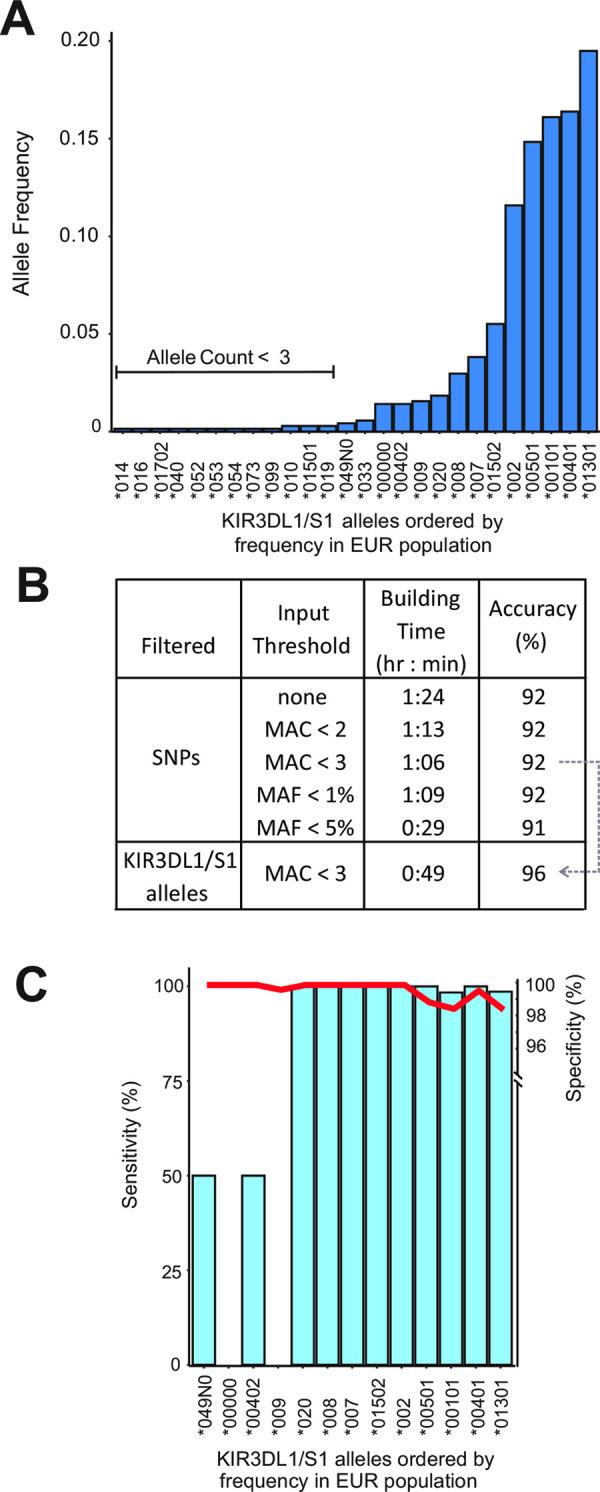
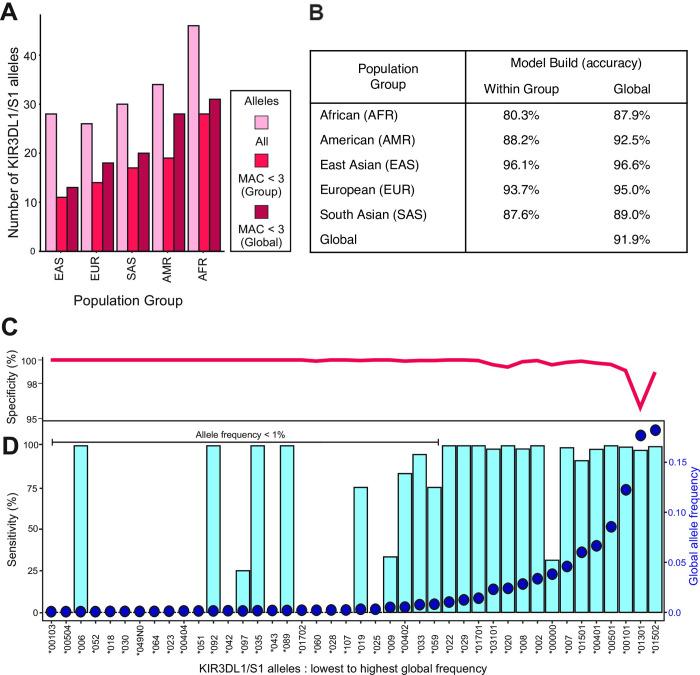
Highly polymorphic interaction of KIR3DL1 and KIR3DS1 with HLA class I ligands modulates the effector functions of natural killer (NK) cells and some T cells. This genetically determined diversity affects severity of infections, immune-mediated diseases, and some cancers, and impacts the course of immunotherapies, including transplantation. KIR3DL1 is an inhibitory receptor, and KIR3DS1 is an activating receptor encoded by the KIR3DL1/S1 gene that has more than 200 diverse and divergent alleles. Determination of KIR3DL1/S1 genotypes for medical application is hampered by complex sequence and structural variation, requiring targeted approaches to generate and analyze high-resolution allele data. To overcome these obstacles, we developed and optimized a model for imputing KIR3DL1/S1 alleles at high-resolution from whole-genome SNP data. We designed the model to represent a substantial component of human genetic diversity. Our Global imputation model is effective at genotyping KIR3DL1/S1 alleles with an accuracy ranging from 88% in Africans to 97% in East Asians, with mean specificity of 99% and sensitivity of 95% for alleles >1% frequency. We used the established algorithm of the HIBAG program, in a modification named Pulling Out Natural killer cell Genomics (PONG). Because HIBAG was designed to impute HLA alleles also from whole-genome SNP data, PONG allows combinatorial diversity of KIR3DL1/S1 with HLA-A and -B to be analyzed using complementary techniques on a single data source. The use of PONG thus negates the need for targeted sequencing data in very large-scale association studies where such methods might not be tractable.
KIR3DL1 和 KIR3DS1 与 HLA Ⅰ类配体的高度多态相互作用调节自然杀伤 (NK) 细胞和一些 T 细胞的效应功能。这种遗传决定的多样性影响感染、免疫介导的疾病和一些癌症的严重程度,并影响免疫治疗的过程,包括移植。KIR3DL1 是一种抑制性受体,KIR3DS1 是 KIR3DL1/S1 基因编码的一种激活受体,它有 200 多种不同和多样化的等位基因。由于 KIR3DL1/S1 基因型的复杂序列和结构变异,其用于医疗的确定受到阻碍,需要采用靶向方法来生成和分析高分辨率的等位基因数据。为了克服这些障碍,我们开发并优化了一种从全基因组 SNP 数据高分辨率推断 KIR3DL1/S1 等位基因的模型。我们设计的模型代表了人类遗传多样性的重要组成部分。我们的全球推断模型在对 KIR3DL1/S1 等位基因进行基因分型方面非常有效,其准确性从非洲人的 88%到东亚人的 97%不等,平均特异性为 99%,频率大于 1%的等位基因的敏感性为 95%。我们使用 HIBAG 程序的既定算法,在名为 Pulling Out Natural killer cell Genomics (PONG) 的修改中进行了使用。由于 HIBAG 旨在从全基因组 SNP 数据推断 HLA 等位基因,因此 PONG 允许使用互补技术在单个数据源上分析 KIR3DL1/S1 与 HLA-A 和 -B 的组合多样性。因此,在非常大规模的关联研究中,使用 PONG 可以避免对靶向测序数据的需求,而在这些研究中,这种方法可能不可行。


 Zotero 插件