
视觉修复人工视觉后的视触形状感知。
Visual-tactile shape perception in the visually restored with artificial vision.
机构信息
Department of Ophthalmology, University of Southern California, Los Angeles, CA, USA.
Departments of Biomedical Engineering and Ophthalmology and Visual Sciences, University of Michigan, Ann Arbor, MI, USA.
出版信息
J Vis. 2022 Feb 1;22(2):14. doi: 10.1167/jov.22.2.14.
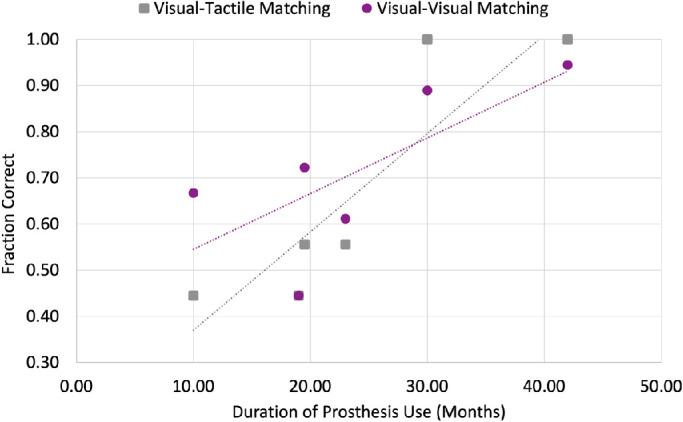
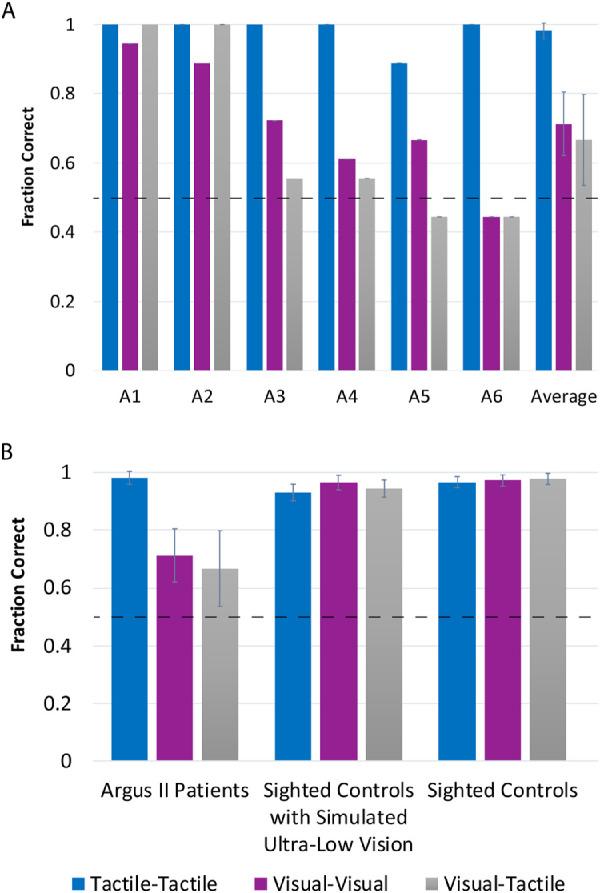
Retinal prostheses partially restore vision to late blind patients with retinitis pigmentosa through electrical stimulation of still-viable retinal ganglion cells. We investigated whether the late blind can perform visual-tactile shape matching following the partial restoration of vision via retinal prostheses after decades of blindness. We tested for visual-visual, tactile-tactile, and visual-tactile two-dimensional shape matching with six Argus II retinal prosthesis patients, ten sighted controls, and eight sighted controls with simulated ultra-low vision. In the Argus II patients, the visual-visual shape matching performance was significantly greater than chance. Although the visual-tactile shape matching performance of the Argus II patients was not significantly greater than chance, it was significantly higher with longer duration of prosthesis use. The sighted controls using natural vision and the sighted controls with simulated ultra-low vision both performed the visual-visual and visual-tactile shape matching tasks significantly more accurately than the Argus II patients. The tactile-tactile matching was not significantly different between the Argus II patients and sighted controls with or without simulated ultra-low vision. These results show that experienced retinal prosthesis patients can match shapes across the senses and integrate artificial vision with somatosensation. The correlation of retinal prosthesis patients' crossmodal shape matching performance with the duration of device use supports the value of experience to crossmodal shape learning. These crossmodal shape matching results in Argus II patients are the first step toward understanding crossmodal perception after artificial visual restoration.
视网膜假体通过对仍然存活的视网膜神经节细胞进行电刺激,为晚期失明的色素性视网膜炎患者部分恢复视力。我们研究了在失明几十年后,通过视网膜假体的部分恢复视力,晚期失明患者是否能够进行视觉-触觉二维形状匹配。我们对六位 Argus II 视网膜假体患者、十位视力正常的对照组和八位模拟超低视力的视力正常对照组进行了视觉-视觉、触觉-触觉和视觉-触觉二维形状匹配测试。在 Argus II 患者中,视觉-视觉形状匹配性能明显优于随机水平。虽然 Argus II 患者的视觉-触觉形状匹配性能没有明显优于随机水平,但随着假体使用时间的延长,该性能显著提高。使用自然视觉的视力正常对照组和模拟超低视力的视力正常对照组在视觉-视觉和视觉-触觉形状匹配任务中的表现都明显优于 Argus II 患者。Argus II 患者与有或没有模拟超低视力的视力正常对照组之间的触觉-触觉匹配没有显著差异。这些结果表明,经验丰富的视网膜假体患者可以在不同感觉之间匹配形状,并将人工视觉与体感融合。视网膜假体患者的跨模态形状匹配性能与设备使用时间的相关性支持经验在跨模态形状学习中的价值。Argus II 患者的这些跨模态形状匹配结果是理解人工视觉恢复后跨模态感知的第一步。

 Zotero 插件