
2000-2016 年美国与其他预期寿命较高国家心血管疾病死亡率差距
Cardiovascular Mortality Gap Between the United States and Other High Life Expectancy Countries in 2000-2016.
机构信息
Max Planck Institute for Demographic Research, Rostock, Germany.
Department of Preventive Medicine and Population Health, The University of Texas Medical Branch, Galveston, Texas, USA.
出版信息
J Gerontol B Psychol Sci Soc Sci. 2022 May 27;77(Suppl_2):S148-S157. doi: 10.1093/geronb/gbac032.
OBJECTIVES
Reductions in U.S. cardiovascular disease (CVD) mortality have stagnated. While other high life expectancy countries (HLCs) have also recently experienced a stall, the stagnation in CVD mortality in the United States appeared earlier and has been more pronounced. The reasons for the stall are unknown. We analyze cross-national variations in mortality trends to quantify the U.S. exceptionality and provide insight into its underlying causes.
METHODS
Data are from the World Health Organization (2000-2016). We quantified differences in levels and trends of CVD mortality between the United States and 17 other HLCs. We decomposed differences to identify the individual contributions of major CVD subclassifications (ischemic heart disease [IHD], stroke, other heart diseases). To identify potential behavioral explanations, we compared trends in CVD mortality with trends in other causes of death related to obesity, smoking, alcohol, and drugs.
RESULTS
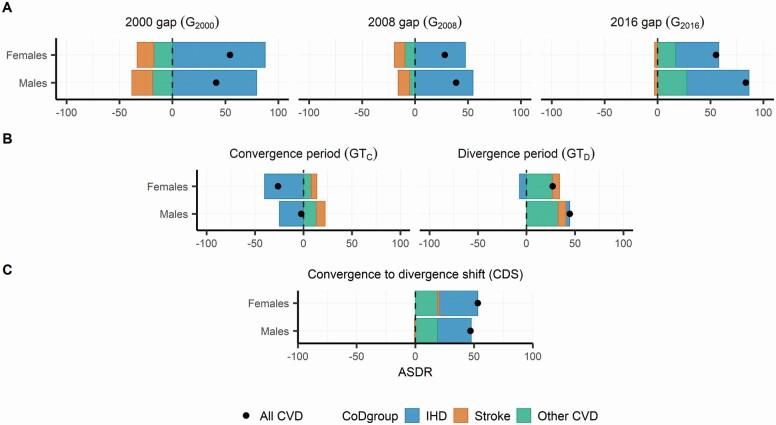
Our study has four central findings: (a) U.S. CVD mortality is consistently higher than the average of other HLCs; (b) the U.S.-HLC gap declined until around 2008 and increased thereafter; (c) the shift from convergence to divergence was mainly driven by slowing IHD and stroke mortality reductions and increasing mortality from other CVD causes; (d) among the potential risk factors, only obesity- and alcohol-related mortality showed age-specific temporal changes that are similar to those observed for cardiovascular mortality.
DISCUSSION
The exceptional changes in U.S. CVD mortality are driven by a distinct pattern of slowing reductions in IHD and stroke mortality and deteriorating mortality from other CVD causes. Obesity and alcohol abuse appear to be interrelated factors.
目的
美国心血管疾病(CVD)死亡率的下降已经停滞。虽然其他高预期寿命国家(HLCs)最近也出现了同样的停滞,但美国 CVD 死亡率的停滞出现得更早,且更为明显。停滞的原因尚不清楚。我们分析了跨国死亡率趋势的差异,以量化美国的特殊性,并深入了解其潜在原因。
方法
数据来自世界卫生组织(2000-2016 年)。我们量化了美国与其他 17 个 HLC 之间 CVD 死亡率水平和趋势的差异。我们对差异进行了分解,以确定主要 CVD 亚分类(缺血性心脏病[IHD]、中风、其他心脏病)的个体贡献。为了确定潜在的行为解释,我们比较了 CVD 死亡率与与肥胖、吸烟、酒精和药物相关的其他死亡原因的趋势。
结果
我们的研究有四个主要发现:(a)美国 CVD 死亡率始终高于其他 HLC 的平均值;(b)美国-HLC 差距在 2008 年左右之前缩小,之后又扩大;(c)从趋同到发散的转变主要是由于 IHD 和中风死亡率下降速度放缓以及其他 CVD 死因死亡率上升所致;(d)在潜在的风险因素中,只有肥胖和酒精相关的死亡率显示出与心血管死亡率相似的特定年龄的时间变化。
讨论
美国 CVD 死亡率的异常变化是由 IHD 和中风死亡率下降速度放缓以及其他 CVD 死因死亡率恶化的独特模式驱动的。肥胖和酗酒似乎是相互关联的因素。


 Zotero 插件