
不同寿命的(双翅目:实蝇科)物种的再交配行为模式
Patterns of Remating Behaviour in (Diptera: Tephritidae) Species of Varying Lifespan.
作者信息
Pogue Tania, Malod Kevin, Weldon Christopher W
机构信息
Department of Zoology and Entomology, University of Pretoria, Pretoria, South Africa.
出版信息
Front Physiol. 2022 Feb 7;13:824768. doi: 10.3389/fphys.2022.824768. eCollection 2022.
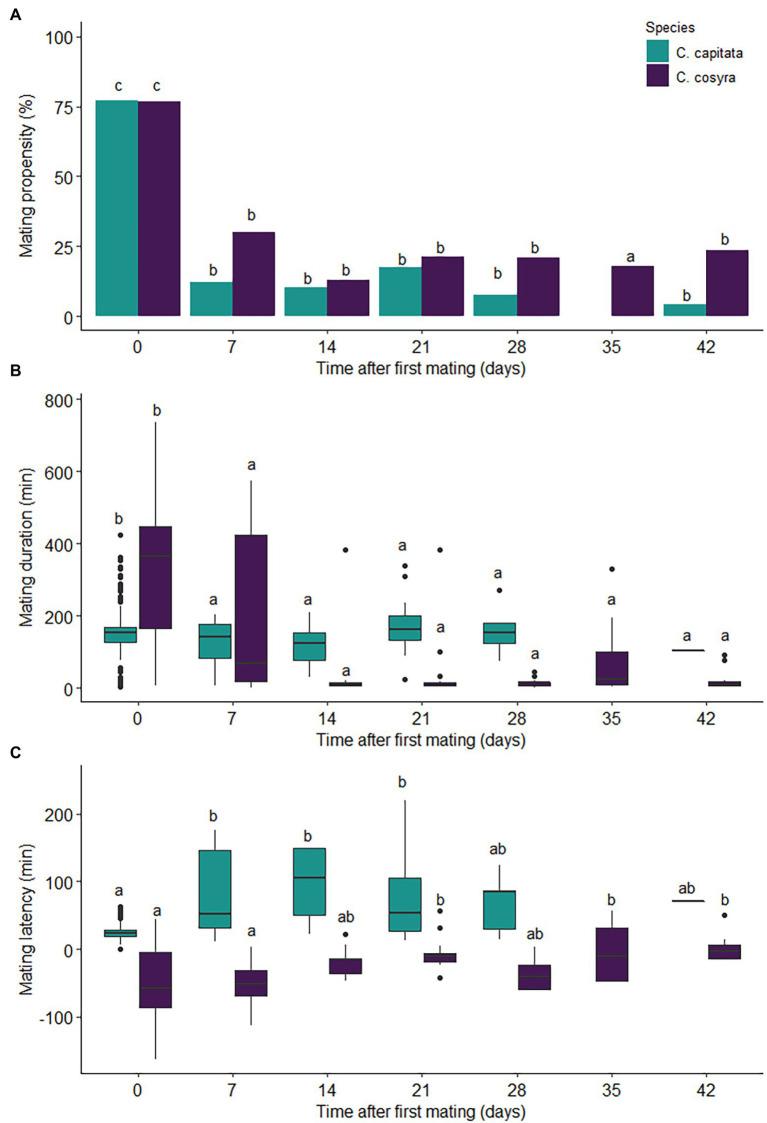
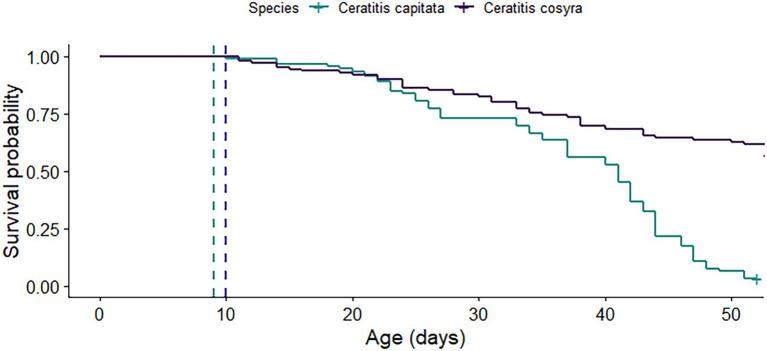
Trade-offs between life-history traits offset the energetic costs of maintaining fitness in complex environments. species have been recorded to have long lifespans, which may have evolved in response to seasonal resource fluctuation. It is thus likely that reproductive patterns have evolved concomitantly as part of the trade-off between lifespan and reproduction. In this study, we investigated how reproductive patterns differ between (Walker) and (Wiedemann; Diptera: Tephritidae), two species with different average and maximum lifespans. Females of both species were mated and patterns of female survival, fecundity, remating and sperm storage were tested. had a higher rate of survival and a lower fecundity when compared with the shorter-lived , suggesting that both species exhibit a trade-off between lifespan and reproduction. Both species showed a similar and consistent willingness to remate, despite declines in sperm storage, suggesting that sperm alone does not fully inhibit remating. As expected, transferred high numbers of sperm during the first mating. However, sperm stores declined unexpectedly by 14 days. This indicates that males might transfer large ejaculates as a nuptial gift, that females then later degrade as a source of nutrients. Large declines in sperm storage may also indicate that females discard excess sperm stores due to the toxicity involved with storing sperm. These results do not suggest that patterns of sperm storage and remating align with lifespan and resource seasonality in these species, but a wider range of species needs to be assessed to better understand variation in mating systems.
生活史特征之间的权衡抵消了在复杂环境中维持适应性的能量成本。已记录到某些物种具有较长的寿命,这可能是对季节性资源波动的一种进化反应。因此,生殖模式很可能作为寿命与繁殖之间权衡的一部分而协同进化。在本研究中,我们调查了具有不同平均寿命和最长寿命的两种实蝇,即(沃克)和(维德曼;双翅目:实蝇科)之间的生殖模式有何不同。两种实蝇的雌蝇均进行了交配,并测试了雌蝇的存活、繁殖力、再次交配和精子储存模式。与寿命较短的相比,的存活率更高但繁殖力更低,这表明这两个物种在寿命与繁殖之间均表现出一种权衡。尽管精子储存量有所下降,但两种实蝇再次交配的意愿相似且一致,这表明仅精子并不能完全抑制再次交配。正如预期的那样,在首次交配时转移了大量精子。然而,精子储存量在14天后意外下降。这表明雄性可能会作为结婚礼物转移大量射精,然后雌性随后将其降解作为营养来源。精子储存量的大幅下降也可能表明雌性由于储存精子涉及的毒性而丢弃多余的精子储存。这些结果并不表明这些物种的精子储存和再次交配模式与寿命和资源季节性一致,但需要评估更广泛的物种范围以更好地理解交配系统的变化。


 Zotero 插件