
疫苗预防严重急性呼吸综合征冠状病毒 2 型(SARS-CoV-2)感染和 COVID-19 疾病有效性的持续时间:系统评价和荟萃回归的结果。
Duration of effectiveness of vaccines against SARS-CoV-2 infection and COVID-19 disease: results of a systematic review and meta-regression.
机构信息
Department of Immunisations, Vaccines, and Biologicals, WHO, Geneva, Switzerland.
International Vaccine Access Center, Department of International Health, John Hopkins Bloomberg School of Public Health, Baltimore, MA, USA.
出版信息
Lancet. 2022 Mar 5;399(10328):924-944. doi: 10.1016/S0140-6736(22)00152-0. Epub 2022 Feb 23.
BACKGROUND
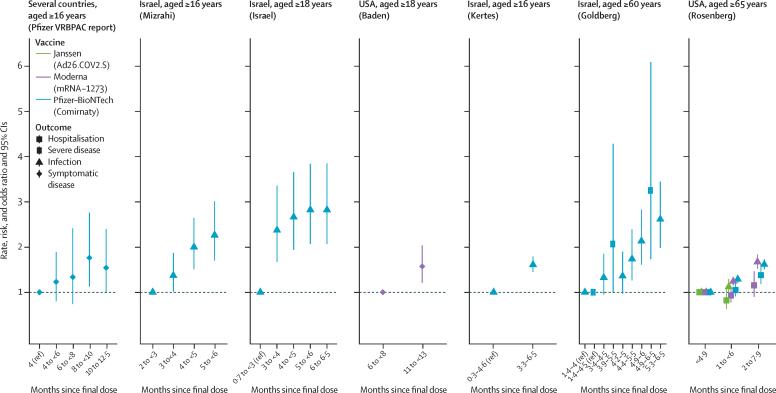
Knowing whether COVID-19 vaccine effectiveness wanes is crucial for informing vaccine policy, such as the need for and timing of booster doses. We aimed to systematically review the evidence for the duration of protection of COVID-19 vaccines against various clinical outcomes, and to assess changes in the rates of breakthrough infection caused by the delta variant with increasing time since vaccination.
METHODS
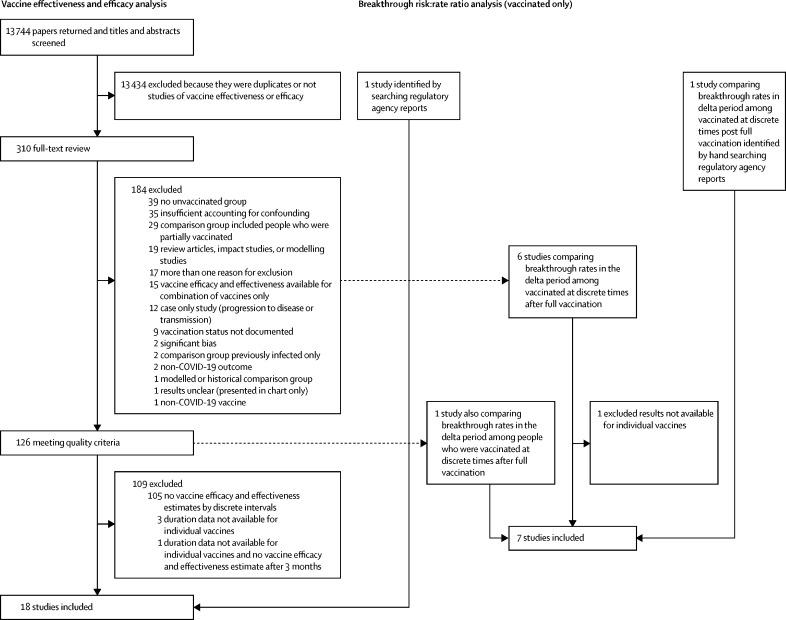
This study was designed as a systematic review and meta-regression. We did a systematic review of preprint and peer-reviewed published article databases from June 17, 2021, to Dec 2, 2021. Randomised controlled trials of COVID-19 vaccine efficacy and observational studies of COVID-19 vaccine effectiveness were eligible. Studies with vaccine efficacy or effectiveness estimates at discrete time intervals of people who had received full vaccination and that met predefined screening criteria underwent full-text review. We used random-effects meta-regression to estimate the average change in vaccine efficacy or effectiveness 1-6 months after full vaccination.
FINDINGS
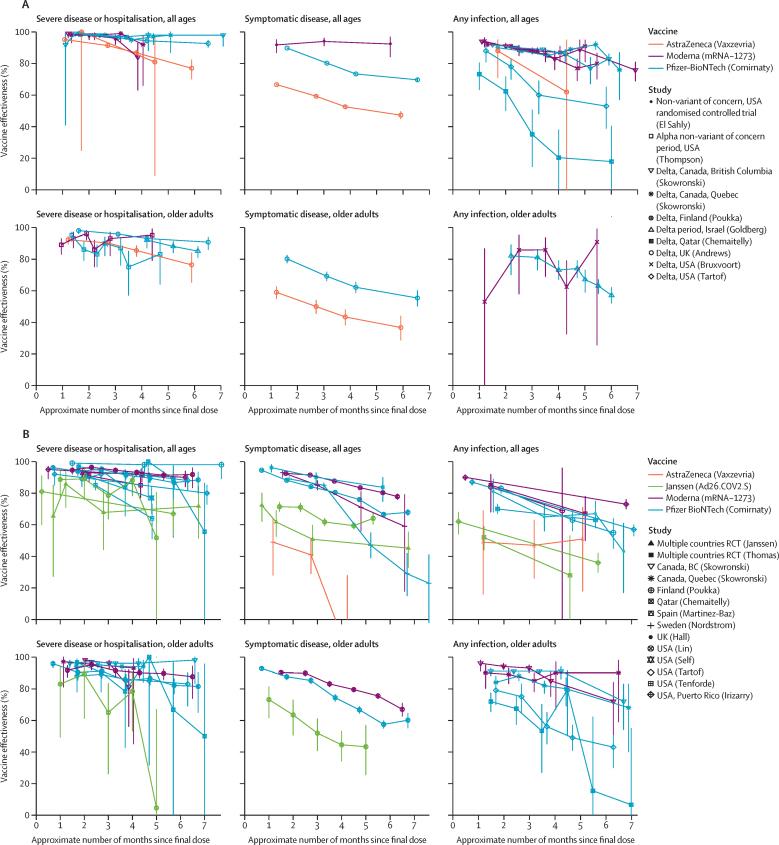
Of 13 744 studies screened, 310 underwent full-text review, and 18 studies were included (all studies were carried out before the omicron variant began to circulate widely). Risk of bias, established using the risk of bias 2 tool for randomised controlled trials or the risk of bias in non-randomised studies of interventions tool was low for three studies, moderate for eight studies, and serious for seven studies. We included 78 vaccine-specific vaccine efficacy or effectiveness evaluations (Pfizer-BioNTech-Comirnaty, n=38; Moderna-mRNA-1273, n=23; Janssen-Ad26.COV2.S, n=9; and AstraZeneca-Vaxzevria, n=8). On average, vaccine efficacy or effectiveness against SARS-CoV-2 infection decreased from 1 month to 6 months after full vaccination by 21·0 percentage points (95% CI 13·9-29·8) among people of all ages and 20·7 percentage points (10·2-36·6) among older people (as defined by each study, who were at least 50 years old). For symptomatic COVID-19 disease, vaccine efficacy or effectiveness decreased by 24·9 percentage points (95% CI 13·4-41·6) in people of all ages and 32·0 percentage points (11·0-69·0) in older people. For severe COVID-19 disease, vaccine efficacy or effectiveness decreased by 10·0 percentage points (95% CI 6·1-15·4) in people of all ages and 9·5 percentage points (5·7-14·6) in older people. Most (81%) vaccine efficacy or effectiveness estimates against severe disease remained greater than 70% over time.
INTERPRETATION
COVID-19 vaccine efficacy or effectiveness against severe disease remained high, although it did decrease somewhat by 6 months after full vaccination. By contrast, vaccine efficacy or effectiveness against infection and symptomatic disease decreased approximately 20-30 percentage points by 6 months. The decrease in vaccine efficacy or effectiveness is likely caused by, at least in part, waning immunity, although an effect of bias cannot be ruled out. Evaluating vaccine efficacy or effectiveness beyond 6 months will be crucial for updating COVID-19 vaccine policy.
FUNDING
Coalition for Epidemic Preparedness Innovations.
背景
了解 COVID-19 疫苗效力是否减弱对于告知疫苗政策至关重要,例如是否需要加强针以及加强针的接种时间。我们旨在系统地评估 COVID-19 疫苗在预防各种临床结果方面的保护持续时间的证据,并评估随着时间的推移,delta 变异株引起突破性感染的发生率的变化。
方法
本研究设计为系统评价和荟萃回归分析。我们对 2021 年 6 月 17 日至 2021 年 12 月 2 日的预印本和同行评审的已发表文献数据库进行了系统评价。符合条件的是 COVID-19 疫苗效力的随机对照试验和 COVID-19 疫苗有效性的观察性研究。在完全接种疫苗的人群中以离散时间间隔评估疫苗效力或有效性且符合预先设定的筛选标准的研究进行了全文审查。我们使用随机效应荟萃回归来估计完全接种疫苗后 1-6 个月疫苗效力或有效性的平均变化。
发现
在筛选出的 13744 项研究中,有 310 项进行了全文审查,最终纳入了 18 项研究(所有研究均在 omicron 变异株开始广泛传播之前进行)。使用随机对照试验的风险偏倚 2 工具或非随机干预研究的风险偏倚工具评估的偏倚风险,对于三项研究为低风险,对于八项研究为中风险,对于七项研究为高风险。我们纳入了 78 项针对特定疫苗的疫苗效力或有效性评估(辉瑞-生物技术/Comirnaty,n=38;莫德纳-mRNA-1273,n=23;强生-Ad26.COV2.S,n=9;阿斯利康-Vaxzevria,n=8)。平均而言,在所有年龄段的人群中,完全接种疫苗后 1 至 6 个月,疫苗效力或有效性对 SARS-CoV-2 感染的预防作用降低了 21.0 个百分点(95%CI,13.9-29.8),在老年人(根据每项研究的定义,年龄至少为 50 岁)中降低了 20.7 个百分点(10.2-36.6)。对于有症状的 COVID-19 疾病,在所有年龄段的人群中,疫苗效力或有效性降低了 24.9 个百分点(95%CI,13.4-41.6),在老年人中降低了 32.0 个百分点(11.0-69.0)。对于严重的 COVID-19 疾病,在所有年龄段的人群中,疫苗效力或有效性降低了 10.0 个百分点(95%CI,6.1-15.4),在老年人中降低了 9.5 个百分点(5.7-14.6)。大多数(81%)针对严重疾病的疫苗效力或有效性估计在整个时间内仍保持在 70%以上。
解释
COVID-19 疫苗对严重疾病的效力或有效性仍然很高,尽管在完全接种疫苗后 6 个月时确实略有下降。相比之下,疫苗对感染和有症状疾病的效力或有效性在 6 个月时降低了约 20-30 个百分点。疫苗效力或有效性的下降可能至少部分是由于免疫力下降引起的,尽管不能排除偏倚的影响。评估 6 个月后疫苗的效力或有效性对于更新 COVID-19 疫苗政策至关重要。
资助
流行病防范创新联盟。
 Zotero 插件