
多样性的恢复:将 COVID-19 作为整体环境现象的预防方法。
Diversity regained: Precautionary approaches to COVID-19 as a phenomenon of the total environment.
机构信息
Konrad Lorenz Institute for Evolution and Cognition Research, Martinstrasse 12, Klosterneuburg 3400, Austria.
Konrad Lorenz Institute for Evolution and Cognition Research, Martinstrasse 12, Klosterneuburg 3400, Austria.
出版信息
Sci Total Environ. 2022 Jun 15;825:154029. doi: 10.1016/j.scitotenv.2022.154029. Epub 2022 Feb 22.
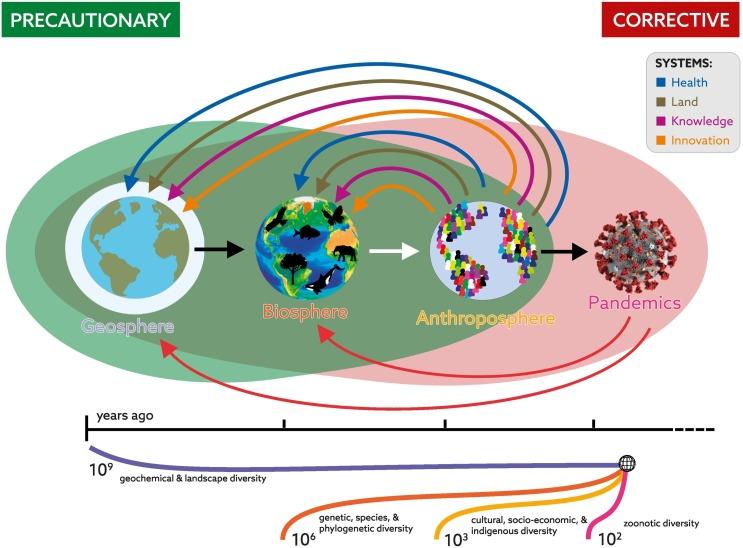
As COVID-19 emerged as a phenomenon of the total environment, and despite the intertwined and complex relationships that make humanity an organic part of the Bio- and Geospheres, the majority of our responses to it have been corrective in character, with few or no consideration for unintended consequences which bring about further vulnerability to unanticipated global events. Tackling COVID-19 entails a systemic and precautionary approach to human-nature relations, which we frame as regaining diversity in the Geo-, Bio-, and Anthropospheres. Its implementation requires nothing short of an overhaul in the way we interact with and build knowledge from natural and social environments. Hence, we discuss the urgency of shifting from current to precautionary approaches to COVID-19 and look, through the lens of diversity, at the anticipated benefits in four systems crucially affecting and affected by the pandemic: health, land, knowledge and innovation. Our reflections offer a glimpse of the sort of changes needed, from pursuing planetary health and creating more harmonious forms of land use to providing a multi-level platform for other ways of knowing/understanding and turning innovation into a source of global public goods. These exemplary initiatives introduce and solidify systemic thinking in policymaking and move priorities from reaction-based strategies to precautionary frameworks.
随着 COVID-19 成为一种全环境现象,尽管人类与生物和地球圈层相互交织且复杂的关系使人类成为其有机组成部分,但我们对其的大多数应对措施都是纠正性的,很少或根本没有考虑到可能带来进一步脆弱性的意外后果,这些脆弱性会导致对意想不到的全球事件的应对不足。应对 COVID-19 需要采取一种系统的、预防的方法来处理人类与自然的关系,我们将其表述为在地理、生物和人类圈中恢复多样性。其实施需要彻底改变我们与自然和社会环境互动并从中获取知识的方式。因此,我们讨论了从当前方法向预防方法转变的紧迫性,并从多样性的角度来看,在四个对大流行产生重大影响和受其影响的系统中预期的收益:健康、土地、知识和创新。我们的思考提供了对所需变革的一瞥,从追求行星健康和创造更和谐的土地利用形式,到为其他认知/理解方式提供一个多层次的平台,并将创新转化为全球公益的源泉。这些典型的举措在决策制定中引入并巩固了系统思维,并将优先事项从基于反应的策略转移到预防框架。

 Zotero 插件