
青蒿素类药物与肿瘤细胞死亡:作用机制、与生物制剂的联合治疗及纳米颗粒递送
Artemisinin-Type Drugs in Tumor Cell Death: Mechanisms, Combination Treatment with Biologics and Nanoparticle Delivery.
作者信息
Zhou Xinyu, Suo Fengzhi, Haslinger Kristina, Quax Wim J
机构信息
Department of Chemical and Pharmaceutical Biology, Groningen Research Institute of Pharmacy, University of Groningen, Antonius Deusinglaan 1, 9713 AV Groningen, The Netherlands.
出版信息
Pharmaceutics. 2022 Feb 10;14(2):395. doi: 10.3390/pharmaceutics14020395.
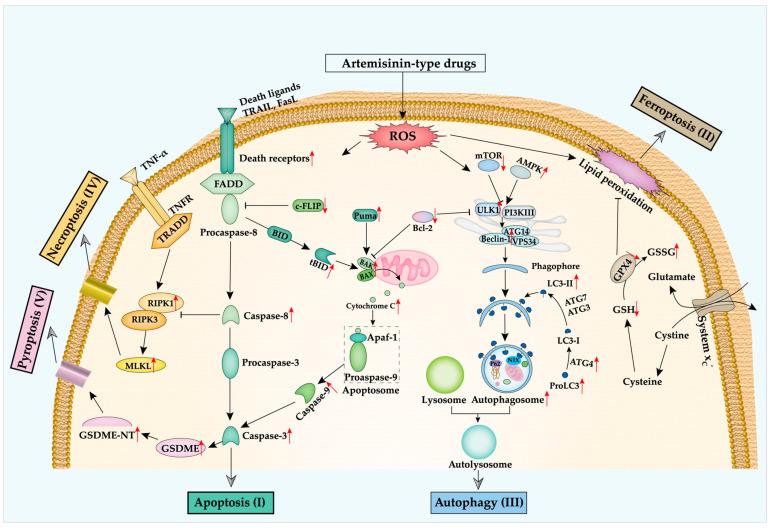
Artemisinin, the most famous anti-malaria drug initially extracted from L., also exhibits anti-tumor properties in vivo and in vitro. To improve its solubility and bioavailability, multiple derivatives have been synthesized. However, to reveal the anti-tumor mechanism and improve the efficacy of these artemisinin-type drugs, studies have been conducted in recent years. In this review, we first provide an overview of the effect of artemisinin-type drugs on the regulated cell death pathways, which may uncover novel therapeutic approaches. Then, to overcome the shortcomings of artemisinin-type drugs, we summarize the recent advances in two different therapeutic approaches, namely the combination therapy with biologics influencing regulated cell death, and the use of nanocarriers as drug delivery systems. For the former approach, we discuss the superiority of combination treatments compared to monotherapy in tumor cells based on their effects on regulated cell death. For the latter approach, we give a systematic overview of nanocarrier design principles used to deliver artemisinin-type drugs, including inorganic-based nanoparticles, liposomes, micelles, polymer-based nanoparticles, carbon-based nanoparticles, nanostructured lipid carriers and niosomes. Both approaches have yielded promising findings in vitro and in vivo, providing a strong scientific basis for further study and upcoming clinical trials.
青蒿素是最初从黄花蒿中提取的最著名的抗疟疾药物,在体内和体外也具有抗肿瘤特性。为了提高其溶解度和生物利用度,人们合成了多种衍生物。然而,为了揭示这些青蒿素类药物的抗肿瘤机制并提高其疗效,近年来已经开展了相关研究。在这篇综述中,我们首先概述青蒿素类药物对程序性细胞死亡途径的影响,这可能会揭示新的治疗方法。然后,为了克服青蒿素类药物的缺点,我们总结了两种不同治疗方法的最新进展,即与影响程序性细胞死亡的生物制剂联合治疗,以及使用纳米载体作为药物递送系统。对于前一种方法,我们基于其对程序性细胞死亡的影响,讨论联合治疗相对于单一疗法在肿瘤细胞中的优势。对于后一种方法,我们系统概述了用于递送青蒿素类药物的纳米载体设计原则,包括无机纳米颗粒、脂质体、胶束、聚合物纳米颗粒、碳基纳米颗粒、纳米结构脂质载体和非离子表面活性剂囊泡。这两种方法在体外和体内均取得了有前景的结果,为进一步研究和即将开展的临床试验提供了有力的科学依据。

 Zotero 插件