
GARDE:一个基于标准的临床决策支持平台,用于识别人群健康管理队列。
GARDE: a standards-based clinical decision support platform for identifying population health management cohorts.
机构信息
Department of Biomedical Informatics, University of Utah, Salt Lake City, Utah, USA.
University of Utah Health, Salt Lake City, Utah, USA.
出版信息
J Am Med Inform Assoc. 2022 Apr 13;29(5):928-936. doi: 10.1093/jamia/ocac028.
UNLABELLED
Population health management (PHM) is an important approach to promote wellness and deliver health care to targeted individuals who meet criteria for preventive measures or treatment. A critical component for any PHM program is a data analytics platform that can target those eligible individuals.
OBJECTIVE
The aim of this study was to design and implement a scalable standards-based clinical decision support (CDS) approach to identify patient cohorts for PHM and maximize opportunities for multi-site dissemination.
MATERIALS AND METHODS
An architecture was established to support bidirectional data exchanges between heterogeneous electronic health record (EHR) data sources, PHM systems, and CDS components. HL7 Fast Healthcare Interoperability Resources and CDS Hooks were used to facilitate interoperability and dissemination. The approach was validated by deploying the platform at multiple sites to identify patients who meet the criteria for genetic evaluation of familial cancer.
RESULTS
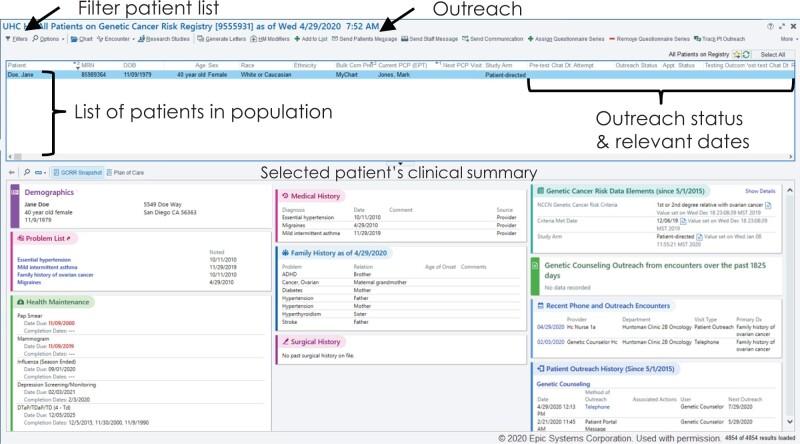
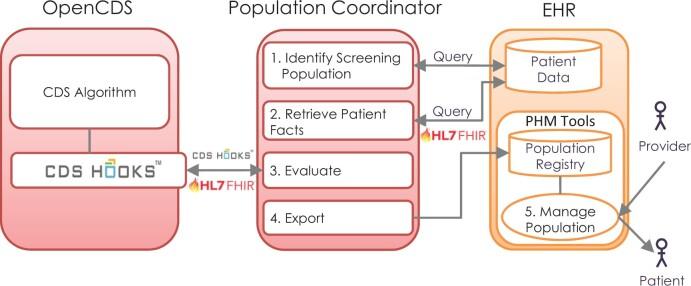
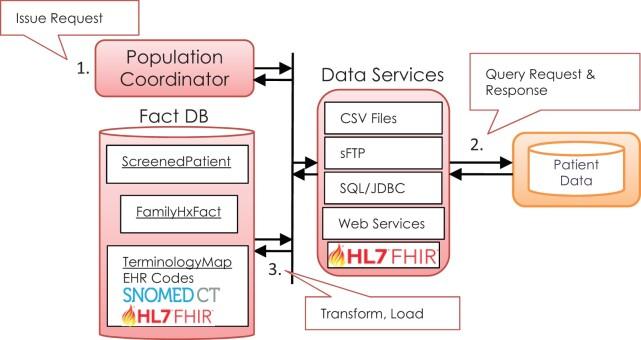
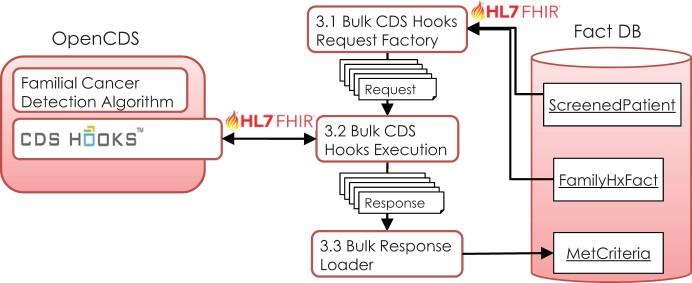
The Genetic Cancer Risk Detector (GARDE) platform was created and is comprised of four components: (1) an open-source CDS Hooks server for computing patient eligibility for PHM cohorts, (2) an open-source Population Coordinator that processes GARDE requests and communicates results to a PHM system, (3) an EHR Patient Data Repository, and (4) EHR PHM Tools to manage patients and perform outreach functions. Site-specific deployments were performed on onsite virtual machines and cloud-based Amazon Web Services.
DISCUSSION
GARDE's component architecture establishes generalizable standards-based methods for computing PHM cohorts. Replicating deployments using one of the established deployment methods requires minimal local customization. Most of the deployment effort was related to obtaining site-specific information technology governance approvals.
未加标签
人群健康管理(PHM)是一种重要的方法,可以促进健康,并为符合预防措施或治疗标准的目标个体提供医疗服务。任何 PHM 计划的一个关键组成部分是数据分析平台,该平台可以针对符合条件的个人。
目的
本研究的目的是设计和实施一种可扩展的基于标准的临床决策支持(CDS)方法,以确定 PHM 的患者队列,并最大限度地提高多站点传播的机会。
材料和方法
建立了一种架构,以支持异构电子健康记录(EHR)数据源、PHM 系统和 CDS 组件之间的双向数据交换。使用 HL7 Fast Healthcare Interoperability Resources 和 CDS Hooks 来促进互操作性和传播。该方法通过在多个站点部署该平台来验证,以确定符合家族性癌症遗传评估标准的患者。
结果
创建了遗传癌症风险探测器(GARDE)平台,它由四个组件组成:(1)用于计算 PHM 队列患者资格的开源 CDS Hooks 服务器,(2)处理 GARDE 请求并将结果传达给 PHM 系统的开源人口协调器,(3)EHR 患者数据存储库,(4)EHR PHM 工具,用于管理患者和执行外展功能。在现场虚拟机和基于云的 Amazon Web Services 上进行了特定于站点的部署。
讨论
GARDE 的组件架构为计算 PHM 队列建立了可通用的基于标准的方法。使用其中一种已建立的部署方法复制部署需要最小的本地自定义。大部分部署工作都与获得特定于站点的信息技术治理批准有关。

 Zotero 插件