
Fitbit Charge 4和三星Galaxy Watch Active2的心率测量准确性:设备评估研究。
Heart Rate Measurement Accuracy of Fitbit Charge 4 and Samsung Galaxy Watch Active2: Device Evaluation Study.
作者信息
Nissen Michael, Slim Syrine, Jäger Katharina, Flaucher Madeleine, Huebner Hanna, Danzberger Nina, Fasching Peter A, Beckmann Matthias W, Gradl Stefan, Eskofier Bjoern M
机构信息
Department Artificial Intelligence in Biomedical Engineering, Friedrich-Alexander University Erlangen-Nürnberg, Erlangen, Germany.
Department of Gynecology and Obstetrics, Erlangen University Hospital, Erlangen, Germany.
出版信息
JMIR Form Res. 2022 Mar 1;6(3):e33635. doi: 10.2196/33635.
BACKGROUND
Fitness trackers and smart watches are frequently used to collect data in longitudinal medical studies. They allow continuous recording in real-life settings, potentially revealing previously uncaptured variabilities of biophysiological parameters and diseases. Adequate device accuracy is a prerequisite for meaningful research.
OBJECTIVE
This study aims to assess the heart rate recording accuracy in two previously unvalidated devices: Fitbit Charge 4 and Samsung Galaxy Watch Active2.
METHODS
Participants performed a study protocol comprising 5 resting and sedentary, 2 low-intensity, and 3 high-intensity exercise phases, lasting an average of 19 minutes 27 seconds. Participants wore two wearables simultaneously during all activities: Fitbit Charge 4 and Samsung Galaxy Watch Active2. Reference heart rate data were recorded using a medically certified Holter electrocardiogram. The data of the reference and evaluated devices were synchronized and compared at 1-second intervals. The mean, mean absolute error, mean absolute percentage error, Lin concordance correlation coefficient, Pearson correlation coefficient, and Bland-Altman plots were analyzed.
RESULTS
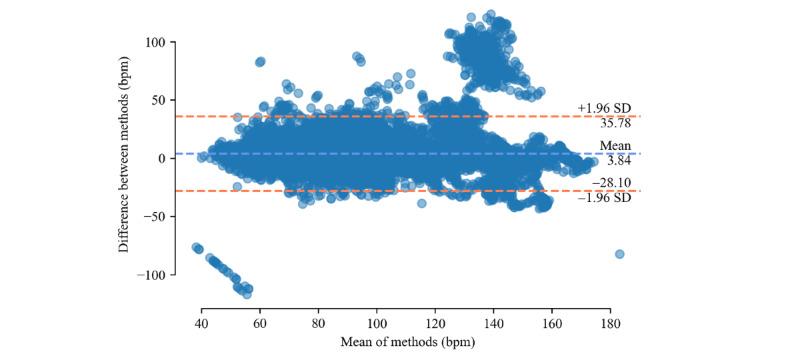
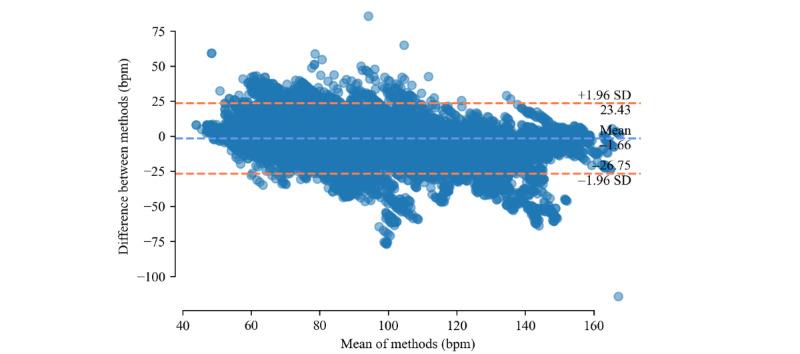
A total of 23 healthy adults (mean age 24.2, SD 4.6 years) participated in our study. Overall, and across all activities, the Fitbit Charge 4 slightly underestimated the heart rate, whereas the Samsung Galaxy Watch Active2 overestimated it (-1.66 beats per minute [bpm]/3.84 bpm). The Fitbit Charge 4 achieved a lower mean absolute error during resting and sedentary activities (seated rest: 7.8 vs 9.4; typing: 8.1 vs 11.6; laying down [left]: 7.2 vs 9.4; laying down [back]: 6.0 vs 8.6; and walking slowly: 6.8 vs 7.7 bpm), whereas the Samsung Galaxy Watch Active2 performed better during and after low- and high-intensity activities (standing up: 12.3 vs 9.0; walking fast: 6.1 vs 5.8; stairs: 8.8 vs 6.9; squats: 15.7 vs 6.1; resting: 9.6 vs 5.6 bpm).
CONCLUSIONS
Device accuracy varied with activity. Overall, both devices achieved a mean absolute percentage error of just <10%. Thus, they were considered to produce valid results based on the limits established by previous work in the field. Neither device reached sufficient accuracy during seated rest or keyboard typing. Thus, both devices may be eligible for use in respective studies; however, researchers should consider their individual study requirements.
背景
健身追踪器和智能手表常用于纵向医学研究中收集数据。它们能够在现实生活环境中进行连续记录,有可能揭示此前未被捕捉到的生物生理参数和疾病的变异性。足够的设备准确性是进行有意义研究的前提条件。
目的
本研究旨在评估两款此前未经验证的设备——Fitbit Charge 4和三星Galaxy Watch Active2的心率记录准确性。
方法
参与者执行了一项研究方案,包括5个静息和久坐阶段、2个低强度运动阶段以及3个高强度运动阶段,平均持续19分27秒。在所有活动期间,参与者同时佩戴两款可穿戴设备:Fitbit Charge 4和三星Galaxy Watch Active2。使用经医学认证的动态心电图记录参考心率数据。参考设备和评估设备的数据以1秒的间隔进行同步和比较。分析了平均值、平均绝对误差、平均绝对百分比误差、林氏一致性相关系数、皮尔逊相关系数以及布兰德-奥特曼图。
结果
共有23名健康成年人(平均年龄24.2岁,标准差4.6岁)参与了我们的研究。总体而言,在所有活动中,Fitbit Charge 4略微低估了心率,而三星Galaxy Watch Active2则高估了心率(-1.66次/分钟/3.84次/分钟)。Fitbit Charge 4在静息和久坐活动期间的平均绝对误差较低(静坐休息:7.8对9.4;打字:8.1对11.6;平躺[左侧]:7.2对9.4;平躺[背部]:6.0对8.6;慢走:6.8对7.7次/分钟),而三星Galaxy Watch Active2在低强度和高强度活动期间及之后表现更好(站立:12.3对9.0;快走:6.1对5.8;上楼梯:8.8对6.9;深蹲:15.7对6.1;静息:9.6对5.6次/分钟)。
结论
设备准确性随活动而变化。总体而言,两款设备的平均绝对百分比误差均略低于10%。因此,根据该领域先前工作确定的限值,它们被认为能产生有效的结果。在静坐休息或键盘打字期间,两款设备均未达到足够的准确性。因此,两款设备在各自的研究中可能都适用;然而,研究人员应考虑其个人研究需求。

 Zotero 插件