
1990 年至 2019 年特定部位骨关节炎的流行趋势:2019 年全球疾病负担研究的结果。
Prevalence Trends of Site-Specific Osteoarthritis From 1990 to 2019: Findings From the Global Burden of Disease Study 2019.
机构信息
Beijing Friendship Hospital, Capital Medical University, Beijing, China.
Peking University People's Hospital, Peking University, Beijing, China.
出版信息
Arthritis Rheumatol. 2022 Jul;74(7):1172-1183. doi: 10.1002/art.42089. Epub 2022 Jun 2.
OBJECTIVE
To estimate systematic and anatomic site-specific age-standardized prevalence rates (ASRs) and analyze the secular trends of osteoarthritis (OA) at global, regional, and national levels.
METHODS
Data were derived from the Global Burden of Disease Study 2019. ASRs and their estimated annual percentage changes (EAPCs) were used to describe the secular trends of OA according to age group, sex, region, country, and territory, as well as the joints involved.
RESULTS
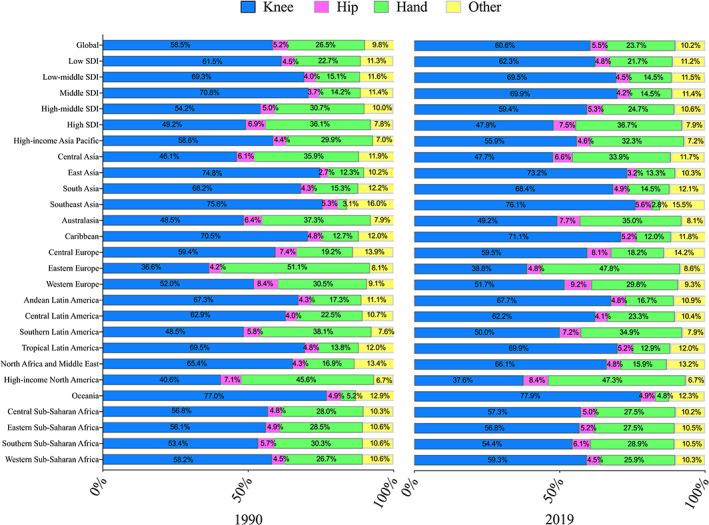
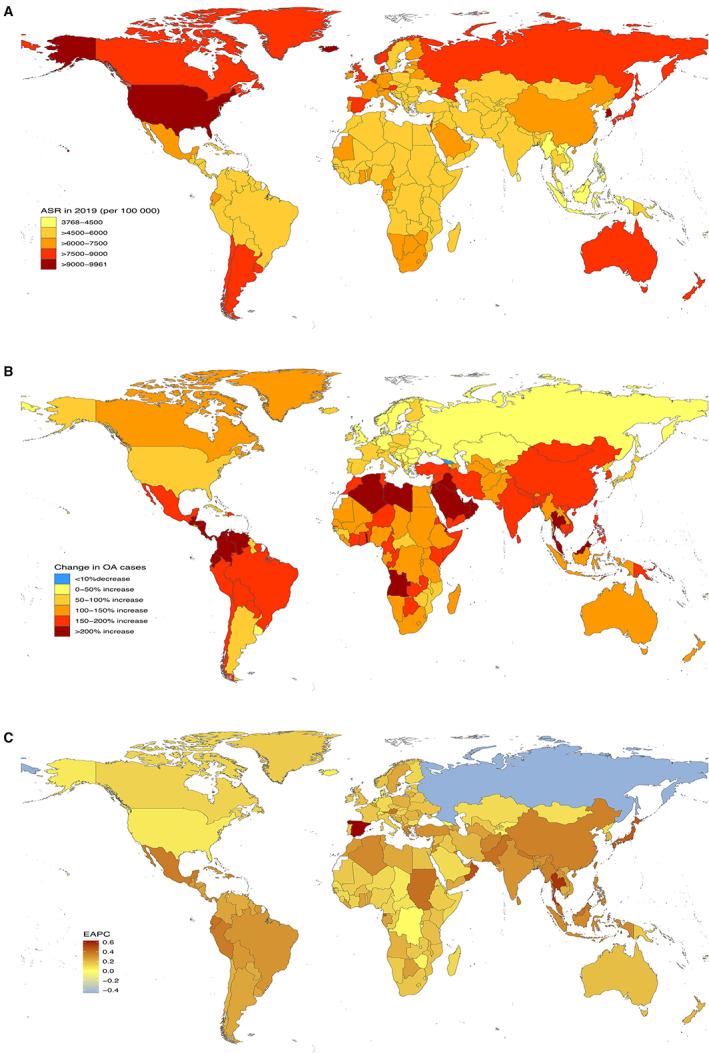
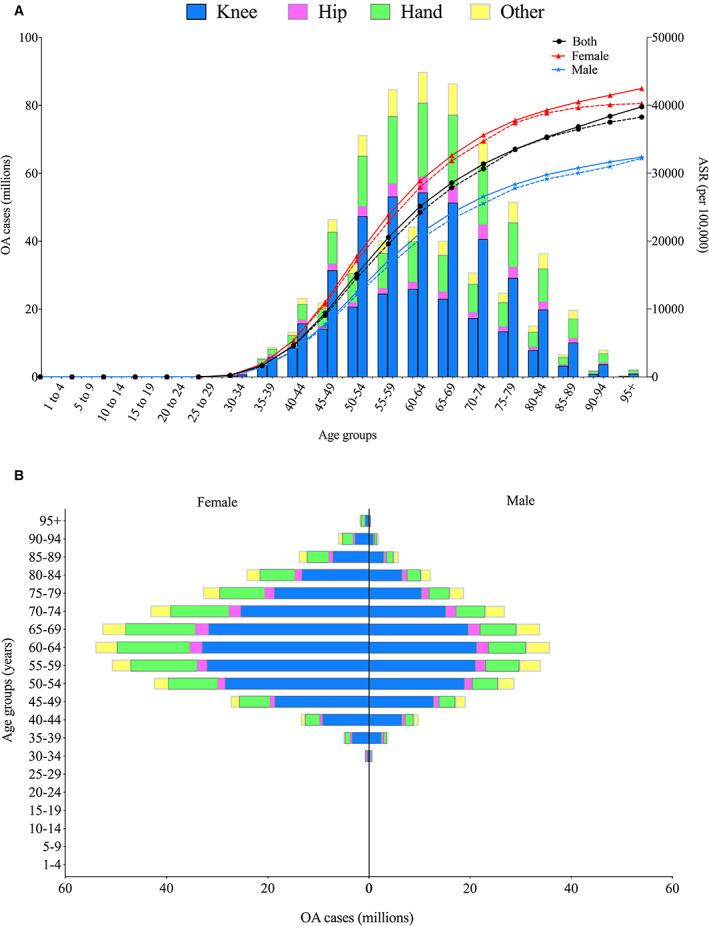
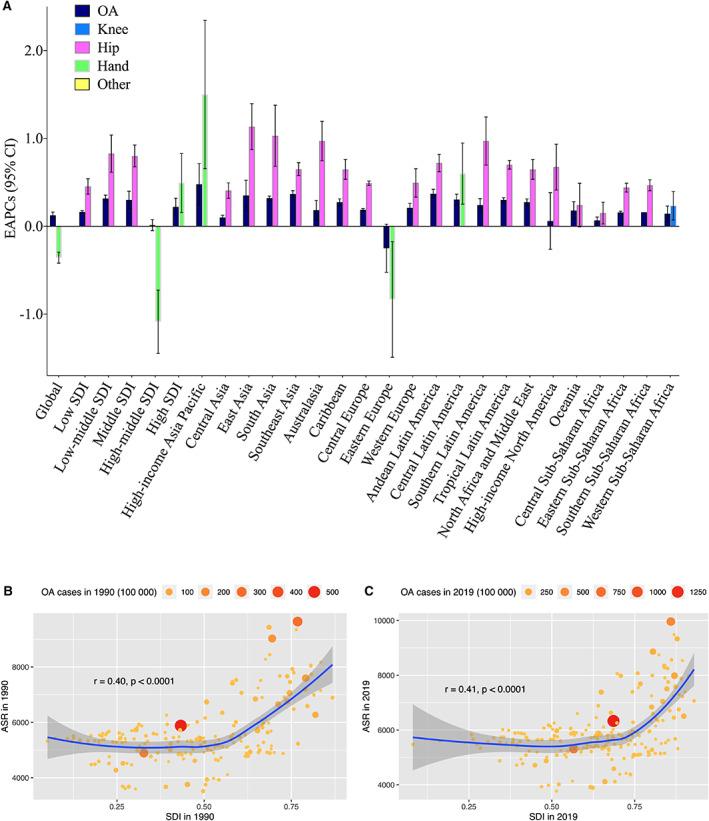
Globally, prevalent cases of OA increased by 113.25%, from 247.51 million in 1990 to 527.81 million in 2019. ASRs were 6,173.38 per 100,000 in 1990 and 6,348.25 per 100,000 in 2019, with an average annual increase of 0.12% (95% confidence interval [95% CI] 0.11%, 0.14%). The ASR of OA increased for the knee, hip, and other joints, but decreased for the hand, with EAPCs of 0.32 (95% CI 0.29, 0.34), 0.28 (95% CI 0.26, 0.31), 0.18 (95% CI 0.18, 0.19), and -0.36 (95% CI -0.38, -0.33), respectively. OA prevalence increased with age and revealed female preponderance, geographic diversity, and disparity with regard to anatomic site. OA of the knee contributed the most to the overall burden, while OA of the hip had the highest EAPC in most regions.
CONCLUSION
OA has remained a major public health concern worldwide over the past decades. The prevalence of OA has increased and diversified by geographic location and affected joint. Prevention and early treatment are pivotal to mitigating the growing burden of OA.
目的
估计全球、区域和国家层面骨关节炎(OA)的系统和解剖部位特异性年龄标准化患病率(ASR),并分析其随时间的变化趋势。
方法
数据来自 2019 年全球疾病负担研究。使用 ASR 及其估计的年百分比变化(EAPC),根据年龄组、性别、地区、国家和地区以及受累关节,描述 OA 随时间的变化趋势。
结果
全球范围内,OA 的现患病例增加了 113.25%,从 1990 年的 2.4751 亿例增至 2019 年的 5.2781 亿例。1990 年的 ASR 为每 10 万人 6173.38 例,2019 年为每 10 万人 6348.25 例,年均增长率为 0.12%(95%置信区间[95%CI]:0.11%,0.14%)。膝关节、髋关节和其他关节的 OA ASR 增加,而手部的 OA ASR 则减少,EAPC 分别为 0.32(95%CI:0.29,0.34)、0.28(95%CI:0.26,0.31)、0.18(95%CI:0.18,0.19)和-0.36(95%CI:-0.38,-0.33)。OA 的患病率随年龄增长而增加,并表现出女性优势、地域多样性和解剖部位的差异。膝关节 OA 对总体负担的贡献最大,而大多数地区髋关节 OA 的 EAPC 最高。
结论
在过去几十年中,OA 一直是全球主要的公共卫生问题。OA 的患病率在地域分布和受累关节方面有所增加和多样化。预防和早期治疗对于减轻 OA 不断增长的负担至关重要。

 Zotero 插件