
用于慢性疼痛患者自我监测和医学随访的eDOL移动健康应用程序和网络平台:观察性可行性研究。
eDOL mHealth App and Web Platform for Self-monitoring and Medical Follow-up of Patients With Chronic Pain: Observational Feasibility Study.
作者信息
Kerckhove Nicolas, Delage Noémie, Cambier Sébastien, Cantagrel Nathalie, Serra Eric, Marcaillou Fabienne, Maindet Caroline, Picard Pascale, Martiné Gaelle, Deleens Rodrigue, Trouvin Anne-Priscille, Fourel Lauriane, Espagne-Dubreuilh Gaelle, Douay Ludovic, Foulon Stéphane, Dufraisse Bénédicte, Gov Christian, Viel Eric, Jedryka François, Pouplin Sophie, Lestrade Cécile, Combe Emmanuel, Perrot Serge, Perocheau Dominique, De Brisson Valentine, Vergne-Salle Pascale, Mertens Patrick, Pereira Bruno, Djiberou Mahamadou Abdoul Jalil, Antoine Violaine, Corteval Alice, Eschalier Alain, Dualé Christian, Attal Nadine, Authier Nicolas
机构信息
Service de Pharmacologie médicale, Centre Hospitalier Universitaire de Clermont-Ferrand, Clermont-Ferrand, France.
Centre d'évaluation et de traitement de la douleur, Centre Hospitalier Universitaire de Clermont-Ferrand, Clermont-Ferrand, France.
出版信息
JMIR Form Res. 2022 Mar 2;6(3):e30052. doi: 10.2196/30052.
BACKGROUND
Chronic pain affects approximately 30% of the general population, severely degrades quality of life (especially in older adults) and professional life (inability or reduction in the ability to work and loss of employment), and leads to billions in additional health care costs. Moreover, available painkillers are old, with limited efficacy and can cause significant adverse effects. Thus, there is a need for innovation in the management of chronic pain. Better characterization of patients could help to identify the predictors of successful treatments, and thus, guide physicians in the initial choice of treatment and in the follow-up of their patients. Nevertheless, current assessments of patients with chronic pain provide only fragmentary data on painful daily experiences. Real-life monitoring of subjective and objective markers of chronic pain using mobile health (mHealth) programs can address this issue.
OBJECTIVE
We hypothesized that regular patient self-monitoring using an mHealth app would lead physicians to obtain deeper understanding and new insight into patients with chronic pain and that, for patients, regular self-monitoring using an mHealth app would play a positive therapeutic role and improve adherence to treatment. We aimed to evaluate the feasibility and acceptability of a new mHealth app called eDOL.
METHODS
We conducted an observational study to assess the feasibility and acceptability of the eDOL tool. Patients completed several questionnaires using the tool over a period of 2 weeks and repeated assessments weekly over a period of 3 months. Physicians saw their patients at a follow-up visit that took place at least 3 months after the inclusion visit. A composite criterion of the acceptability and feasibility of the eDOL tool was calculated after the completion of study using satisfaction surveys from both patients and physicians.
RESULTS
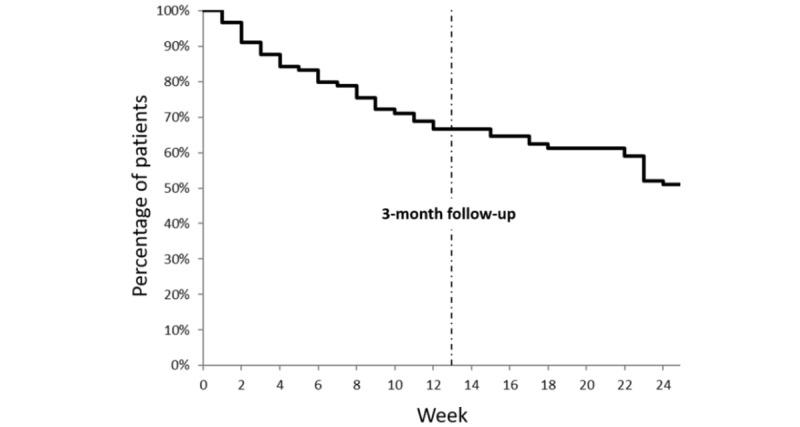
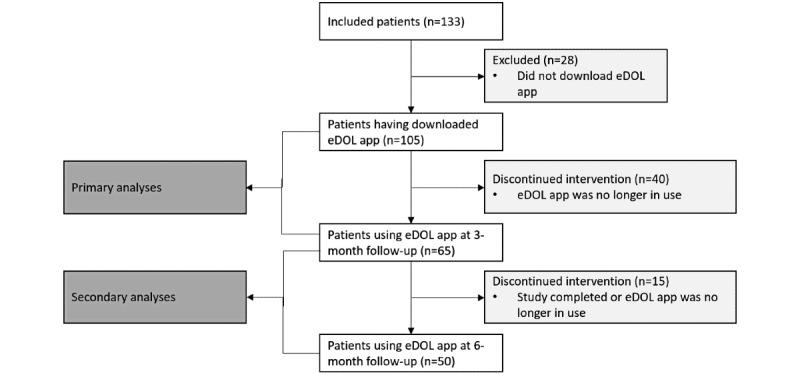
Data from 105 patients (of 133 who were included) were analyzed. The rate of adherence was 61.9% (65/105) after 3 months. The median acceptability score was 7 (out of 10) for both patients and physicians. There was a high rate of completion of the baseline questionnaires and assessments (mean 89.3%), and a low rate of completion of the follow-up questionnaires and assessments (63.8% (67/105) and 61.9% (65/105) respectively). We were also able to characterize subgroups of patients and determine a profile of those who adhered to eDOL. We obtained 4 clusters that differ from each other in their biopsychosocial characteristics. Cluster 4 corresponds to patients with more disabling chronic pain (daily impact and comorbidities) and vice versa for cluster 1.
CONCLUSIONS
This work demonstrates that eDOL is highly feasible and acceptable for both patients with chronic pain and their physicians. It also shows that such a tool can integrate many parameters to ensure the detailed characterization of patients for future research works and pain management.
TRIAL REGISTRATION
ClinicalTrial.gov NCT03931694; http://clinicaltrials.gov/ct2/show/NCT03931694.
背景
慢性疼痛影响着约30%的普通人群,严重降低生活质量(尤其是在老年人中)和职业生活(工作能力丧失或下降以及失业),并导致数十亿美元的额外医疗费用。此外,现有的止痛药老旧,疗效有限且会引起严重的不良反应。因此,慢性疼痛管理需要创新。对患者进行更全面的特征描述有助于识别成功治疗的预测因素,从而指导医生在初始治疗选择及对患者的随访中做出决策。然而,目前对慢性疼痛患者的评估仅提供了关于日常疼痛经历的零散数据。使用移动健康(mHealth)程序对慢性疼痛的主观和客观指标进行现实生活监测可以解决这一问题。
目的
我们假设使用mHealth应用程序对患者进行定期自我监测会使医生对慢性疼痛患者有更深入的了解和新的认识,并且对于患者来说,使用mHealth应用程序进行定期自我监测将发挥积极的治疗作用并提高治疗依从性。我们旨在评估一款名为eDOL的新型mHealth应用程序的可行性和可接受性。
方法
我们进行了一项观察性研究,以评估eDOL工具的可行性和可接受性。患者在2周内使用该工具完成了几份问卷,并在3个月内每周重复进行评估。医生在入选访视后至少3个月进行的随访中见到他们的患者。在研究完成后,使用患者和医生的满意度调查计算出eDOL工具可接受性和可行性的综合标准。
结果
分析了133名纳入患者中的105名患者的数据。3个月后的依从率为61.9%(65/105)。患者和医生给出的可接受性评分中位数均为7(满分10分)。基线问卷和评估的完成率较高(平均89.3%),而随访问卷和评估的完成率较低(分别为63.8%(67/105)和61.9%(65/105))。我们还能够对患者亚组进行特征描述,并确定坚持使用eDOL的患者特征。我们获得了4个在生物心理社会特征上彼此不同的聚类。聚类4对应于慢性疼痛致残性更高的患者(日常影响和合并症),聚类1则相反。
结论
这项工作表明,eDOL对于慢性疼痛患者及其医生来说具有高度的可行性和可接受性。它还表明,这样一种工具可以整合许多参数,以确保对患者进行详细的特征描述,用于未来的研究工作和疼痛管理。
试验注册
ClinicalTrial.gov NCT03931694;http://clinicaltrials.gov/ct2/show/NCT03931694 。
 Zotero 插件