
用于鉴定具有抗真菌特性的细菌生防菌株的高通量定量筛选方法。
Quantitative High-Throughput Screening Methods Designed for Identification of Bacterial Biocontrol Strains with Antifungal Properties.
机构信息
Discovery, R&D, Chr. Hansen A/S, Hoersholm, Denmark.
Bacterial Interactions and Evolution Group, DTU Bioengineering, Technical University of Denmark, Kongens Lyngby, Denmark.
出版信息
Microbiol Spectr. 2022 Apr 27;10(2):e0143321. doi: 10.1128/spectrum.01433-21. Epub 2022 Mar 7.
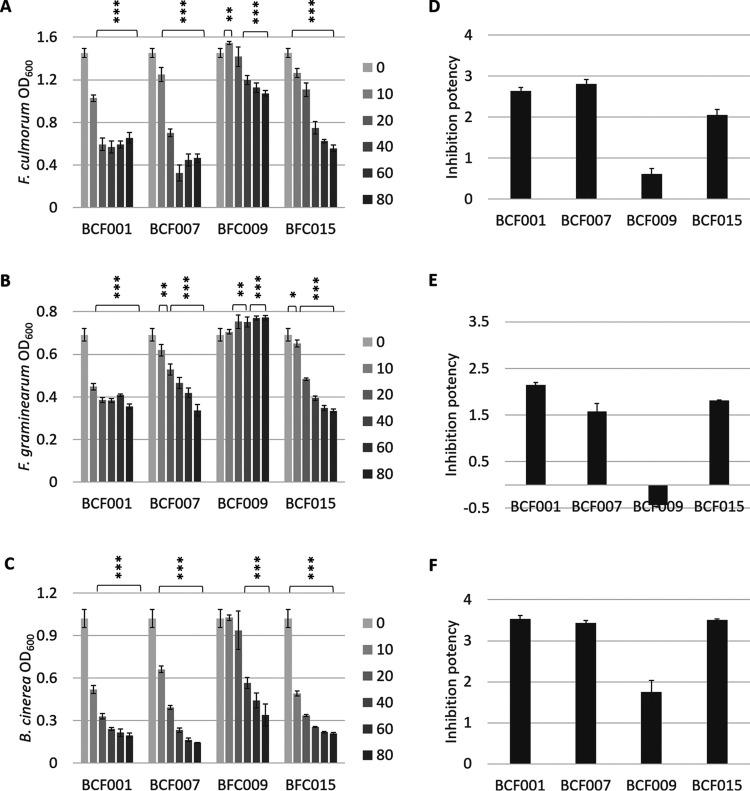
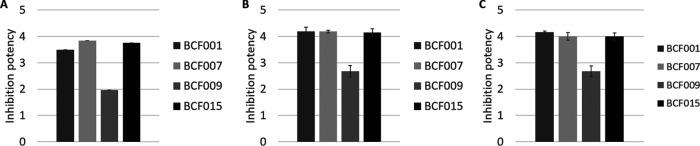
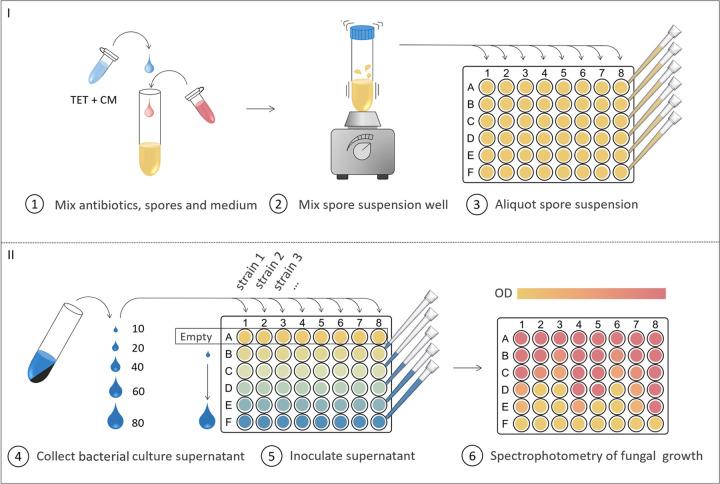
Large screens of bacterial strain collections to identify potential biocontrol agents often are time-consuming and costly and fail to provide quantitative results. In this study, we present two quantitative and high-throughput methods to assess the inhibitory capacity of bacterial biocontrol candidates against fungal phytopathogens. One method measures the inhibitory effect of bacterial culture supernatant components on the fungal growth, while the other accounts for direct interaction between growing bacteria and the fungus by cocultivating the two organisms. The antagonistic supernatant method quantifies the culture components' antifungal activity by calculating the cumulative impact of supernatant addition relative to the growth of a nontreated fungal control, while the antagonistic cocultivation method identifies the minimal bacterial cell concentration required to inhibit fungal growth by coinoculating fungal spores with bacterial culture dilution series. Thereby, both methods provide quantitative measures of biocontrol efficiency and allow prominent fungal inhibitors to be distinguished from less effective strains. The combination of the two methods sheds light on the types of inhibition mechanisms and provides the basis for further mode-of-action studies. We demonstrate the efficacy of the methods using Bacillus spp. with different levels of antifungal activities as model antagonists and quantify their inhibitory potencies against classic plant pathogens. Fungal phytopathogens are responsible for tremendous agricultural losses on an annual basis. While microbial biocontrol agents represent a promising solution to the problem, there is a growing need for high-throughput methods to evaluate and quantify inhibitory properties of new potential biocontrol agents for agricultural application. In this study, we present two high-throughput and quantitative fungal inhibition methods that are suitable for commercial biocontrol screening.
大型细菌菌株收集物屏幕经常耗时且昂贵,并且无法提供定量结果,无法识别潜在的生物防治剂。在这项研究中,我们提出了两种定量和高通量的方法来评估细菌生物防治候选物对真菌植物病原体的抑制能力。一种方法测量细菌培养上清液成分对真菌生长的抑制作用,而另一种方法则通过共培养两种生物来考虑生长细菌与真菌之间的直接相互作用。拮抗上清液方法通过计算上清液添加相对于未处理真菌对照物的生长的累积影响来量化培养物成分的抗真菌活性,而拮抗共培养方法通过用细菌培养稀释系列与真菌孢子共接种来确定抑制真菌生长所需的最小细菌细胞浓度。因此,这两种方法都提供了生物防治效率的定量衡量标准,并允许从效果较差的菌株中区分出具有明显抑制作用的菌株。这两种方法的结合揭示了抑制机制的类型,并为进一步的作用模式研究提供了基础。我们使用具有不同抗真菌活性水平的芽孢杆菌作为模型拮抗剂来证明这些方法的功效,并量化它们对经典植物病原体的抑制能力。真菌植物病原体每年都会造成巨大的农业损失。虽然微生物生物防治剂是解决这个问题的有希望的方法,但越来越需要高通量方法来评估和量化新的潜在农业应用生物防治剂的抑制特性。在这项研究中,我们提出了两种适用于商业生物防治筛选的高通量和定量真菌抑制方法。


 Zotero 插件