
人工智能驱动的肿瘤浸润淋巴细胞空间分析作为非小细胞肺癌免疫检查点抑制的补充生物标志物
Artificial Intelligence-Powered Spatial Analysis of Tumor-Infiltrating Lymphocytes as Complementary Biomarker for Immune Checkpoint Inhibition in Non-Small-Cell Lung Cancer.
作者信息
Park Sehhoon, Ock Chan-Young, Kim Hyojin, Pereira Sergio, Park Seonwook, Ma Minuk, Choi Sangjoon, Kim Seokhwi, Shin Seunghwan, Aum Brian Jaehong, Paeng Kyunghyun, Yoo Donggeun, Cha Hongui, Park Sunyoung, Suh Koung Jin, Jung Hyun Ae, Kim Se Hyun, Kim Yu Jung, Sun Jong-Mu, Chung Jin-Haeng, Ahn Jin Seok, Ahn Myung-Ju, Lee Jong Seok, Park Keunchil, Song Sang Yong, Bang Yung-Jue, Choi Yoon-La, Mok Tony S, Lee Se-Hoon
机构信息
Division of Hematology-Oncology, Department of Medicine, Samsung Medical Center, Sungkyunkwan University School of Medicine, Seoul 06351, Republic of Korea.
Lunit, Seoul, Republic of Korea.
出版信息
J Clin Oncol. 2022 Jun 10;40(17):1916-1928. doi: 10.1200/JCO.21.02010. Epub 2022 Mar 10.
PURPOSE
Biomarkers on the basis of tumor-infiltrating lymphocytes (TIL) are potentially valuable in predicting the effectiveness of immune checkpoint inhibitors (ICI). However, clinical application remains challenging because of methodologic limitations and laborious process involved in spatial analysis of TIL distribution in whole-slide images (WSI).
METHODS
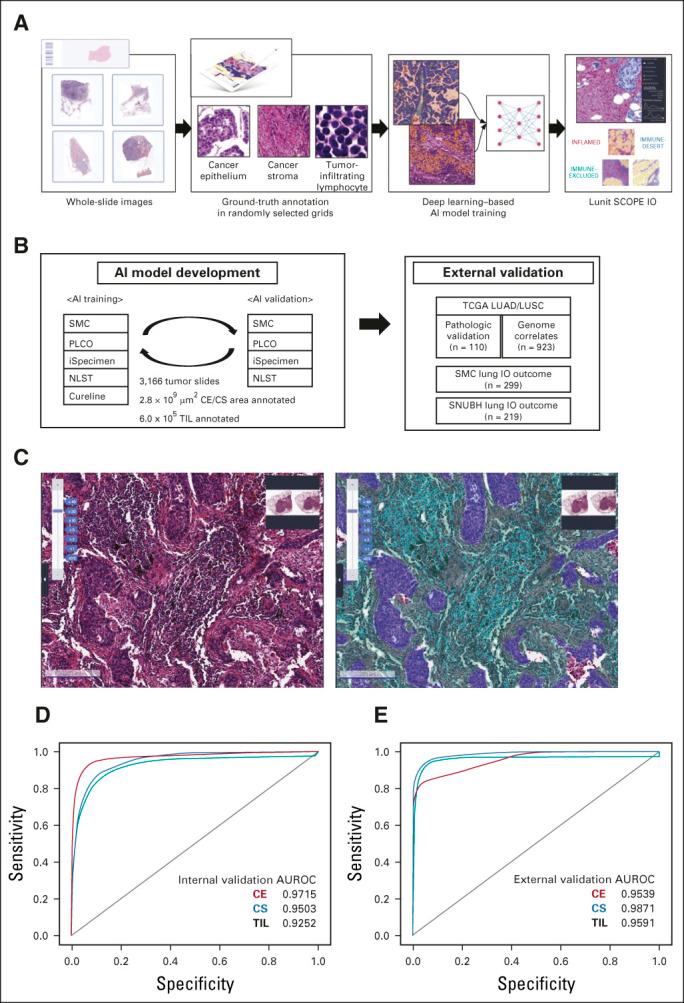
We have developed an artificial intelligence (AI)-powered WSI analyzer of TIL in the tumor microenvironment that can define three immune phenotypes (IPs): inflamed, immune-excluded, and immune-desert. These IPs were correlated with tumor response to ICI and survival in two independent cohorts of patients with advanced non-small-cell lung cancer (NSCLC).
RESULTS
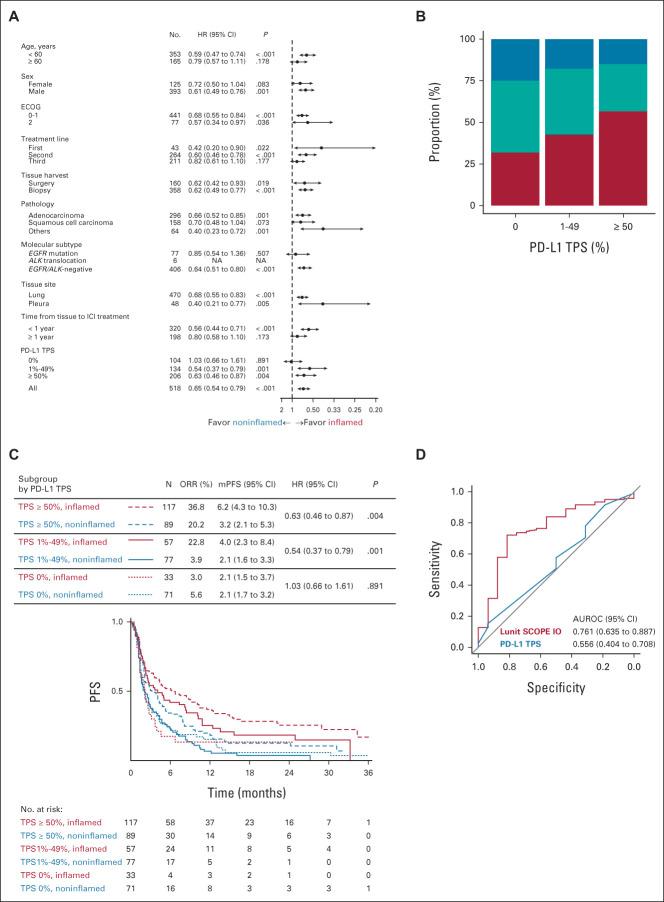
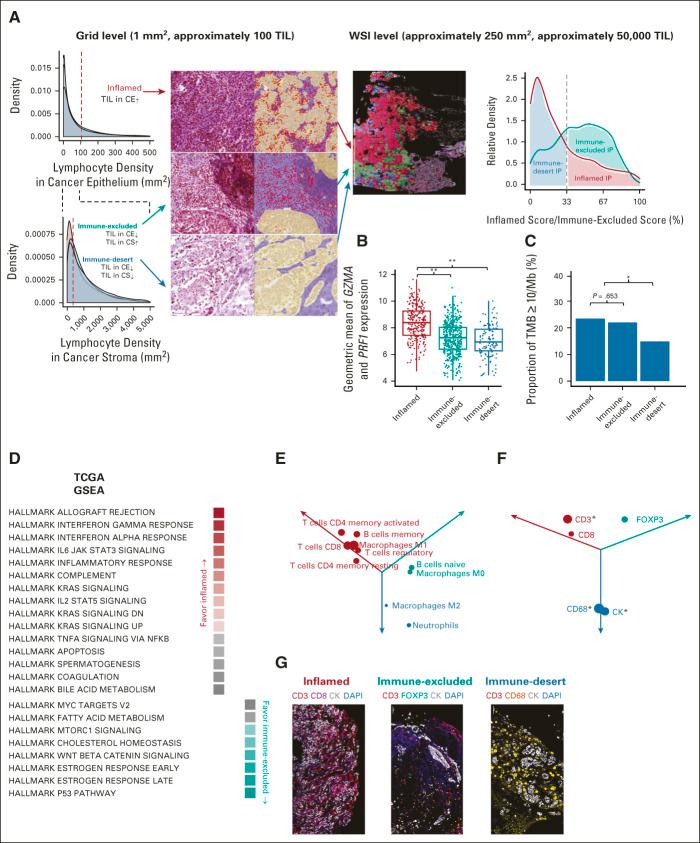
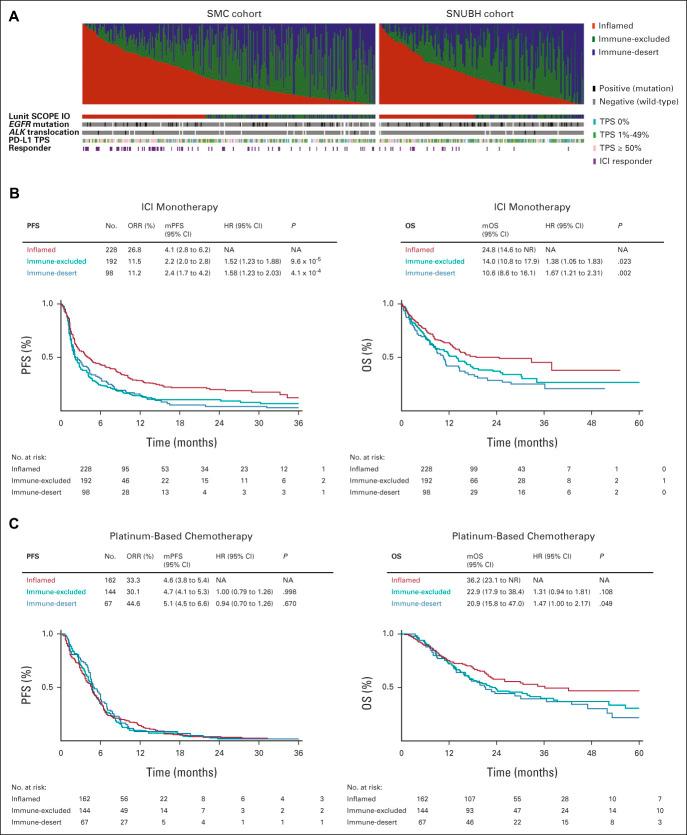
Inflamed IP correlated with enrichment in local immune cytolytic activity, higher response rate, and prolonged progression-free survival compared with patients with immune-excluded or immune-desert phenotypes. At the WSI level, there was significant positive correlation between tumor proportion score (TPS) as determined by the AI model and control TPS analyzed by pathologists ( < .001). Overall, 44.0% of tumors were inflamed, 37.1% were immune-excluded, and 18.9% were immune-desert. Incidence of inflamed IP in patients with programmed death ligand-1 TPS at < 1%, 1%-49%, and ≥ 50% was 31.7%, 42.5%, and 56.8%, respectively. Median progression-free survival and overall survival were, respectively, 4.1 months and 24.8 months with inflamed IP, 2.2 months and 14.0 months with immune-excluded IP, and 2.4 months and 10.6 months with immune-desert IP.
CONCLUSION
The AI-powered spatial analysis of TIL correlated with tumor response and progression-free survival of ICI in advanced NSCLC. This is potentially a supplementary biomarker to TPS as determined by a pathologist.
目的
基于肿瘤浸润淋巴细胞(TIL)的生物标志物在预测免疫检查点抑制剂(ICI)的疗效方面具有潜在价值。然而,由于方法学上的局限性以及在全切片图像(WSI)中对TIL分布进行空间分析所涉及的繁琐过程,其临床应用仍然具有挑战性。
方法
我们开发了一种基于人工智能(AI)的肿瘤微环境中TIL的WSI分析仪,该分析仪可以定义三种免疫表型(IP):炎症型、免疫排除型和免疫荒漠型。在两个独立的晚期非小细胞肺癌(NSCLC)患者队列中,将这些IP与肿瘤对ICI的反应及生存情况进行关联分析。
结果
与免疫排除型或免疫荒漠型表型的患者相比,炎症型IP与局部免疫细胞溶解活性增强、更高的反应率以及更长的无进展生存期相关。在WSI水平上,由AI模型确定的肿瘤比例评分(TPS)与病理学家分析的对照TPS之间存在显著正相关(<0.001)。总体而言,44.0%的肿瘤为炎症型,37.1%为免疫排除型,18.9%为免疫荒漠型。程序性死亡配体-1 TPS<1%、1%-49%和≥50%的患者中,炎症型IP的发生率分别为31.7%、42.5%和56.8%。炎症型IP患者的中位无进展生存期和总生存期分别为4.1个月和24.8个月,免疫排除型IP患者分别为2.2个月和14.0个月,免疫荒漠型IP患者分别为2.4个月和10.6个月。
结论
基于AI的TIL空间分析与晚期NSCLC中ICI的肿瘤反应和无进展生存期相关。这可能是病理学家确定的TPS的一种补充生物标志物。
 Zotero 插件