
免疫荒漠型肿瘤微环境在胸内 SMARCA4 缺陷型未分化肿瘤中,免疫检查点抑制剂疗效有限。
Immune-Desert Tumor Microenvironment in Thoracic SMARCA4-Deficient Undifferentiated Tumors with Limited Efficacy of Immune Checkpoint Inhibitors.
机构信息
Department of Medical Oncology, Strasbourg-Europe Cancer Institute (ICANS), Strasbourg, France.
Fédération de Médecine Translationnelle (FMTS), Strasbourg, France.
出版信息
Oncologist. 2022 Jun 8;27(6):501-511. doi: 10.1093/oncolo/oyac040.
BACKGROUND
Thoracic SMARCA4-deficient undifferentiated tumors (SMARCA4-UT) are aggressive neoplasms. Data linking BAF alterations with tumor microenvironment (TME) and efficacy of immune checkpoint inhibitors (ICI) are contradictory. The TME of SMARCA4-UT and their response to ICI are unknown.
MATERIALS AND METHODS
Patients diagnosed with SMARCA4-UT in our institution were included. Immunostainings for tertiary lymphoid structures (TLS), immune cell markers, and checkpoints were assessed. Validation was performed using an independent transcriptome dataset including SMARCA4-UT, non-small cell lung cancers (NSCLC) with/without SMARCA4 mutations, and unclassified thoracic sarcomas (UTS). CXCL9 and PD-L1 expressions were assessed in NSCLC and thoracic fibroblast cell lines, with/without SMARCA4 knockdown, treated with/without interferon gamma.
RESULTS
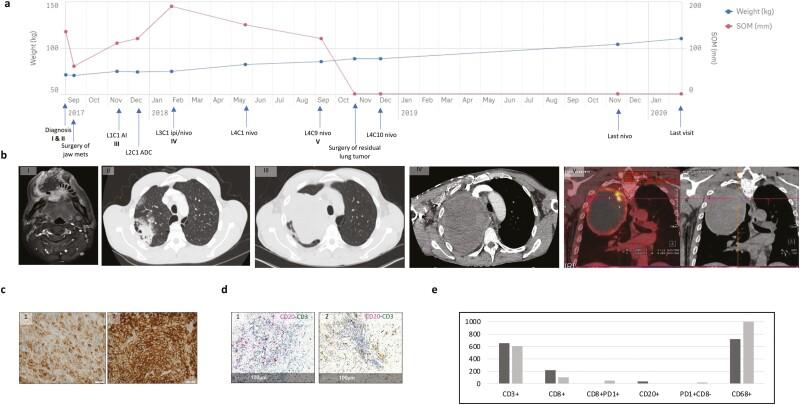
Nine patients were identified. All samples but one showed no TLS, consistent with an immune desert TME phenotype. Four patients received ICI as part of their treatment, but the only one who responded, had a tumor with a TLS and immune-rich TME. Unsupervised clustering of the validation cohort using immune cell scores identified 2 clusters associated with cell ontogeny and immunity (cluster 1 enriched for NSCLC independently of SMARCA4 status (n = 9/10; P = .001); cluster 2 enriched for SMARCA4-UT (n = 11/12; P = .005) and UTS (n = 5/5; P = .0005). SMARCA4 loss-of-function experiments revealed interferon-induced upregulation of CXCL9 and PD-L1 expression in the NSCLC cell line with no effect on the thoracic fibroblast cell line.
CONCLUSION
SMARCA4-UT mainly have an immune desert TME with limited efficacy to ICI. TME of SMARCA4-driven tumors varies according to the cell of origin questioning the interplay between BAF alterations, cell ontogeny and immunity.
背景
胸 SMARCA4 缺陷未分化肿瘤(SMARCA4-UT)是侵袭性肿瘤。将 BAF 改变与肿瘤微环境(TME)和免疫检查点抑制剂(ICI)疗效相关联的数据存在矛盾。SMARCA4-UT 的 TME 及其对 ICI 的反应尚不清楚。
材料和方法
纳入我院诊断为 SMARCA4-UT 的患者。评估了三级淋巴结构(TLS)、免疫细胞标志物和检查点的免疫染色。使用包括 SMARCA4-UT、无/有 SMARCA4 突变的非小细胞肺癌(NSCLC)和未分类的胸肉瘤(UTS)的独立转录组数据集进行验证。在有/无 SMARCA4 敲低的 NSCLC 和胸成纤维细胞系中评估了 CXCL9 和 PD-L1 的表达,并与干扰素γ联合/不联合处理。
结果
确定了 9 名患者。除了一个样本外,所有样本均未显示 TLS,与免疫荒漠 TME 表型一致。4 名患者接受了 ICI 作为其治疗的一部分,但唯一有反应的患者的肿瘤有 TLS 和免疫丰富的 TME。使用免疫细胞评分对验证队列进行无监督聚类,确定了 2 个与细胞起源和免疫相关的聚类(簇 1 富集 NSCLC,与 SMARCA4 状态无关(n = 9/10;P =.001);簇 2 富集 SMARCA4-UT(n = 11/12;P =.005)和 UTS(n = 5/5;P =.0005)。SMARCA4 功能丧失实验显示,干扰素诱导 NSCLC 细胞系中 CXCL9 和 PD-L1 的表达上调,但对胸成纤维细胞系无影响。
结论
SMARCA4-UT 主要具有免疫荒漠 TME,对 ICI 的疗效有限。SMARCA4 驱动的肿瘤的 TME 根据起源细胞而变化,质疑 BAF 改变、细胞起源和免疫之间的相互作用。


 Zotero 插件