
估算2019冠状病毒病大流行造成的超额死亡率:2020 - 2021年与2019冠状病毒病相关死亡率的系统分析
Estimating excess mortality due to the COVID-19 pandemic: a systematic analysis of COVID-19-related mortality, 2020-21.
出版信息
Lancet. 2022 Apr 16;399(10334):1513-1536. doi: 10.1016/S0140-6736(21)02796-3. Epub 2022 Mar 10.
BACKGROUND
Mortality statistics are fundamental to public health decision making. Mortality varies by time and location, and its measurement is affected by well known biases that have been exacerbated during the COVID-19 pandemic. This paper aims to estimate excess mortality from the COVID-19 pandemic in 191 countries and territories, and 252 subnational units for selected countries, from Jan 1, 2020, to Dec 31, 2021.
METHODS
All-cause mortality reports were collected for 74 countries and territories and 266 subnational locations (including 31 locations in low-income and middle-income countries) that had reported either weekly or monthly deaths from all causes during the pandemic in 2020 and 2021, and for up to 11 year previously. In addition, we obtained excess mortality data for 12 states in India. Excess mortality over time was calculated as observed mortality, after excluding data from periods affected by late registration and anomalies such as heat waves, minus expected mortality. Six models were used to estimate expected mortality; final estimates of expected mortality were based on an ensemble of these models. Ensemble weights were based on root mean squared errors derived from an out-of-sample predictive validity test. As mortality records are incomplete worldwide, we built a statistical model that predicted the excess mortality rate for locations and periods where all-cause mortality data were not available. We used least absolute shrinkage and selection operator (LASSO) regression as a variable selection mechanism and selected 15 covariates, including both covariates pertaining to the COVID-19 pandemic, such as seroprevalence, and to background population health metrics, such as the Healthcare Access and Quality Index, with direction of effects on excess mortality concordant with a meta-analysis by the US Centers for Disease Control and Prevention. With the selected best model, we ran a prediction process using 100 draws for each covariate and 100 draws of estimated coefficients and residuals, estimated from the regressions run at the draw level using draw-level input data on both excess mortality and covariates. Mean values and 95% uncertainty intervals were then generated at national, regional, and global levels. Out-of-sample predictive validity testing was done on the basis of our final model specification.
FINDINGS
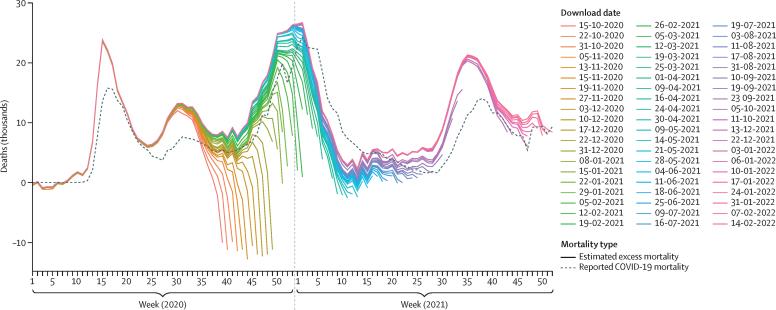
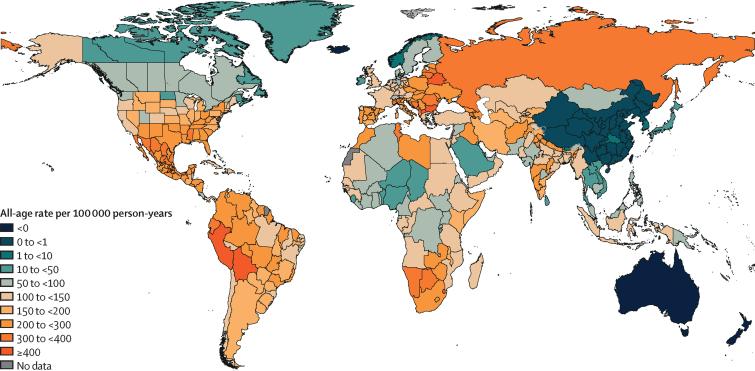
Although reported COVID-19 deaths between Jan 1, 2020, and Dec 31, 2021, totalled 5·94 million worldwide, we estimate that 18·2 million (95% uncertainty interval 17·1-19·6) people died worldwide because of the COVID-19 pandemic (as measured by excess mortality) over that period. The global all-age rate of excess mortality due to the COVID-19 pandemic was 120·3 deaths (113·1-129·3) per 100 000 of the population, and excess mortality rate exceeded 300 deaths per 100 000 of the population in 21 countries. The number of excess deaths due to COVID-19 was largest in the regions of south Asia, north Africa and the Middle East, and eastern Europe. At the country level, the highest numbers of cumulative excess deaths due to COVID-19 were estimated in India (4·07 million [3·71-4·36]), the USA (1·13 million [1·08-1·18]), Russia (1·07 million [1·06-1·08]), Mexico (798 000 [741 000-867 000]), Brazil (792 000 [730 000-847 000]), Indonesia (736 000 [594 000-955 000]), and Pakistan (664 000 [498 000-847 000]). Among these countries, the excess mortality rate was highest in Russia (374·6 deaths [369·7-378·4] per 100 000) and Mexico (325·1 [301·6-353·3] per 100 000), and was similar in Brazil (186·9 [172·2-199·8] per 100 000) and the USA (179·3 [170·7-187·5] per 100 000).
INTERPRETATION
The full impact of the pandemic has been much greater than what is indicated by reported deaths due to COVID-19 alone. Strengthening death registration systems around the world, long understood to be crucial to global public health strategy, is necessary for improved monitoring of this pandemic and future pandemics. In addition, further research is warranted to help distinguish the proportion of excess mortality that was directly caused by SARS-CoV-2 infection and the changes in causes of death as an indirect consequence of the pandemic.
FUNDING
Bill & Melinda Gates Foundation, J Stanton, T Gillespie, and J and E Nordstrom.
背景
死亡率统计是公共卫生决策的基础。死亡率随时间和地点而变化,其测量受到一些众所周知的偏差影响,而这些偏差在新冠疫情期间进一步加剧。本文旨在估计2020年1月1日至2021年12月31日期间191个国家和地区以及部分国家的252个次国家级单位因新冠疫情导致的超额死亡率。
方法
收集了74个国家和地区以及266个次国家级地区(包括31个低收入和中等收入国家的地区)的全因死亡率报告,这些地区在2020年和2021年疫情期间报告了每周或每月的全因死亡情况,且此前最多有11年的数据。此外,我们还获得了印度12个邦的超额死亡率数据。随时间推移的超额死亡率计算方法为:在排除受延迟登记和热浪等异常情况影响期间的数据后,观察到的死亡率减去预期死亡率。使用了六种模型来估计预期死亡率;预期死亡率的最终估计基于这些模型的集合。集合权重基于样本外预测有效性测试得出的均方根误差。由于全球范围内的死亡率记录不完整,我们构建了一个统计模型,用于预测全因死亡率数据不可用的地区和时间段的超额死亡率。我们使用最小绝对收缩和选择算子(LASSO)回归作为变量选择机制,选择了15个协变量,包括与新冠疫情相关的协变量(如血清阳性率)以及与背景人群健康指标相关的协变量(如医疗保健可及性和质量指数),这些协变量对超额死亡率的影响方向与美国疾病控制与预防中心的一项荟萃分析一致。使用选定的最佳模型,我们通过对每个协变量进行100次抽样以及对估计系数和残差进行100次抽样来运行预测过程,这些抽样是根据使用抽样水平的超额死亡率和协变量输入数据在抽样水平运行的回归估计得出的。然后在国家、区域和全球层面生成平均值和95%的不确定性区间。基于我们的最终模型规范进行了样本外预测有效性测试。
结果
尽管2020年1月1日至2021年12月31日期间全球报告的新冠死亡病例总计594万例,但我们估计在此期间全球因新冠疫情(以超额死亡率衡量)死亡的人数为1820万(95%不确定性区间为1710万 - 1960万)。新冠疫情导致的全球全年龄段超额死亡率为每10万人120.3例死亡(113.1 - 129.3),21个国家的超额死亡率超过每10万人300例死亡。因新冠疫情导致的超额死亡人数在南亚、北非和中东以及东欧地区最多。在国家层面,估计因新冠疫情导致的累计超额死亡人数最多的是印度(407万 [371万 - 436万])、美国(113万 [108万 - 118万])、俄罗斯(107万 [106万 - 108万])、墨西哥(79.8万 [74.1万 - 86.7万])、巴西(79.2万 [73万 - 84.7万])、印度尼西亚(73.6万 [59.4万 - 95.5万])和巴基斯坦(66.4万 [49.8万 - 84.7万])。在这些国家中,俄罗斯(每10万人374.6例死亡 [369.7 - 378.4])和墨西哥(每10万人325.1例 [301.6 - 353.3])的超额死亡率最高,巴西(每10万人186.9例 [172.2 - 199.8])和美国(每10万人179.3例 [170.7 - 187.5])的超额死亡率相近。
解读
疫情的全面影响远大于仅由报告的新冠死亡病例所显示的情况。加强全球死亡登记系统对于改善对本次疫情及未来疫情的监测至关重要,而长期以来人们都明白这对全球公共卫生战略至关重要。此外,有必要进行进一步研究,以帮助区分由SARS-CoV-2感染直接导致的超额死亡率比例以及作为疫情间接后果的死亡原因变化。
资金来源
比尔及梅琳达·盖茨基金会、J·斯坦顿、T·吉莱斯皮以及J和E·诺德斯特龙。


 Zotero 插件