
有关人类冠状病毒 SARS-CoV-2 从食品和包装材料转移到手套上的数据表明,接触传播的重要性较小。
Data on Transfer of Human Coronavirus SARS-CoV-2 from Foods and Packaging Materials to Gloves Indicate That Fomite Transmission Is of Minor Importance.
机构信息
Société des Produits Nestlé, Nestlé Research, Institute of Food Safety and Analytical Science, Lausanne, Switzerland.
出版信息
Appl Environ Microbiol. 2022 Apr 12;88(7):e0233821. doi: 10.1128/aem.02338-21. Epub 2022 Mar 14.
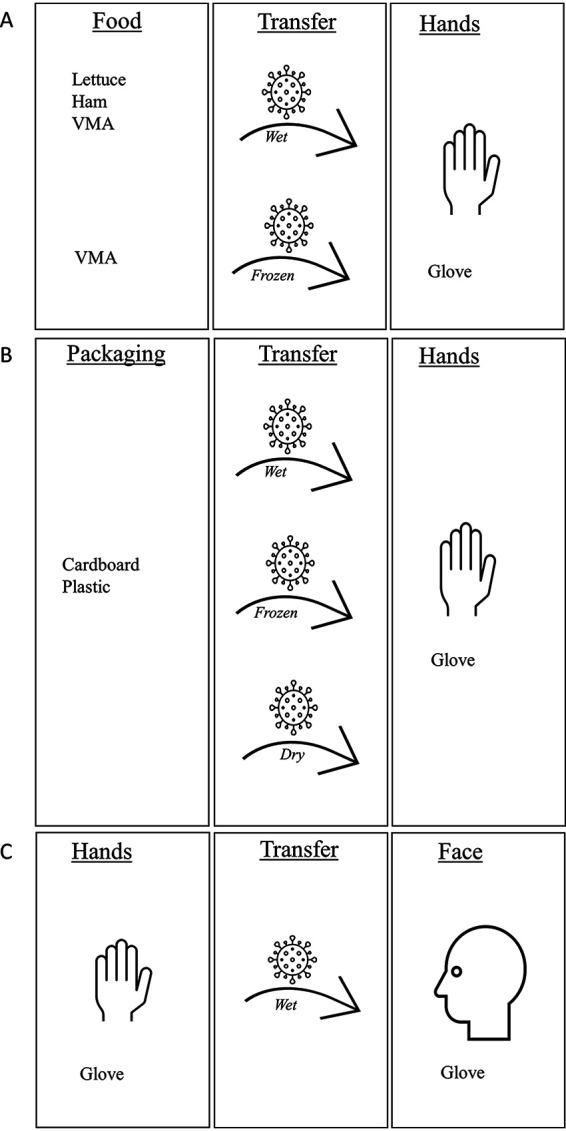
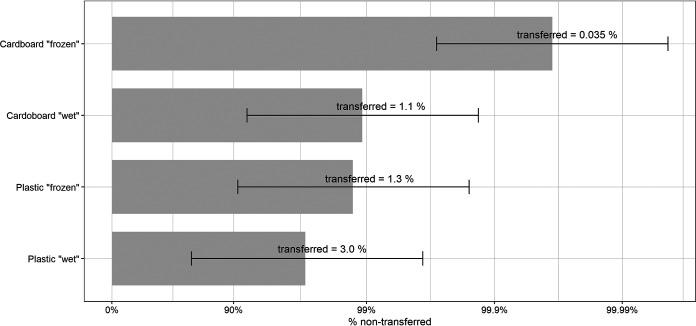
Severe acute respiratory syndrome coronavirus 2 (SARS-CoV-2) infection is mainly transmitted via droplets and aerosols. To evaluate the role of transmission by fomites, SARS-CoV-2-specific data on transfer rates from surfaces to hands and from hands to face are lacking. Here, we generated quantitatively controlled transfer rates for SARS-CoV-2 from food items (lettuce, ham, and vegetarian meat alternative [VMA]) and packaging materials (cardboard and plastic) to gloves using a wet, dry, and frozen viral inoculum and from glove to glove using a wet viral inoculum. For biosafety reasons, the transfer from surfaces to hands and hands to face was simulated by using gloves. The cumulative transfer rate was calculated by using the data from the first transfer experiment, food or packaging material to glove, and combined with the transfer rate obtained from the second transfer experiment from glove to glove. The cumulative transfer rates from lettuce (4.7%) and ham (3.4%) were not significantly different ( > 0.05) but were significantly higher ( < 0.05) than that from VMA ("wet" or "frozen"). The wet cumulative transfer rate from VMA (1.3%) was significantly higher than the cumulative transfer rate from frozen VMA (0.0011%). No transfer from plastic or cardboard was observed with a dry inoculum. The plastic packaging under wet conditions provided the highest cumulative transfer rate (3.0%), while the cumulative transfer from frozen cardboard was very small (0.035%). Overall, the transfer rates determined in this study suggest a minor role of foods or food packaging materials in infection transmission. The observation of SARS-CoV-2 RNA in swab samples from frozen fish packages in China, confirmed only once by cell culture, led to the hypothesis that food contaminated with SARS-CoV-2 virus particles could be the source of an outbreak. Epidemiological evidence for fomites as infection source is scarce, but it is important for the food industry to evaluate this infection path with quantitative microbial risk assessment (QMRA), using measured viral transfer rates from surfaces to hands and face. The present study provides transfer data for SARS-CoV-2 from various types of foods and packaging materials using quantitative methods that take uncertainties related to the virus recovery from the different surfaces into consideration. The transfer data from this model system provide important input parameters for QMRA models to assess the risk of SARS-CoV-2 transmission from contaminated food items.
严重急性呼吸系统综合症冠状病毒 2(SARS-CoV-2)感染主要通过飞沫和气溶胶传播。为了评估通过污染物传播的作用,缺乏有关 SARS-CoV-2 从表面转移到手和从手转移到面部的特定数据。在这里,我们使用湿的、干的和冷冻的病毒接种物从生菜、火腿和素食肉替代品[VMA]和包装材料(纸板和塑料)到手套上生成定量控制的 SARS-CoV-2 转移率,并用湿病毒接种物从手套到手套上进行模拟。出于生物安全原因,通过使用手套模拟从表面到手和手到面部的转移。通过使用第一个转移实验的数据(从表面到手套)来计算累积转移率,然后将该转移率与从手套到手套的第二个转移实验获得的转移率结合起来。生菜(4.7%)和火腿(3.4%)的累积转移率无显著差异(>0.05),但明显高于 VMA(“湿”或“冷冻”)(<0.05)。VMA 的湿累积转移率(1.3%)明显高于冷冻 VMA 的累积转移率(0.0011%)。在干燥接种物的情况下,未观察到来自塑料或纸板的转移。湿条件下的塑料包装提供了最高的累积转移率(3.0%),而冷冻纸板的累积转移率很小(0.035%)。总体而言,本研究中确定的转移率表明食品或食品包装材料在感染传播中作用不大。在中国冷冻鱼包装的拭子样本中仅检测到一次 SARS-CoV-2 RNA,这导致了一种假设,即受 SARS-CoV-2 病毒颗粒污染的食品可能是疫情的源头。有关污染物作为感染源的流行病学证据很少,但食品行业使用从表面到手和面部的定量微生物风险评估(QMRA)来评估这种感染途径非常重要,该方法需要考虑到与从不同表面回收病毒相关的不确定性。本研究使用定量方法从各种类型的食品和包装材料中提供了 SARS-CoV-2 的转移数据,这些方法考虑了与从不同表面回收病毒相关的不确定性。该模型系统的转移数据为 QMRA 模型提供了重要的输入参数,以评估受污染食品中 SARS-CoV-2 传播的风险。

 Zotero 插件