
基于网络的方法整合营养微环境,以预测癌症代谢中的合成致死性。
A network-based approach to integrate nutrient microenvironment in the prediction of synthetic lethality in cancer metabolism.
机构信息
Universidad de Navarra, Tecnun Escuela de Ingeniería, San Sebastián, Spain.
Universidad de Navarra, Centro de Ingeniería Biomédica, Pamplona, Spain.
出版信息
PLoS Comput Biol. 2022 Mar 14;18(3):e1009395. doi: 10.1371/journal.pcbi.1009395. eCollection 2022 Mar.
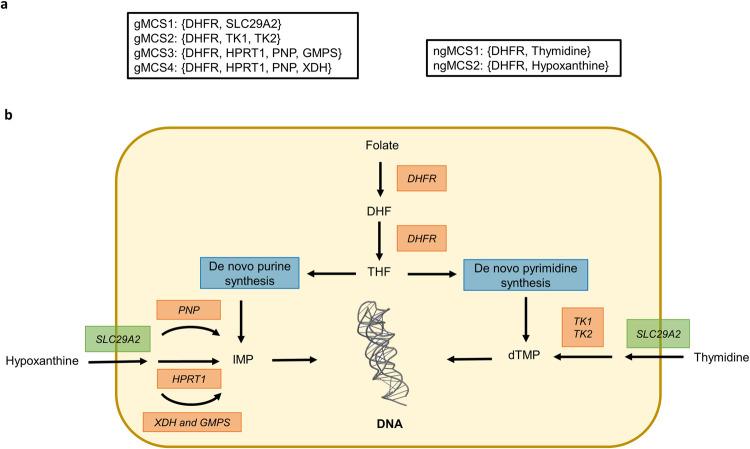
Synthetic Lethality (SL) is currently defined as a type of genetic interaction in which the loss of function of either of two genes individually has limited effect in cell viability but inactivation of both genes simultaneously leads to cell death. Given the profound genomic aberrations acquired by tumor cells, which can be systematically identified with -omics data, SL is a promising concept in cancer research. In particular, SL has received much attention in the area of cancer metabolism, due to the fact that relevant functional alterations concentrate on key metabolic pathways that promote cellular proliferation. With the extensive prior knowledge about human metabolic networks, a number of computational methods have been developed to predict SL in cancer metabolism, including the genetic Minimal Cut Sets (gMCSs) approach. A major challenge in the application of SL approaches to cancer metabolism is to systematically integrate tumor microenvironment, given that genetic interactions and nutritional availability are interconnected to support proliferation. Here, we propose a more general definition of SL for cancer metabolism that combines genetic and environmental interactions, namely loss of gene functions and absence of nutrients in the environment. We extend our gMCSs approach to determine this new family of metabolic synthetic lethal interactions. A computational and experimental proof-of-concept is presented for predicting the lethality of dihydrofolate reductase (DHFR) inhibition in different environments. Finally, our approach is applied to identify extracellular nutrient dependences of tumor cells, elucidating cholesterol and myo-inositol depletion as potential vulnerabilities in different malignancies.
合成致死性 (SL) 目前被定义为一种遗传相互作用类型,其中两个基因中任何一个基因的功能丧失单独对细胞活力的影响有限,但两个基因同时失活会导致细胞死亡。鉴于肿瘤细胞获得的深刻基因组异常,可以通过组学数据系统地识别,SL 是癌症研究中的一个有前途的概念。特别是,由于相关的功能改变集中在促进细胞增殖的关键代谢途径上,因此 SL 在癌症代谢领域受到了广泛关注。由于对人类代谢网络有广泛的先验知识,已经开发了许多计算方法来预测癌症代谢中的 SL,包括遗传最小割集 (gMCS) 方法。将 SL 方法应用于癌症代谢的一个主要挑战是系统地整合肿瘤微环境,因为遗传相互作用和营养可用性相互关联以支持增殖。在这里,我们提出了一个更一般的癌症代谢 SL 定义,它结合了遗传和环境相互作用,即基因功能的丧失和环境中营养物质的缺乏。我们扩展了我们的 gMCS 方法来确定这种新的代谢合成致死相互作用家族。提出了一种计算和实验概念验证,用于预测不同环境中二氢叶酸还原酶 (DHFR) 抑制的致死性。最后,我们的方法被应用于识别肿瘤细胞的细胞外营养依赖性,阐明胆固醇和肌醇耗尽是不同恶性肿瘤的潜在弱点。



 Zotero 插件