
双管齐下:现成的双 CAR NK-92 细胞靶向治疗 B 细胞恶性肿瘤中的 BCMA 和 CD19。
Two for one: targeting BCMA and CD19 in B-cell malignancies with off-the-shelf dual-CAR NK-92 cells.
机构信息
Laboratory of Experimental Hematology, Vaccine & Infectious Disease Institute (VAXINFECTIO), Faculty of Medicine and Health Sciences, University of Antwerp, 2650, Edegem, Belgium.
Division of Hematology, Antwerp University Hospital, Drie Eikenstraat 655, 2650, Edegem, Belgium.
出版信息
J Transl Med. 2022 Mar 14;20(1):124. doi: 10.1186/s12967-022-03326-6.
BACKGROUND
Chimeric antigen receptor (CAR) T-cell therapy has proven to be a valuable new treatment option for patients with B-cell malignancies. However, by applying selective pressure, outgrowth of antigen-negative tumor cells can occur, eventually resulting in relapse. Subsequent rescue by administration of CAR-T cells with different antigen-specificity indicates that those tumor cells are still sensitive to CAR-T treatment and points towards a multi-target strategy. Due to their natural tumor sensitivity and highly cytotoxic nature, natural killer (NK) cells are a compelling alternative to T cells, especially considering the availability of an off-the-shelf unlimited supply in the form of the clinically validated NK-92 cell line.
METHODS
Given our goal to develop a flexible system whereby the CAR expression repertoire of the effector cells can be rapidly adapted to the changing antigen expression profile of the target cells, electrotransfection with CD19-/BCMA-CAR mRNA was chosen as CAR loading method in this study. We evaluated the functionality of mRNA-engineered dual-CAR NK-92 against tumor B-cell lines and primary patient samples. In order to test the clinical applicability of the proposed cell therapy product, the effect of irradiation on the proliferative rate and functionality of dual-CAR NK-92 cells was investigated.
RESULTS
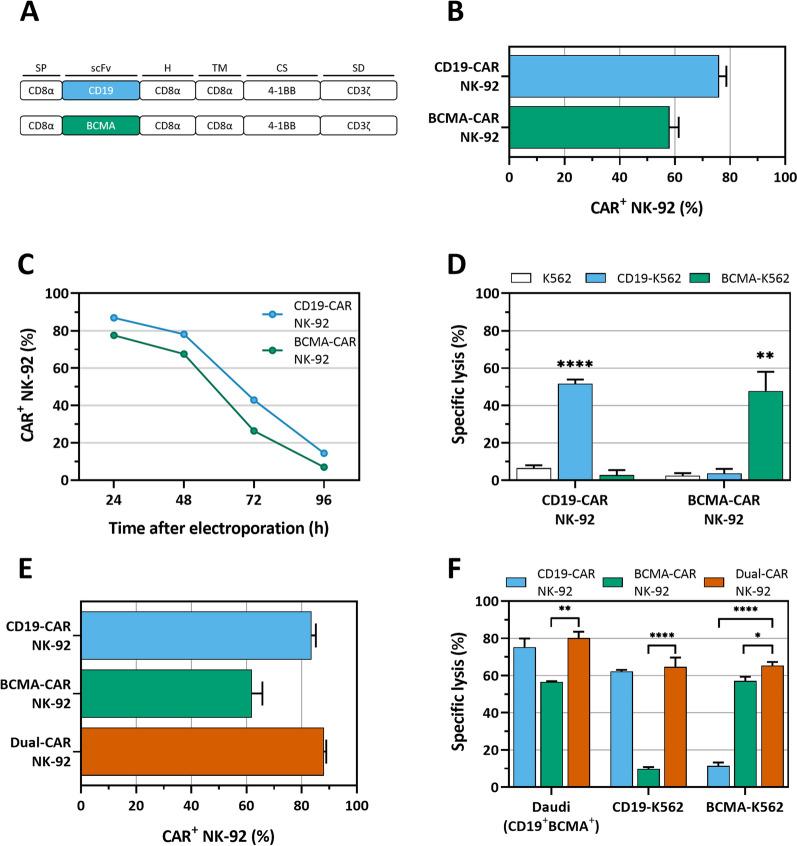
Co-electroporation of CD19 and BMCA CAR mRNA was highly efficient, resulting in 88.1% dual-CAR NK-92 cells. In terms of CD107a degranulation, and secretion of interferon (IFN)-γ and granzyme B, dual-CAR NK-92 significantly outperformed single-CAR NK-92. More importantly, the killing capacity of dual-CAR NK-92 exceeded 60% of single and dual antigen-expressing cell lines, as well as primary tumor cells, in a 4h co-culture assay at low effector to target ratios, matching that of single-CAR counterparts. Furthermore, our results confirm that dual-CAR NK-92 irradiated with 10 Gy cease to proliferate and are gradually cleared while maintaining their killing capacity.
CONCLUSIONS
Here, using the clinically validated NK-92 cell line as a therapeutic cell source, we established a readily accessible and flexible platform for the generation of highly functional dual-targeted CAR-NK cells.
背景
嵌合抗原受体(CAR)T 细胞疗法已被证明是治疗 B 细胞恶性肿瘤患者的一种有价值的新治疗选择。然而,通过施加选择性压力,抗原阴性肿瘤细胞的生长会发生,最终导致复发。随后通过给予具有不同抗原特异性的 CAR-T 细胞进行挽救表明,这些肿瘤细胞仍然对 CAR-T 治疗敏感,并指向多靶点策略。由于其自然的肿瘤敏感性和高细胞毒性,自然杀伤(NK)细胞是 T 细胞的一个很有吸引力的替代品,尤其是考虑到可以使用临床验证的 NK-92 细胞系作为现成的、无限供应的方式。
方法
鉴于我们的目标是开发一种灵活的系统,使效应细胞的 CAR 表达谱能够快速适应靶细胞不断变化的抗原表达谱,因此在这项研究中选择电穿孔转染 CD19-/BCMA-CAR mRNA 作为 CAR 加载方法。我们评估了针对肿瘤 B 细胞系和原代患者样本的 mRNA 工程双 CAR NK-92 的功能。为了测试所提出的细胞治疗产品的临床适用性,研究了辐照对双 CAR NK-92 细胞增殖率和功能的影响。
结果
CD19 和 BMCA CAR mRNA 的共电穿孔非常高效,导致 88.1%的双 CAR NK-92 细胞。在 CD107a 脱颗粒以及干扰素(IFN)-γ和颗粒酶 B 的分泌方面,双 CAR NK-92 明显优于单 CAR NK-92。更重要的是,在低效应细胞与靶细胞比的 4 小时共培养测定中,双 CAR NK-92 的杀伤能力超过了 60%的单抗原和双抗原表达细胞系以及原代肿瘤细胞,与单 CAR 对应物相当。此外,我们的结果证实,10 Gy 照射的双 CAR NK-92 停止增殖并逐渐清除,同时保持其杀伤能力。
结论
在这里,我们使用临床验证的 NK-92 细胞系作为治疗性细胞来源,为生成高度功能性的双靶向 CAR-NK 细胞建立了一个易于获得和灵活的平台。



 Zotero 插件