
醛脱氢酶同工型在抗癌治疗耐药性中的新作用
Emerging Roles of Aldehyde Dehydrogenase Isoforms in Anti-cancer Therapy Resistance.
作者信息
Zanoni Michele, Bravaccini Sara, Fabbri Francesco, Arienti Chiara
机构信息
Biosciences Laboratory,IRCCS Istituto Romagnolo per lo Studio dei Tumori (IRST) "Dino Amadori", Meldola, Italy.
出版信息
Front Med (Lausanne). 2022 Mar 1;9:795762. doi: 10.3389/fmed.2022.795762. eCollection 2022.
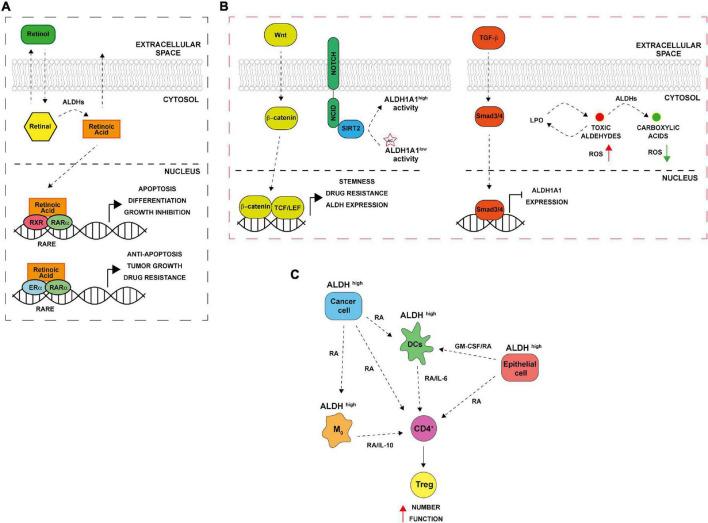
Aldehyde dehydrogenases (ALDHs) are a family of detoxifying enzymes often upregulated in cancer cells and associated with therapeutic resistance. In humans, the ALDH family comprises 19 isoenzymes active in the majority of mammalian tissues. Each ALDH isoform has a specific differential expression pattern and most of them have individual functional roles in cancer. ALDHs are overexpressed in subpopulations of cancer cells with stem-like features, where they are involved in several processes including cellular proliferation, differentiation, detoxification and survival, participating in lipids and amino acid metabolism and retinoic acid synthesis. In particular, ALDH enzymes protect cancer cells by metabolizing toxic aldehydes in less reactive and more soluble carboxylic acids. High metabolic activity as well as conventional anticancer therapies contribute to aldehyde accumulation, leading to DNA double strand breaks (DSB) through the generation of reactive oxygen species (ROS) and lipid peroxidation. ALDH overexpression is crucial not only for the survival of cancer stem cells but can also affect immune cells of the tumour microenvironment (TME). The reduction of ROS amount and the increase in retinoic acid signaling impairs immunogenic cell death (ICD) inducing the activation and stability of immunosuppressive regulatory T cells (Tregs). Dissecting the role of ALDH specific isoforms in the TME can open new scenarios in the cancer treatment. In this review, we summarize the current knowledge about the role of ALDH isoforms in solid tumors, in particular in association with therapy-resistance.
醛脱氢酶(ALDHs)是一类解毒酶,在癌细胞中常上调表达,并与治疗耐药性相关。在人类中,ALDH家族由19种在大多数哺乳动物组织中具有活性的同工酶组成。每种ALDH同工型都有特定的差异表达模式,其中大多数在癌症中具有各自的功能作用。ALDHs在具有干细胞样特征的癌细胞亚群中过表达,它们参与包括细胞增殖、分化、解毒和存活在内的多个过程,参与脂质和氨基酸代谢以及视黄酸合成。特别是,ALDH酶通过将有毒醛代谢为反应性较低且更易溶解的羧酸来保护癌细胞。高代谢活性以及传统抗癌疗法会导致醛积累,通过产生活性氧(ROS)和脂质过氧化导致DNA双链断裂(DSB)。ALDH过表达不仅对癌症干细胞的存活至关重要,但也会影响肿瘤微环境(TME)的免疫细胞。ROS量的减少和视黄酸信号的增加会损害免疫原性细胞死亡(ICD),诱导免疫抑制调节性T细胞(Tregs)的激活和稳定性。剖析ALDH特定同工型在TME中的作用可以为癌症治疗开辟新的前景。在这篇综述中,我们总结了关于ALDH同工型在实体瘤中的作用,特别是与治疗耐药性相关的当前知识。
 Zotero 插件