
超声与纳米材料:抗癌的高效组合。
Ultrasound and nanomaterial: an efficient pair to fight cancer.
机构信息
Sorbonne Université, Muséum National d'Histoire Naturelle, UMR CNRS, 7590, IRD, Institut de Minéralogie, de Physique des Matériaux et de. Cosmochimie, IMPMC, 75005, Paris, France.
Nanobacterie SARL, 36 boulevard Flandrin, 75116, Paris, France.
出版信息
J Nanobiotechnology. 2022 Mar 18;20(1):139. doi: 10.1186/s12951-022-01243-w.
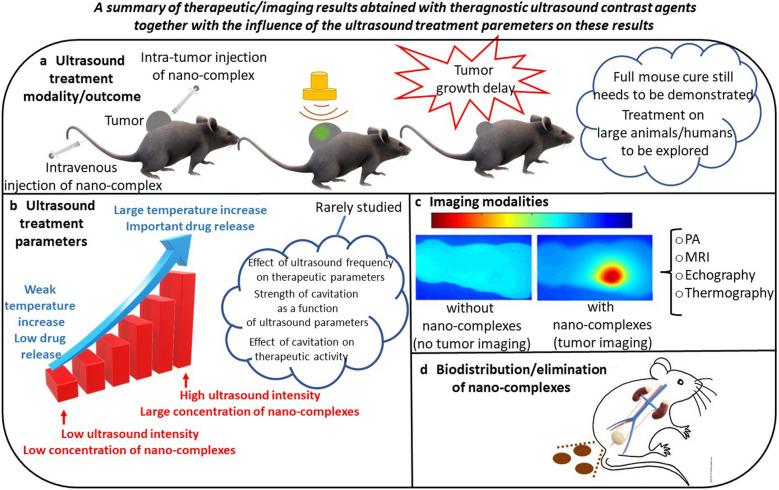
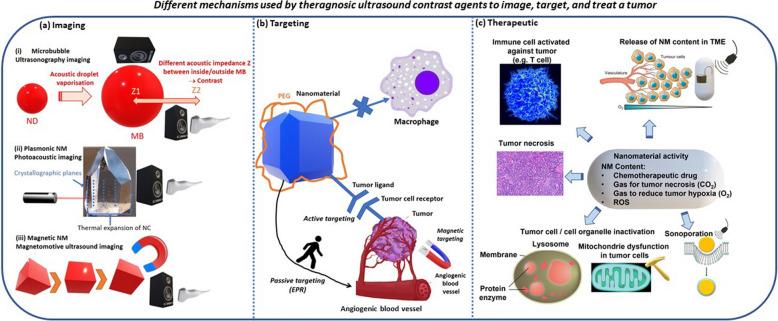
Ultrasounds are often used in cancer treatment protocols, e.g. to collect tumor tissues in the right location using ultrasound-guided biopsy, to image the region of the tumor using more affordable and easier to use apparatus than MRI and CT, or to ablate tumor tissues using HIFU. The efficacy of these methods can be further improved by combining them with various nano-systems, thus enabling: (i) a better resolution of ultrasound imaging, allowing for example the visualization of angiogenic blood vessels, (ii) the specific tumor targeting of anti-tumor chemotherapeutic drugs or gases attached to or encapsulated in nano-systems and released in a controlled manner in the tumor under ultrasound application, (iii) tumor treatment at tumor site using more moderate heating temperatures than with HIFU. Furthermore, some nano-systems display adjustable sizes, i.e. nanobubbles can grow into micro-bubbles. Such dual size is advantageous since it enables gathering within the same unit the targeting properties of nano bubbles via EPR effect and the enhanced ultrasound contrasting properties of micro bubbles. Interestingly, the way in which nano-systems act against a tumor could in principle also be adjusted by accurately selecting the nano-system among a large choice and by tuning the values of the ultrasound parameters, which can lead, due to their mechanical nature, to specific effects such as cavitation that are usually not observed with purely electromagnetic waves and can potentially help destroying the tumor. This review highlights the clinical potential of these combined treatments that can improve the benefit/risk ratio of current cancer treatments.
超声技术常用于癌症治疗方案中,例如,通过超声引导活检在正确的位置采集肿瘤组织,使用比 MRI 和 CT 更经济实惠且易于操作的仪器对肿瘤区域进行成像,或使用 HIFU 消融肿瘤组织。通过将这些方法与各种纳米系统结合使用,可以进一步提高它们的疗效,从而实现:(i) 提高超声成像的分辨率,例如可视化血管生成的血管,(ii) 将附着在纳米系统上或封装在纳米系统中的抗肿瘤化疗药物或气体靶向特定肿瘤,并在超声应用下在肿瘤中以受控的方式释放,(iii) 在肿瘤部位使用比 HIFU 更温和的加热温度进行肿瘤治疗。此外,一些纳米系统显示出可调节的尺寸,即纳米气泡可以生长成微气泡。这种双尺寸是有利的,因为它可以使同一单位内的纳米气泡通过 EPR 效应的靶向特性和微气泡的增强超声对比特性结合在一起。有趣的是,通过在大量选择中准确选择纳米系统并调整超声参数的值,原则上也可以调整纳米系统对肿瘤的作用方式,这可能导致由于其机械性质而产生的特定效应,如空化,这些效应通常不会与纯电磁波一起观察到,并可能有助于破坏肿瘤。这篇综述强调了这些联合治疗的临床潜力,可以提高当前癌症治疗的获益/风险比。

 Zotero 插件