
改善 CAR-T 免疫疗法:克服 T 细胞耗竭的挑战。
Improving CAR-T immunotherapy: Overcoming the challenges of T cell exhaustion.
机构信息
Irell and Manella Graduate School of Biological Sciences, City of Hope National Medical Center, Beckman Research Institute, Duarte CA, United States; Department of Immunooncology, City of Hope National Medical Center, Beckman Research Institute, Duarte, CA, United States.
Irell and Manella Graduate School of Biological Sciences, City of Hope National Medical Center, Beckman Research Institute, Duarte CA, United States; Department of Immunooncology, City of Hope National Medical Center, Beckman Research Institute, Duarte, CA, United States; Department of Pediatrics, City of Hope National Medical Center, Duarte, CA, United States.
出版信息
EBioMedicine. 2022 Mar;77:103941. doi: 10.1016/j.ebiom.2022.103941. Epub 2022 Mar 15.
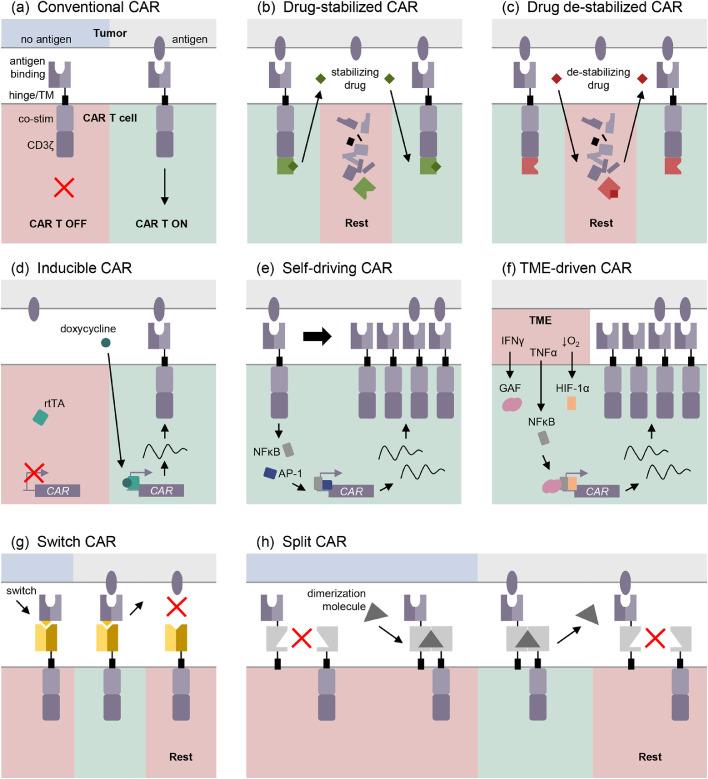
Chimeric antigen receptor (CAR) T cell therapy has emerged as a cancer treatment with enormous potential, demonstrating impressive antitumor activity in the treatment of hematological malignancies. However, CAR T cell exhaustion is a major limitation to their efficacy, particularly in the application of CAR T cells to solid tumors. CAR T cell exhaustion is thought to be due to persistent antigen stimulation, as well as an immunosuppressive tumor microenvironment, and mitigating exhaustion to maintain CAR T cell effector function and persistence and achieve clinical potency remains a central challenge. Here, we review the underlying mechanisms of exhaustion and discuss emerging strategies to prevent or reverse exhaustion through modifications of the CAR receptor or CAR independent pathways. Additionally, we discuss the potential of these strategies for improving clinical outcomes of CAR T cell therapy.
嵌合抗原受体 (CAR) T 细胞疗法作为一种癌症治疗方法具有巨大的潜力,在治疗血液系统恶性肿瘤方面显示出令人印象深刻的抗肿瘤活性。然而,CAR T 细胞耗竭是其疗效的主要限制因素,特别是在将 CAR T 细胞应用于实体瘤方面。CAR T 细胞耗竭被认为是由于持续的抗原刺激以及免疫抑制性肿瘤微环境,减轻耗竭以维持 CAR T 细胞效应功能和持久性并实现临床效力仍然是一个核心挑战。在这里,我们综述了耗竭的潜在机制,并讨论了通过修饰 CAR 受体或 CAR 独立途径来预防或逆转耗竭的新策略。此外,我们还讨论了这些策略在改善 CAR T 细胞治疗临床效果方面的潜力。


 Zotero 插件