
2020 年 4 月至 6 月,芬兰采用过氧化氢蒸汽对一次性 FFP2 和 FFP3 呼吸器进行大规模消毒。
Large-scale decontamination of disposable FFP2 and FFP3 respirators by hydrogen peroxide vapour, Finland, April to June 2020.
机构信息
Department of Separation Science, Lappeenranta-Lahti University of Technology LUT, Lappeenranta, Finland.
LAB University of Applied Science, Lappeenranta and Lahti, Finland.
出版信息
Euro Surveill. 2022 Mar;27(11). doi: 10.2807/1560-7917.ES.2022.27.11.2100119.
BackgroundThe shortage of FFP2 and FFP3 respirators posed a serious threat to the operation of the healthcare system at the onset of the COVID-19 pandemic.AimOur aim was to develop and validate a large-scale facility that uses hydrogen peroxide vapour for the decontamination of used respirators.MethodsA multidisciplinary and multisectoral ad hoc group of experts representing various organisations was assembled to implement the collection and transport of used FFP2 and FFP3 respirators from hospitals covering 86% of the Finnish population. A large-scale decontamination facility using hydrogen peroxide vapour was designed and constructed. Microbiological tests were used to confirm efficacy of hydrogen peroxide vapour decontamination together with a test to assess the effect of decontamination on the filtering efficacy and fit of respirators. Bacterial and fungal growth in stored respirators was determined by standard methods.ResultsLarge-scale hydrogen peroxide vapour decontamination of a range of FFP2 and FFP3 respirator models effectively reduced the recovery of biological indicators: and spores, as well as model virus bacteriophage MS2. The filtering efficacy and facial fit after hydrogen peroxide vapour decontamination were not affected by the process. Microbial growth in the hydrogen peroxide vapour-treated respirators indicated appropriate microbial cleanliness.ConclusionsLarge-scale hydrogen peroxide vapour decontamination was validated. After effective decontamination, no significant changes in the key properties of the respirators were detected. European Union regulations should incorporate a facilitated pathway to allow reuse of appropriately decontaminated respirators in a severe pandemic when unused respirators are not available.
背景
在 COVID-19 大流行初期,FFP2 和 FFP3 呼吸器短缺对医疗保健系统的运作构成了严重威胁。
目的
我们的目的是开发和验证一个大规模的设施,该设施使用过氧化氢蒸气对用过的呼吸器进行消毒。
方法
一个由代表各种组织的多学科和多部门专门小组的专家组成,负责收集和运输来自覆盖芬兰 86%人口的医院的用过的 FFP2 和 FFP3 呼吸器。设计并建造了一个使用过氧化氢蒸气的大规模消毒设施。使用微生物测试来确认过氧化氢蒸气消毒的效果,同时测试评估消毒对呼吸器过滤效率和贴合度的影响。通过标准方法确定储存呼吸器中的细菌和真菌生长情况。
结果
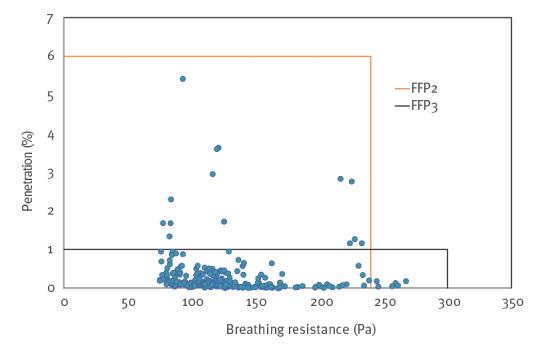
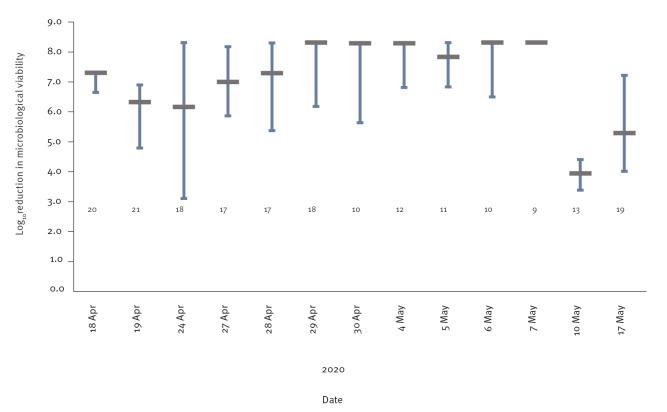
对各种 FFP2 和 FFP3 呼吸器模型进行大规模过氧化氢蒸气消毒可有效减少生物指示剂的回收:芽孢 和 孢子,以及模型病毒噬菌体 MS2。过氧化氢蒸气消毒后,过滤效率和面部贴合度不受该过程影响。过氧化氢蒸气处理后的呼吸器中的微生物生长表明微生物清洁度适宜。
结论
大规模过氧化氢蒸气消毒得到了验证。经过有效消毒后,呼吸器的关键性能未发生明显变化。当无法获得未使用的呼吸器时,欧盟法规应纳入一个便利途径,允许在严重大流行期间重复使用经过适当消毒的呼吸器。


 Zotero 插件