
Toll样受体信号传导及其在细胞介导免疫中的作用。
Toll-Like Receptor Signaling and Its Role in Cell-Mediated Immunity.
作者信息
Duan Tianhao, Du Yang, Xing Changsheng, Wang Helen Y, Wang Rong-Fu
机构信息
Department of Medicine, Keck School of Medicine, University of Southern California, Los Angeles, CA, United States.
Department of Pediatrics, Children's Hospital Los Angeles, Keck School of Medicine, University of Southern California, Los Angeles, CA, United States.
出版信息
Front Immunol. 2022 Mar 3;13:812774. doi: 10.3389/fimmu.2022.812774. eCollection 2022.
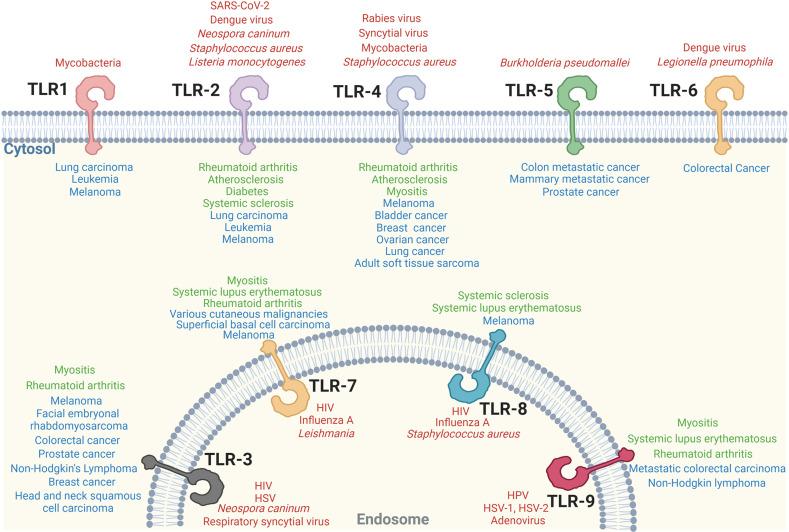
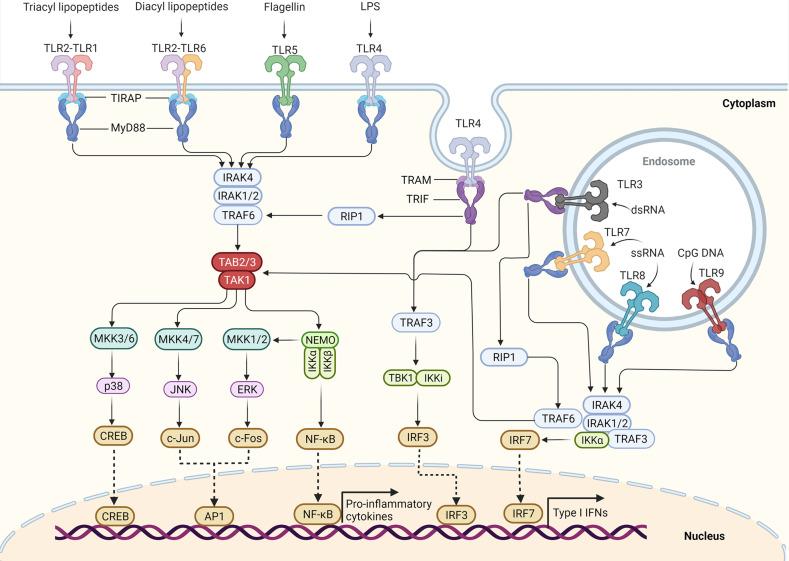
Innate immunity is the first defense system against invading pathogens. Toll-like receptors (TLRs) are well-defined pattern recognition receptors responsible for pathogen recognition and induction of innate immune responses. Since their discovery, TLRs have revolutionized the field of immunology by filling the gap between the initial recognition of pathogens by innate immune cells and the activation of the adaptive immune response. TLRs critically link innate immunity to adaptive immunity by regulating the activation of antigen-presenting cells and key cytokines. Furthermore, recent studies also have shown that TLR signaling can directly regulate the T cell activation, growth, differentiation, development, and function under diverse physiological conditions. This review provides an overview of TLR signaling pathways and their regulators and discusses how TLR signaling, directly and indirectly, regulates cell-mediated immunity. In addition, we also discuss how TLR signaling is critically important in the host's defense against infectious diseases, autoimmune diseases, and cancer.
固有免疫是抵御入侵病原体的第一道防御系统。Toll样受体(TLRs)是明确的模式识别受体,负责病原体识别和固有免疫反应的诱导。自发现以来,TLRs通过填补固有免疫细胞对病原体的初始识别与适应性免疫反应激活之间的空白,彻底改变了免疫学领域。TLRs通过调节抗原呈递细胞和关键细胞因子的激活,将固有免疫与适应性免疫紧密联系起来。此外,最近的研究还表明,TLR信号传导可在多种生理条件下直接调节T细胞的激活、生长、分化、发育和功能。本综述概述了TLR信号通路及其调节因子,并讨论了TLR信号传导如何直接和间接地调节细胞介导的免疫。此外,我们还讨论了TLR信号传导在宿主抵御传染病、自身免疫性疾病和癌症中的关键重要性。

 Zotero 插件