
2013 - 2018年瑞典某地区跨性别青少年和成年人的生育力保存与生育治疗
Fertility preservation and fertility treatment in transgender adolescents and adults in a Swedish region, 2013-2018.
作者信息
Mattelin Ellenor, Strandell Annika, Bryman Inger
机构信息
Department of Obstetrics and Gynaecology, Sahlgrenska University Hospital, Gothenburg, Sweden.
Department of Obstetrics and Gynaecology, Institute of Clinical Sciences, Sahlgrenska Academy, University of Gothenburg, Gothenburg, Sweden.
出版信息
Hum Reprod Open. 2022 Feb 21;2022(2):hoac008. doi: 10.1093/hropen/hoac008. eCollection 2022.
STUDY QUESTION
In a transgender population referred for fertility consultation, which factors influence the decision to cryopreserve oocytes and sperm?
SUMMARY ANSWER
Previous hormonal treatment, gender affirmation surgery and sexual orientation were associated with the decision to undergo fertility preservation and transgender women underwent fertility preservation more frequently than transgender men.
WHAT IS KNOWN ALREADY
It is well-known internationally that fertility preservation and fertility treatment are increasingly requested by transgender men and women. Factors affecting their decisions as well as treatment differences between transgender women and transgender men have been reported, but many studies have had low participation rates and small sample sizes.
STUDY DESIGN SIZE DURATION
This retrospective cohort study, conducted during 2013-2018, included 78 transgender women (assigned male at birth and referred for sperm cryopreservation) and 164 transgender men (assigned female at birth referred for oocyte cryopreservation).
PARTICIPANTS/MATERIALS SETTING METHODS: In 2013, the previous requirement for sterilization before completion of a legal gender change was removed in Sweden. All fertile-aged transgender men and transgender women referred to a tertiary care centre for consultation concerning fertility preservation, fertility treatment or hysterectomy were identified from administrative systems. Demographic, medical and treatment data were extracted from electronic medical records and from an ART database. Logistic regression was applied to analyse factors affecting the decision to cryopreserve gametes among transgender men and transgender women.
MAIN RESULTS AND THE ROLE OF CHANCE
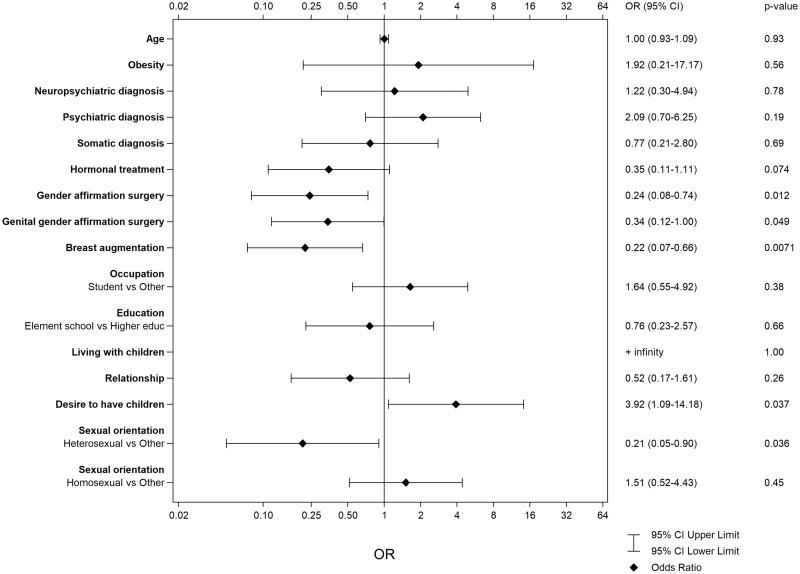
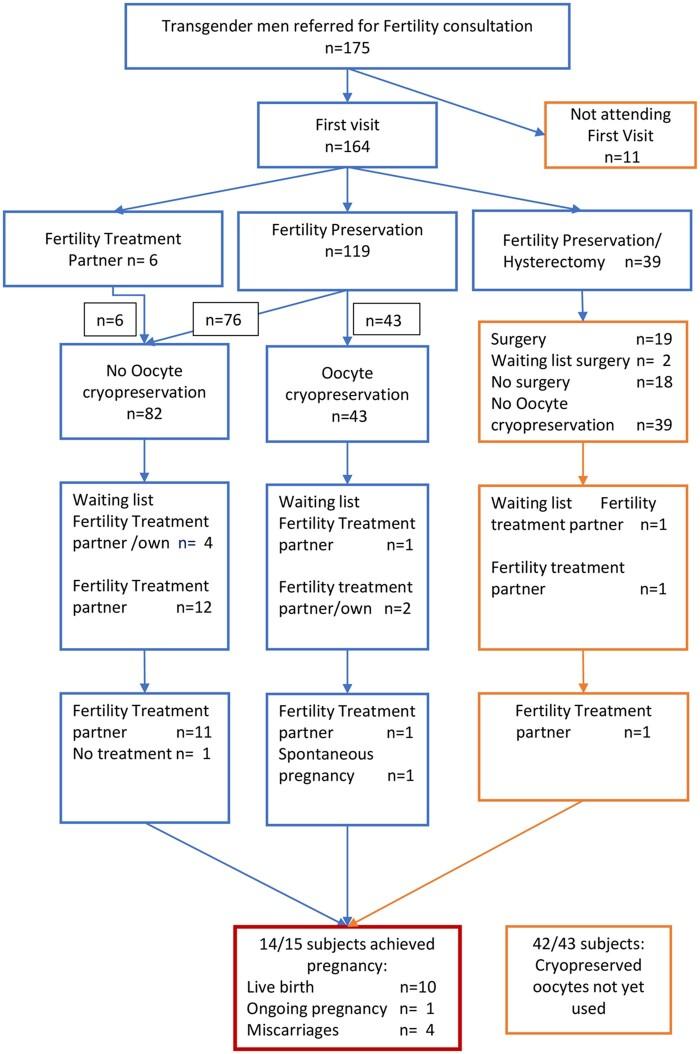
A majority of transgender men (69.5%) and transgender women (82%), wanted to become parents. Fertility preservation was less frequent in transgender men than in transgender women (26.2% versus 75.6%, respectively). No individuals among those primarily referred for hysterectomy opted for cryopreservation of oocytes. Among transgender men, young age, no previous hormonal treatment and stating homosexual orientation were independent factors associated with the decision to cryopreserve oocytes. Among transgender women, the decision to undergo gender affirmation surgery and stating heterosexual orientation were independent factors associated with a decision to refrain from fertility preservation. Fertility treatments, using IUI or IVF with donor sperm, were mainly performed in partners of transgender men. Ten live births were reported in the group of transgender men and two for transgender women.
LIMITATIONS REASONS FOR CAUTION
The main limitation is the retrospective nature of the study, with missing data for many variables. The short study period and the study population being too young to permit observation of long-term outcomes of fertility preservation and fertility treatments are reasons for caution.
WIDER IMPLICATIONS OF THE FINDINGS
Our results confirm that fertility preservation has been requested by transgender people since the change in Swedish legislation in 2013. Information about aspects of fertility early in the transition process is important, since hormonal and surgical treatments may have a large impact on the decision to undergo fertility preservation. It is important to train fertility clinic staff to identify and handle the specific obstacles, as well as address the need for information and support that transgender people may have when planning for fertility preservation, fertility treatment and pregnancy.
STUDY FUNDING/COMPETING INTERESTS: This research was supported by a grant from the Swedish state, under the ALF agreement between the Swedish government and the county councils (ALFGBG-720291), and by Hjalmar Svensson's Research Foundation. None of the authors has any conflict of interest to declare.
TRIAL REGISTRATION NUMBER
N/A.
研究问题
在寻求生育咨询的跨性别群体中,哪些因素会影响卵母细胞和精子冷冻保存的决定?
总结答案
既往激素治疗、性别确认手术和性取向与生育力保存的决定相关,且跨性别女性比跨性别男性更频繁地进行生育力保存。
已知信息
国际上众所周知,跨性别男性和女性对生育力保存和生育治疗的需求日益增加。已有报道称影响他们决定的因素以及跨性别女性和跨性别男性之间的治疗差异,但许多研究参与率低且样本量小。
研究设计规模持续时间
这项回顾性队列研究在2013年至2018年期间进行,纳入了78名跨性别女性(出生时被指定为男性并前来进行精子冷冻保存)和164名跨性别男性(出生时被指定为女性并前来进行卵母细胞冷冻保存)。
参与者/材料设置方法:2013年,瑞典取消了在完成合法性别变更之前进行绝育的先前要求。从行政系统中识别出所有转诊至三级医疗中心咨询生育力保存、生育治疗或子宫切除术的育龄跨性别男性和跨性别女性。从电子病历和辅助生殖技术数据库中提取人口统计学、医学和治疗数据。应用逻辑回归分析影响跨性别男性和跨性别女性冷冻配子决定的因素。
主要结果及机遇的作用
大多数跨性别男性(69.5%)和跨性别女性(82%)希望成为父母。跨性别男性进行生育力保存的频率低于跨性别女性(分别为26.2%和75.6%)。主要因子宫切除术前来咨询的人群中无人选择卵母细胞冷冻保存。在跨性别男性中,年轻、既往未接受激素治疗以及表明同性恋取向是与卵母细胞冷冻保存决定相关的独立因素。在跨性别女性中,进行性别确认手术的决定以及表明异性恋取向是与放弃生育力保存决定相关的独立因素。使用宫内人工授精或供精体外受精的生育治疗主要在跨性别男性的伴侣中进行。跨性别男性组报告了10例活产,跨性别女性组报告了2例。
局限性谨慎的原因
主要局限性是研究的回顾性性质,许多变量存在数据缺失。研究周期短且研究人群过于年轻,无法观察生育力保存和生育治疗的长期结果,这些都是需要谨慎的原因。
研究结果的更广泛影响
我们的结果证实,自2013年瑞典立法变更以来,跨性别者一直有生育力保存的需求。在过渡过程早期提供有关生育方面的信息很重要,因为激素和手术治疗可能对生育力保存的决定有很大影响。培训生育诊所工作人员识别和处理特定障碍,以及满足跨性别者在计划生育力保存、生育治疗和怀孕时可能有的信息和支持需求非常重要。
研究资金/利益冲突:本研究得到瑞典国家的一项资助,该资助依据瑞典政府与郡议会之间的ALF协议(ALFGBG - 720291),并得到Hjalmar Svensson研究基金会的支持。作者均无利益冲突需要声明。
试验注册号
无。


 Zotero 插件