
对接受带刺被动正畸治疗的前牙开牙合儿童的牙周参数和龈沟液细胞因子的评估。
Evaluation of periodontal parameters and gingival crevicular fluid cytokines in children with anterior open bite receiving passive orthodontic treatment with a spur.
作者信息
Tou Gabriel Antônio Dos Anjos, Diniz Ivana Márcia Alves, Ferreira Marcus Vinicius Lucas, Mesquita Ricardo Alves de, Yamauti Mônica, Silva Tarcília Aparecida, Macari Soraia
机构信息
Department of Restorative Dentistry, Faculty of Dentistry, Federal University of Minas Gerais, Belo Horizonte, Minas Gerais, Brazil.
Department of Oral Pathology and Surgery, Faculty of Dentistry, Federal University of Minas Gerais, Belo Horizonte, Minas Gerais, Brazil.
出版信息
Korean J Orthod. 2022 Mar 25;52(2):142-149. doi: 10.4041/kjod.2022.52.2.142.
OBJECTIVE
To evaluate clinical parameters and gingival crevicular fluid (GCF) cytokines in children with anterior open bite receiving passive orthodontic treatment with spurs.
METHODS
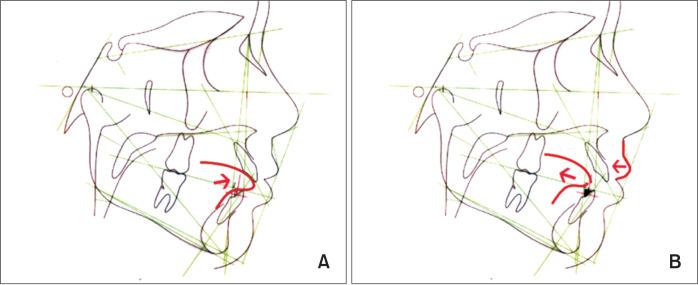
Twenty children with indications for interceptive orthodontic treatment, an anterior open bite, and good oral hygiene and periodontal health were included in this study. GCF samples were collected from the mandibular and maxillary central incisors before (baseline) and 24 hours and 7 days after spur bonding. Clinical and periodontal examinations and cytokine analyses were performed.
RESULTS
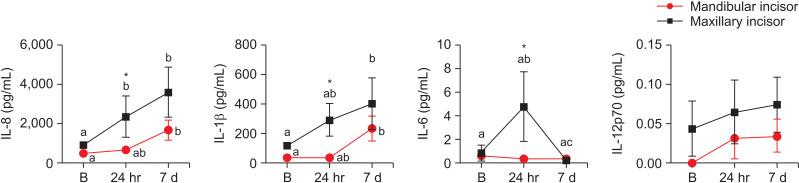
At 7 days after spur attachment, gingival bleeding in the mandibular group was increased relative to that in the maxillary group. Visible plaque was correlated with gingival bleeding at 7 days and the GCF volume at 24 hours after spur attachment. Compared with those at baseline, interleukin (IL)-8 levels in the maxillary group and IL-1β levels in both tooth groups increased at both 24 hours and 7 days and at 7 days, respectively. At 24 hours, IL-8, IL-1β, and IL-6 levels were higher in the maxillary group than in the mandibular group. Cytokine production was positively correlated with increased GCF volume, but not with gingival bleeding, visible plaque, or probing depth.
CONCLUSIONS
Although orthodontic treatment with spurs in children resulted in increased gingival bleeding around the mandibular incisors, IL levels were higher around the maxillary incisors and not correlated with periodontal parameters. Increased cytokine levels in GCF may be associated with the initial tooth movement during open bite correction with a passive orthodontic appliance in children.
目的
评估接受带刺矫治器被动正畸治疗的前牙开牙合儿童的临床参数和龈沟液(GCF)细胞因子。
方法
本研究纳入20名有阻断性正畸治疗指征、前牙开牙合且口腔卫生和牙周健康良好的儿童。在粘结矫治器前(基线)、粘结后24小时和7天,从下颌和上颌中切牙采集GCF样本。进行临床和牙周检查以及细胞因子分析。
结果
在粘结矫治器7天后,下颌组的牙龈出血相对于上颌组有所增加。可见菌斑与粘结矫治器7天后的牙龈出血以及24小时后的GCF量相关。与基线时相比,上颌组的白细胞介素(IL)-8水平在24小时和7天时均升高,而两组牙齿的IL-1β水平在7天时升高。在24小时时,上颌组的IL-8、IL-1β和IL-6水平高于下颌组。细胞因子产生与GCF量增加呈正相关,但与牙龈出血、可见菌斑或探诊深度无关。
结论
尽管儿童使用带刺矫治器进行正畸治疗会导致下颌切牙周围牙龈出血增加,但上颌切牙周围的IL水平更高,且与牙周参数无关。GCF中细胞因子水平升高可能与儿童使用被动正畸矫治器矫正开牙合期间的初始牙齿移动有关。

 Zotero 插件