
强调数据驱动的见解和持续参与的虚拟内分泌护理及其对未控制糖尿病患者血糖结果的影响:一项真实世界回顾性病例系列研究
Virtual Endocrinology Care Emphasizing Data-Driven Insights and Continuous Engagement and Its Impact on Glycemic Outcomes in Patients With Uncontrolled Diabetes: A Real-world Retrospective Case Series.
作者信息
Wu Calvin C, Wu Karin C, José Aimée S, Novin Niloufar
机构信息
Steady Health, Inc, San Francisco, CA, United States.
Endocrine Research Unit, San Francisco Veterans Affairs Health Care System, San Francisco, CA, United States.
出版信息
JMIR Diabetes. 2022 Mar 24;7(1):e30626. doi: 10.2196/30626.
BACKGROUND
Steady Health's novel virtual care model incorporates continuous glucose monitoring (CGM) and a multidisciplinary approach to timely person-centered diabetes care.
OBJECTIVE
This real-world retrospective case series explores the early glycemic outcomes of its patients with uncontrolled diabetes.
METHODS
All patients of Steady Health who had an initial time in range (TIR) below 70% from their first 4 weeks of available CGM data and who had completed onboarding by February 2021 were included in this analysis. We compared the change in TIR, time below range, and average blood glucose from their first 4 weeks with their latest 4 weeks of available CGM data. Hemoglobin A (HbA) values at baseline and at the end of the study were also compared. Patients completed a questionnaire assessing their satisfaction with Steady Health's intervention.
RESULTS
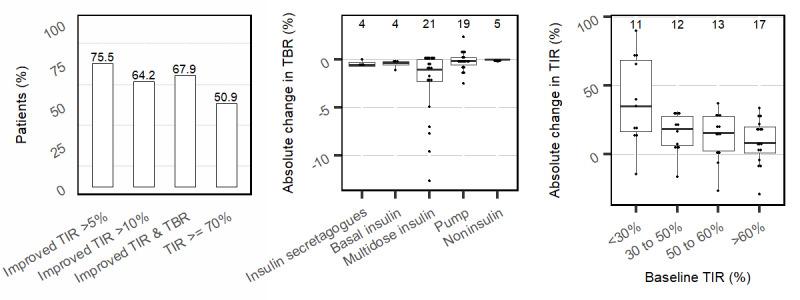
A total of 53 patients (n=35, 66% with type 1 diabetes; n=44, 83% treated with insulin) were included in this analysis. This cohort had a median baseline TIR of 53.0% (IQR 40.9%, 61.7%) and saw a median change in TIR of +16.6% (IQR +6.0%, +27.9%; P<.001) over a median duration of care of 11 months, amounting to nearly 4 more hours spent between 70 to 180 mg/dL a day. Of the 27 patients who had both baseline and follow-up HbA results, their median baseline HbA was 8.6% (IQR 7.5%, 11.4%; 70 mmol/mol), while their median change in HbA was -1.2% (IQR -2.6%, -0.2%; P=.001). Importantly, these glycemic improvements were achieved with a median decrease in the time below range by -0.3% (IQR -1.1%, 0.0%; P<.001), regardless of whether patients were started on an automated insulin delivery system. A total of 40 (75.5%) patients improved TIR by ≥5%, and 27 (50.9%) achieved TIR≥70% by the end of the study. Glycemic improvements were greatest among patients with the lowest baseline TIR and those who collaborated most intensively with Steady Health's clinicians. A total of 25 of these patients responded to a questionnaire assessing levels of satisfaction with their care, and all of them agreed that Steady Health had a positive impact on their diabetes management.
CONCLUSIONS
Our findings suggest that patients with uncontrolled diabetes can achieve significant glycemic improvements by working with a virtual multidisciplinary care team that uses CGM to provide continuous clinical feedback and support.
背景
稳健健康(Steady Health)的新型虚拟护理模式采用持续葡萄糖监测(CGM)和多学科方法,以提供及时的以患者为中心的糖尿病护理。
目的
本项真实世界回顾性病例系列研究探讨了其糖尿病控制不佳患者的早期血糖结局。
方法
纳入稳健健康的所有患者,这些患者从其最初4周的可用CGM数据来看,初始血糖达标时间(TIR)低于70%,且在2021年2月前完成了注册流程。我们比较了他们最初4周与最新4周可用CGM数据的TIR变化、低于目标范围的时间以及平均血糖。还比较了基线和研究结束时的糖化血红蛋白(HbA)值。患者完成了一份问卷,评估他们对稳健健康干预措施的满意度。
结果
本分析共纳入53例患者(n = 35,66%为1型糖尿病;n = 44,83%接受胰岛素治疗)。该队列的基线TIR中位数为53.0%(四分位间距[IQR] 40.9%,61.7%),在中位11个月的护理期间,TIR中位数变化为+16.6%(IQR +6.0%,+27.9%;P <.001),相当于每天在70至180 mg/dL之间的时间增加了近4小时。在27例有基线和随访HbA结果的患者中,他们的基线HbA中位数为8.6%(IQR 7.5%,11.4%;70 mmol/mol),而HbA的中位数变化为-1.2%(IQR -2.6%,-0.2%;P =.001)。重要的是,无论患者是否开始使用自动胰岛素输送系统,这些血糖改善都是在低于目标范围的时间中位数下降-0.3%(IQR -1.1%,0.0%;P <.001)的情况下实现的。共有40例(75.5%)患者的TIR改善≥5%,27例(50.9%)患者在研究结束时TIR≥70%。血糖改善在基线TIR最低的患者以及与稳健健康的临床医生合作最密切的患者中最为显著。其中共有25例患者回复了一份评估护理满意度水平的问卷,他们一致认为稳健健康对他们的糖尿病管理有积极影响。
结论
我们的研究结果表明,糖尿病控制不佳的患者通过与使用CGM提供持续临床反馈和支持的虚拟多学科护理团队合作,可以实现显著的血糖改善。
 Zotero 插件