
微流控辅助制备双层包覆 pH 敏感介孔硅纳米粒子用于蛋白质递送
Microfluidic-Assisted Fabrication of Dual-Coated pH-Sensitive Mesoporous Silica Nanoparticles for Protein Delivery.
机构信息
Pharmaceutical Sciences Laboratory, Faculty of Science and Engineering, Åbo Akademi University, 20500 Turku, Finland.
Department of Pharmaceutical Technology, Faculty of Pharmacy, Ankara University, Ankara 06560, Turkey.
出版信息
Biosensors (Basel). 2022 Mar 18;12(3):181. doi: 10.3390/bios12030181.
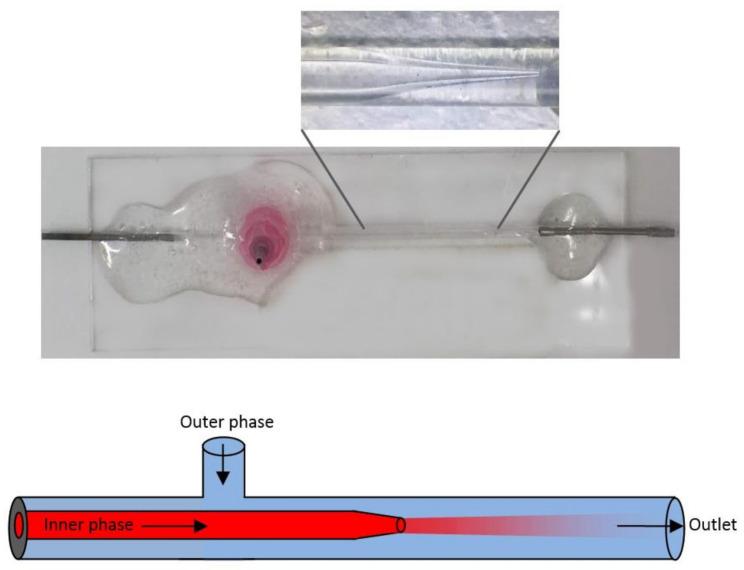
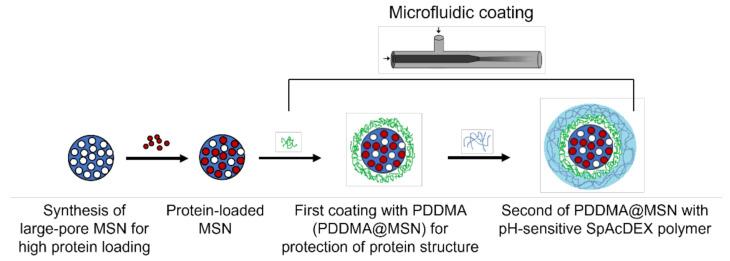
Microfluidics has become a popular method for constructing nanosystems in recent years, but it can also be used to coat other materials with polymeric layers. The polymeric coating may serve as a diffusion barrier against hydrophilic compounds, a responsive layer for controlled release, or a functional layer introduced to a nanocomposite for achieving the desired surface chemistry. In this study, mesoporous silica nanoparticles (MSNs) with enlarged pores were synthesized to achieve high protein loading combined with high protein retention within the MSN system with the aid of a microfluidic coating. Thus, MSNs were first coated with a cationic polyelectrolyte, poly (diallyldimethylammonium chloride) (PDDMA), and to potentially further control the protein release, a second coating of a pH-sensitive polymer (spermine-modified acetylated dextran, SpAcDEX) was deposited by a designed microfluidic device. The protective PDDMA layer was first formed under aqueous conditions, whereby the bioactivity of the protein could be maintained. The second coating polymer, SpAcDEX, was preferred to provide pH-sensitive protein release in the intracellular environment. The optimized formulation was effectively taken up by the cells along with the loaded protein cargo. This proof-of-concept study thus demonstrated that the use of microfluidic technologies for the design of protein delivery systems has great potential in terms of creating multicomponent systems and preserving protein stability.
近年来,微流控技术已成为构建纳米系统的一种流行方法,但它也可用于用聚合层涂覆其他材料。聚合涂层可以作为亲水性化合物的扩散屏障、用于控制释放的响应层,或者作为功能层引入纳米复合材料以实现所需的表面化学性质。在这项研究中,通过微流控涂层的辅助,合成了具有大孔的介孔硅纳米粒子 (MSNs),以实现高蛋白质负载量和高蛋白质保留率。因此,MSNs 首先用阳离子聚电解质聚二烯丙基二甲基氯化铵 (PDDMA) 进行涂层,为了进一步控制蛋白质的释放,通过设计的微流控装置进一步沉积 pH 敏感聚合物 (精胺修饰的乙酰化葡聚糖,SpAcDEX)。保护性 PDDMA 层首先在水相条件下形成,从而可以保持蛋白质的生物活性。第二个涂层聚合物 SpAcDEX 则有利于在细胞内环境中提供 pH 敏感的蛋白质释放。优化的配方有效地与负载的蛋白质一起被细胞摄取。因此,这项概念验证研究表明,使用微流控技术设计蛋白质递送系统在创建多组分系统和保持蛋白质稳定性方面具有很大的潜力。



 Zotero 插件