
周期性机械张力加拉力可诱导生长板软骨细胞自噬。
Cyclic mechanical strain with high-tensile triggers autophagy in growth plate chondrocytes.
机构信息
Department of Orthopedics, Tongji Hospital, Tongji Medical College, Huazhong University of Science and Technology, Wuhan, 430030, Hubei Province, People's Republic of China.
出版信息
J Orthop Surg Res. 2022 Mar 28;17(1):191. doi: 10.1186/s13018-022-03081-w.
BACKGROUND
Mechanical loading has been widely considered to be essential for growth plate to maintain metabolism and development. Cyclic mechanical strain has been demonstrated to induce autophagy, whereas the relationship between cyclic tensile strain (CTS) and autophagy in growth plate chondrocytes (GPCs) is not clear. The objective of this study was to investigate whether CTS can regulate autophagy in GPCs in vitro and explore the potential mechanisms of this regulation.
METHODS
The 2-week-old Sprague-Dawley rat GPCs were subjected to CTS of varying magnitude and duration at a frequency of 2.0 Hz. The mRNA levels of autophagy-related genes were measured by RT-qPCR. The autophagy in GPCs was verified by transmission electron microscopy (TME), immunofluorescence and Western blotting. The fluorescence-activated cell sorting (FACS) was employed to detect the percentage of apoptotic and necrotic cells.
RESULTS
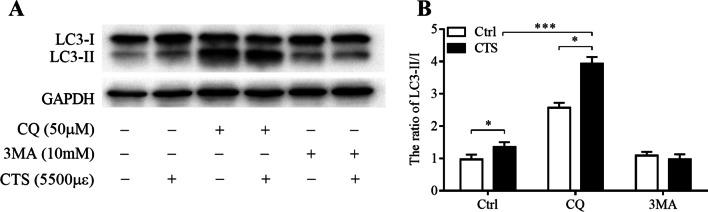
In GPCs, CTS significantly increased the mRNA and protein levels of autophagy-related genes, such as LC3, ULK1, ATG5 and BECN1 in a magnitude- and time-dependent manner. There was no significant difference in the proportion of apoptotic and necrotic cells between control group and CTS group. The autophagy inhibitors, 3-methyladenine (3MA) and chloroquine (CQ) reversed the CTS-induced autophagy via promoting the formation of autophagosomes. Cytochalasin D (cytoD), an inhibitor of G-actin polymerization into F-actin, could effectively block the CTS-induced autophagy in GPCs.
CONCLUSION
Cyclic mechanical strain with high-tensile triggers autophagy in GPCs, which can be suppressed by 3MA and CQ, and cytoskeletal F-actin microfilaments organization plays a key role in chondrocytes' response to mechanical loading.
背景
机械加载被广泛认为是生长板维持代谢和发育所必需的。循环机械应变已被证明能诱导自噬,而循环拉伸应变(CTS)与生长板软骨细胞(GPC)中的自噬之间的关系尚不清楚。本研究旨在探讨 CTS 是否能调节体外 GPC 中的自噬,并探讨这种调节的潜在机制。
方法
将 2 周龄的 Sprague-Dawley 大鼠 GPC 置于不同幅度和持续时间的 CTS 下,频率为 2.0 Hz。通过 RT-qPCR 测量自噬相关基因的 mRNA 水平。通过透射电子显微镜(TME)、免疫荧光和 Western blot 验证 GPC 中的自噬。荧光激活细胞分选(FACS)用于检测凋亡和坏死细胞的比例。
结果
在 GPC 中,CTS 以幅度和时间依赖的方式显著增加了自噬相关基因,如 LC3、ULK1、ATG5 和 BECN1 的 mRNA 和蛋白水平。对照组和 CTS 组之间凋亡和坏死细胞的比例没有显著差异。自噬抑制剂 3-甲基腺嘌呤(3MA)和氯喹(CQ)通过促进自噬体的形成逆转了 CTS 诱导的自噬。细胞松弛素 D(cytoD),一种将 G-肌动蛋白聚合为 F-肌动蛋白的抑制剂,可有效阻断 GPC 中 CTS 诱导的自噬。
结论
高拉伸的循环机械应变触发 GPC 中的自噬,3MA 和 CQ 可抑制自噬,细胞骨架 F-肌动蛋白微丝组织在软骨细胞对机械加载的反应中起关键作用。


 Zotero 插件