
细胞应激信号和未折叠蛋白反应在视网膜变性中的作用机制及治疗意义。
Cellular stress signaling and the unfolded protein response in retinal degeneration: mechanisms and therapeutic implications.
机构信息
Department of Ophthalmology and Ira G. Ross Eye Institute, Jacobs School of Medicine and Biomedical Sciences, University at Buffalo, State University of New York, 955 Main Street, Buffalo, NY, 14203, USA.
Neuroscience Program, Jacobs School of Medicine and Biomedical Sciences, University at Buffalo, State University of New York, Buffalo, NY, USA.
出版信息
Mol Neurodegener. 2022 Mar 28;17(1):25. doi: 10.1186/s13024-022-00528-w.
BACKGROUND
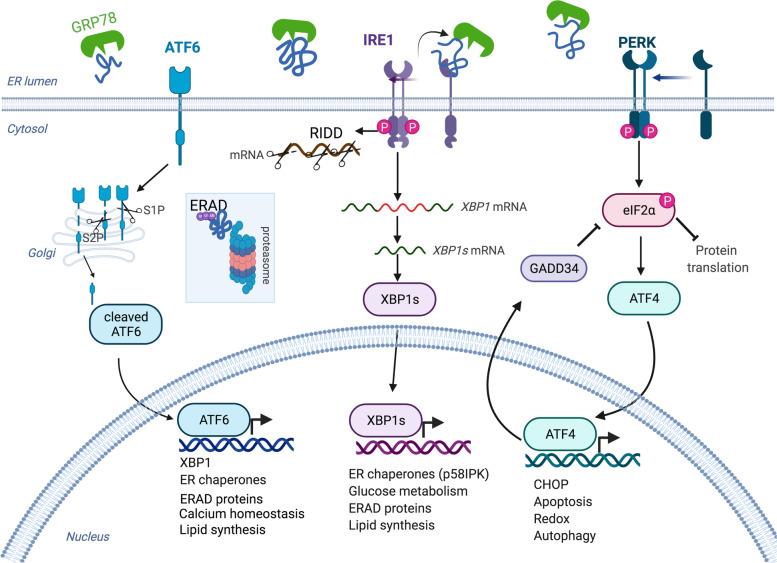
The retina, as part of the central nervous system (CNS) with limited capacity for self-reparation and regeneration in mammals, is under cumulative environmental stress due to high-energy demands and rapid protein turnover. These stressors disrupt the cellular protein and metabolic homeostasis, which, if not alleviated, can lead to dysfunction and cell death of retinal neurons. One primary cellular stress response is the highly conserved unfolded protein response (UPR). The UPR acts through three main signaling pathways in an attempt to restore the protein homeostasis in the endoplasmic reticulum (ER) by various means, including but not limited to, reducing protein translation, increasing protein-folding capacity, and promoting misfolded protein degradation. Moreover, recent work has identified a novel function of the UPR in regulation of cellular metabolism and mitochondrial function, disturbance of which contributes to neuronal degeneration and dysfunction. The role of the UPR in retinal neurons during aging and under disease conditions in age-related macular degeneration (AMD), retinitis pigmentosa (RP), glaucoma, and diabetic retinopathy (DR) has been explored over the past two decades. Each of the disease conditions and their corresponding animal models provide distinct challenges and unique opportunities to gain a better understanding of the role of the UPR in the maintenance of retinal health and function.
METHOD
We performed an extensive literature search on PubMed and Google Scholar using the following keywords: unfolded protein response, metabolism, ER stress, retinal degeneration, aging, age-related macular degeneration, retinitis pigmentosa, glaucoma, diabetic retinopathy.
RESULTS AND CONCLUSION
We summarize recent advances in understanding cellular stress response, in particular the UPR, in retinal diseases, highlighting the potential roles of UPR pathways in regulation of cellular metabolism and mitochondrial function in retinal neurons. Further, we provide perspective on the promise and challenges for targeting the UPR pathways as a new therapeutic approach in age- and disease-related retinal degeneration.
背景
视网膜作为哺乳动物中枢神经系统(CNS)的一部分,自我修复和再生能力有限,由于高能量需求和快速蛋白质周转,它承受着累积的环境压力。这些压力源破坏了细胞蛋白质和代谢的内稳态,如果不能得到缓解,会导致视网膜神经元功能障碍和细胞死亡。一种主要的细胞应激反应是高度保守的未折叠蛋白反应(UPR)。UPR 通过三条主要信号通路发挥作用,试图通过各种方法恢复内质网(ER)中的蛋白质稳态,包括但不限于减少蛋白质翻译、增加蛋白质折叠能力和促进错误折叠蛋白降解。此外,最近的工作还确定了 UPR 在调节细胞代谢和线粒体功能中的新功能,其紊乱会导致神经元变性和功能障碍。在过去的二十年中,人们已经探索了 UPR 在衰老过程中以及在年龄相关性黄斑变性(AMD)、色素性视网膜炎(RP)、青光眼和糖尿病性视网膜病变(DR)等与年龄相关的疾病状态下对视网膜神经元的作用。每种疾病状况及其相应的动物模型都提供了独特的挑战和机会,使我们能够更好地了解 UPR 在维持视网膜健康和功能中的作用。
方法
我们在 PubMed 和 Google Scholar 上使用以下关键词进行了广泛的文献检索:未折叠蛋白反应、代谢、内质网应激、视网膜变性、衰老、年龄相关性黄斑变性、色素性视网膜炎、青光眼、糖尿病性视网膜病变。
结果与结论
我们总结了近年来对细胞应激反应,特别是 UPR 的理解方面的进展,强调了 UPR 途径在调节视网膜神经元细胞代谢和线粒体功能中的潜在作用。此外,我们还对靶向 UPR 途径作为一种新的治疗方法在年龄相关性和疾病相关性视网膜变性中的前景和挑战提供了新的视角。

 Zotero 插件