
ESHRE 指南:子宫内膜异位症。
ESHRE guideline: endometriosis.
机构信息
Nuffield Department of Women's and Reproductive Health, Endometriosis CaRe Centre, University of Oxford, Oxford, UK.
Department of Obstetrics and Gynecology, Semmelweis University, Budapest, Hungary.
出版信息
Hum Reprod Open. 2022 Feb 26;2022(2):hoac009. doi: 10.1093/hropen/hoac009. eCollection 2022.
STUDY QUESTION
How should endometriosis be diagnosed and managed based on the best available evidence from published literature?
SUMMARY ANSWER
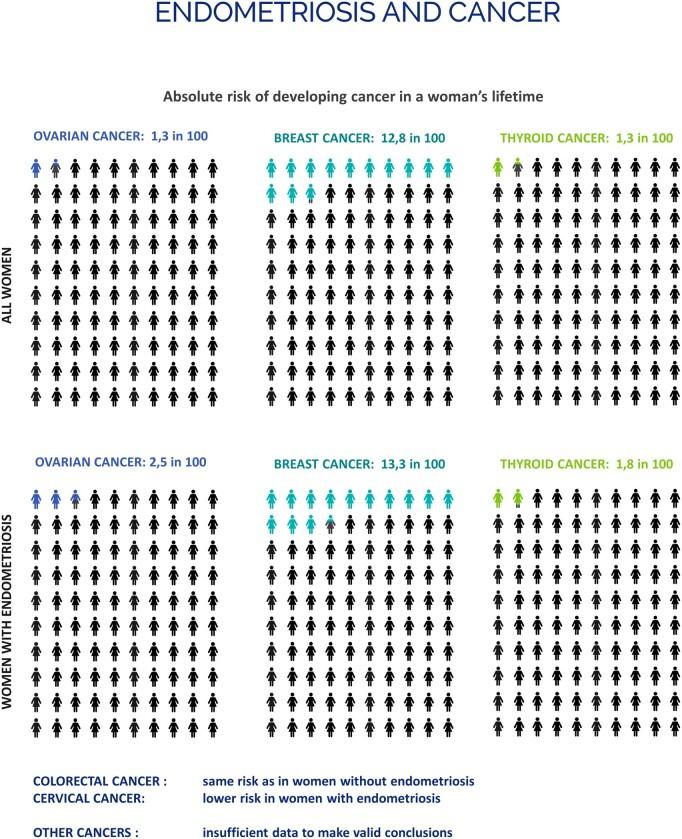
The current guideline provides 109 recommendations on diagnosis, treatments for pain and infertility, management of disease recurrence, asymptomatic or extrapelvic disease, endometriosis in adolescents and postmenopausal women, prevention and the association with cancer.
WHAT IS KNOWN ALREADY
Endometriosis is a chronic condition with a plethora of presentations in terms of not only the occurrence of lesions, but also the presence of signs and symptoms. The most important symptoms include pain and infertility.
STUDY DESIGN SIZE DURATION
The guideline was developed according to the structured methodology for development of ESHRE guidelines. After formulation of key questions by a group of experts, literature searches and assessments were performed. Papers published up to 1 December 2020 and written in English were included in the literature review.
PARTICIPANTS/MATERIALS SETTING METHODS: Based on the collected evidence, recommendations were formulated and discussed within specialist subgroups and then presented to the core guideline development group (GDG) until consensus was reached. A stakeholder review was organized after finalization of the draft. The final version was approved by the GDG and the ESHRE Executive Committee.
MAIN RESULTS AND THE ROLE OF CHANCE
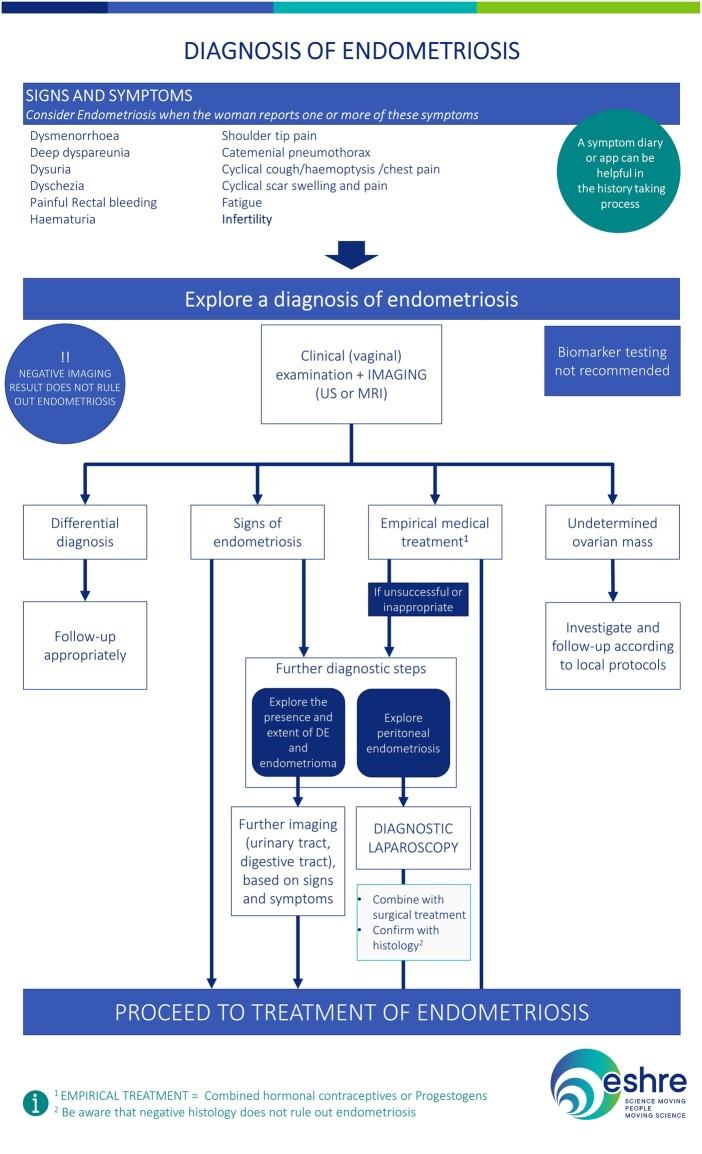
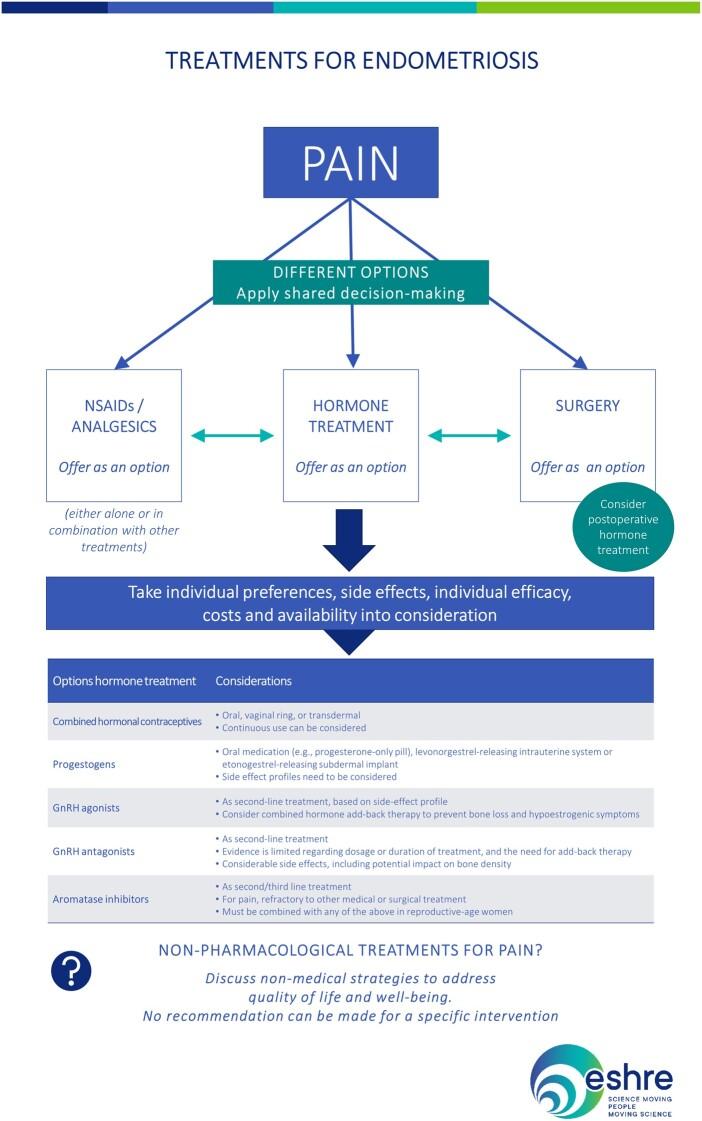
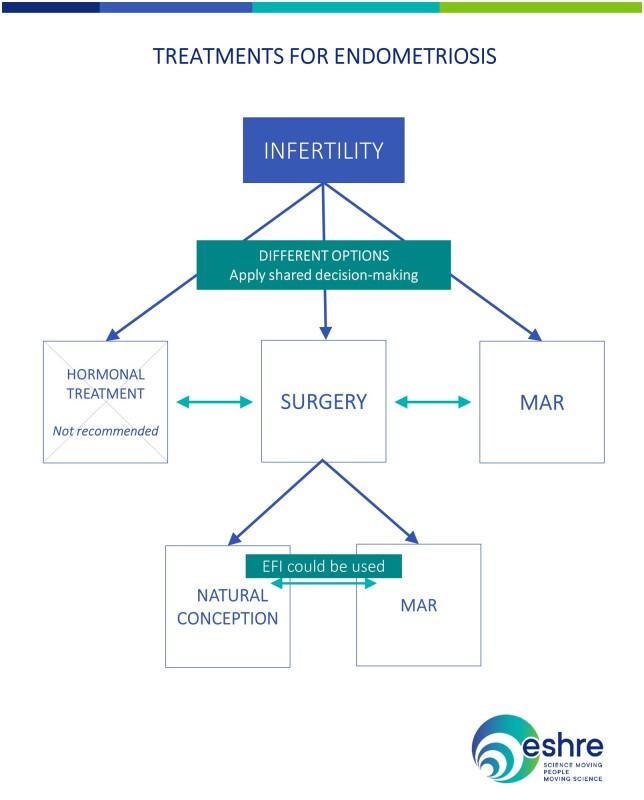
This guideline aims to help clinicians to apply best care for women with endometriosis. Although studies mostly focus on women of reproductive age, the guideline also addresses endometriosis in adolescents and postmenopausal women. The guideline outlines the diagnostic process for endometriosis, which challenges laparoscopy and histology as gold standard diagnostic tests. The options for treatment of endometriosis-associated pain symptoms include analgesics, medical treatments and surgery. Non-pharmacological treatments are also discussed. For management of endometriosis-associated infertility, surgical treatment and/or medically assisted reproduction are feasible. While most of the more recent studies confirm previous ESHRE recommendations, there are five topics in which significant changes to recommendations were required and changes in clinical practice are to be expected.
LIMITATIONS REASONS FOR CAUTION
The guideline describes different management options but, based on existing evidence, no firm recommendations could be formulated on the most appropriate treatments. Also, for specific clinical issues, such as asymptomatic endometriosis or extrapelvic endometriosis, the evidence is too scarce to make evidence-based recommendations.
WIDER IMPLICATIONS OF THE FINDINGS
The guideline provides clinicians with clear advice on best practice in endometriosis care, based on the best evidence currently available. In addition, a list of research recommendations is provided to stimulate further studies in endometriosis.
STUDY FUNDING/COMPETING INTERESTS: The guideline was developed and funded by ESHRE, covering expenses associated with the guideline meetings, with the literature searches and with the dissemination of the guideline. The guideline group members did not receive payments. C.M.B. reports grants from Bayer Healthcare and the European Commission; Participation on a Data Safety Monitoring Board or Advisory Board with ObsEva (Data Safety Monitoring Group) and Myovant (Scientific Advisory Group). A.B. reports grants from FEMaLE executive board member and European Commission Horizon 2020 grant; consulting fees from Ethicon Endo Surgery, Medtronic; honoraria for lectures from Ethicon; and support for meeting attendance from Gedeon Richter; A.H. reports grants from MRC, NIHR, CSO, Roche Diagnostics, Astra Zeneca, Ferring; Consulting fees from Roche Diagnostics, Nordic Pharma, Chugai and Benevolent Al Bio Limited all paid to the institution; a pending patent on Serum endometriosis biomarker; he is also Chair of TSC for STOP-OHSS and CERM trials. O.H. reports consulting fees and speaker's fees from Gedeon Richter and Bayer AG; support for attending meetings from Gedeon-Richter, and leadership roles at the Finnish Society for Obstetrics and Gynecology and the Nordic federation of the societies of obstetrics and gynecology. L.K. reports consulting fees from Gedeon Richter, AstraZeneca, Novartis, Dr KADE/Besins, Palleos Healthcare, Roche, Mithra; honoraria for lectures from Gedeon Richter, AstraZeneca, Novartis, Dr KADE/Besins, Palleos Healthcare, Roche, Mithra; support for attending meetings from Gedeon Richter, AstraZeneca, Novartis, Dr KADE/Besins, Palleos Healthcare, Roche, Mithra; he also has a leadership role in the German Society of Gynecological Endocrinology (DGGEF). M.K. reports grants from French Foundation for Medical Research (FRM), Australian Ministry of Health, Medical Research Future Fund and French National Cancer Institute; support for meeting attendance from European Society for Gynaecological Endoscopy (ESGE), European Congress on Endometriosis (EEC) and ESHRE; She is an advisory Board Member, FEMaLe Project (Finding Endometriosis Using Machine Learning), Scientific Committee Chair for the French Foundation for Research on Endometriosis and Scientific Committee Chair for the ComPaRe-Endometriosis cohort. A.N. reports grants from Merck SA and Ferring; speaker fees from Merck SA and Ferring; support for meeting attendance from Merck SA; Participation on a Data Safety Monitoring Board or Advisory Board with Nordic Pharma and Merck SA; she also is a board member of medical advisory board, Endometriosis Society, the Netherlands (patients advocacy group) and an executive board member of the World Endometriosis Society. E.S. reports grants from National Institute for Health Research UK, Rosetrees Trust, Barts and the London Charity; Royalties from De Gruyter (book editor); consulting fees from Hologic; speakers fees from Hologic, Johnson & Johnson, Medtronic, Intuitive, Olympus and Karl Storz; Participation in the Medicines for Women's Health Expert Advisory Group with Medicines and Healthcare Products Regulatory Agency (MHRA); he is also Ambassador for the World Endometriosis Society. C.T. reports grants from Merck SA; Consulting fees from Gedeon Richter, Nordic Pharma and Merck SA; speaker fees from Merck SA, all paid to the institution; and support for meeting attendance from Ferring, Gedeon Richter and Merck SA. The other authors have no conflicts of interest to declare.
DISCLAIMER
This guideline represents the views of ESHRE, which were achieved after careful consideration of the scientific evidence available at the time of preparation. In the absence of scientific evidence on certain aspects, a consensus between the relevant ESHRE stakeholders has been obtained. . www.eshre.eu/guidelines.).
研究问题
根据已发表文献中的最佳证据,应如何诊断和治疗子宫内膜异位症?
总结答案
本指南提供了 109 条关于诊断、疼痛和不孕治疗、疾病复发管理、无症状或盆腔外疾病、青春期和绝经后妇女的子宫内膜异位症、预防以及与癌症的关联的建议。
已知情况
子宫内膜异位症是一种慢性疾病,其病变的发生不仅表现为病变的发生,而且还表现为症状和体征的存在。最重要的症状包括疼痛和不孕。
研究设计规模持续时间
本指南是根据 ESHRE 指南制定的结构化方法制定的。在一组专家提出关键问题后,进行了文献检索和评估。纳入了截至 2020 年 12 月 1 日发表的英文文献综述。
参与者/材料设置方法:根据收集到的证据,在专家小组内制定建议并进行讨论,然后提交给核心指南制定小组(GDG),直到达成共识。在草案定稿后组织了利益相关者审查。最终版本由 GDG 和 ESHRE 执行委员会批准。
主要结果和机会的作用
本指南旨在帮助临床医生为患有子宫内膜异位症的妇女提供最佳护理。尽管研究主要集中在育龄妇女,但该指南也涉及青春期和绝经后妇女的子宫内膜异位症。该指南概述了子宫内膜异位症的诊断过程,该过程对腹腔镜检查和组织学作为金标准诊断测试提出了挑战。子宫内膜异位症相关疼痛症状的治疗选择包括镇痛药、药物治疗和手术。还讨论了非药物治疗。对于子宫内膜异位症相关不孕的管理,手术治疗和/或辅助生殖是可行的。虽然最近的大多数研究都证实了之前的 ESHRE 建议,但在需要对建议进行重大更改的五个主题和预计会改变临床实践方面存在差异。
局限性注意事项
该指南描述了不同的管理选择,但基于现有证据,无法就最合适的治疗方法提出明确建议。此外,对于某些具体临床问题,如无症状子宫内膜异位症或盆腔外子宫内膜异位症,证据太少,无法提出基于证据的建议。
研究结果的更广泛影响
本指南为临床医生提供了基于现有最佳证据的子宫内膜异位症护理最佳实践的明确建议。此外,还提供了一份研究建议清单,以激发对子宫内膜异位症的进一步研究。
研究资金/利益冲突:该指南由 ESHRE 制定和资助,涵盖了指南会议、文献检索和指南传播的相关费用。指南小组成员没有获得报酬。C.M.B. 报告了 Bayer Healthcare 和欧盟委员会的拨款;参与了 ObsEva(数据安全监测小组)和 Myovant(科学咨询小组)的数据安全监测委员会或咨询委员会。A.B. 报告了 FEMaLE 执行委员会成员和欧盟委员会 Horizon 2020 拨款;Ethicon Endo Surgery、Medtronic 的咨询费;Ethicon 的演讲费;Roche Diagnostics、AstraZeneca、Ferring 的资助会议出席;A.H. 报告了 MRC、NIHR、CSO、Roche Diagnostics、AstraZeneca、Ferring 的拨款;罗氏诊断公司、Nordic Pharma、Chugai 和 Benevolent Al Bio Limited 的所有咨询费均支付给该机构;一种血清子宫内膜异位症生物标志物的专利申请;他还是 TSC 用于 STOP-OHSS 和 CERM 试验的主席。O.H. 报告了 Gedeon Richter 和 Bayer AG 的咨询费和演讲费;Gedeon-Richter、领导职位在芬兰妇产科协会和北欧妇产科协会联合会的支持。L.K. 报告了 Gedeon Richter、AstraZeneca、Novartis、Dr KADE/Besins、Palleos Healthcare、Roche、Mithra 的咨询费;Gedeon Richter、AstraZeneca、Novartis、Dr KADE/Besins、Palleos Healthcare、Roche、Mithra 的演讲费;Gedeon Richter、AstraZeneca、Novartis、Dr KADE/Besins、Palleos Healthcare、Roche、Mithra 的会议出席费;他还在德国妇科内分泌学会(DGGEF)中担任领导角色。M.K. 报告了法国医学研究基金会(FRM)、澳大利亚卫生部、医学研究未来基金和法国国家癌症研究所的拨款;欧洲妇科内镜学会(ESGE)、欧洲子宫内膜异位症大会(EEC)和 ESHRE 的会议出席支持;她是 FEMaLe 项目(使用机器学习发现子宫内膜异位症)的咨询委员会成员、法国子宫内膜异位症研究基金会的科学委员会主席和 ComPaRe-子宫内膜异位症队列的科学委员会主席。A.N. 报告了 Merck SA 和 Ferring 的拨款;Merck SA 和 Ferring 的演讲费;Merck SA 的会议出席支持;参与 Nordic Pharma 和 Merck SA 的数据安全监测委员会或咨询委员会;她还是荷兰子宫内膜异位症协会(患者倡导团体)的医学咨询委员会成员和世界子宫内膜异位症协会的执行委员会成员。E.S. 报告了英国国家卫生研究院、Rosetrees 信托基金、Barts 和伦敦慈善机构的拨款;De Gruyter(书籍编辑)的版税;Hologic 的咨询费;Hologic、Johnson & Johnson、Medtronic、Intuitive、Olympus 和 Karl Storz 的演讲费;参与药品和保健产品监管局(MHRA)的妇女药物咨询小组;他还是世界子宫内膜异位症协会的大使。C.T. 报告了 Merck SA 的拨款;Gedeon Richter、Nordic Pharma 和 Merck SA 的咨询费;Merck SA 的演讲费,均支付给该机构;以及 Ferring、Gedeon Richter 和 Merck SA 的会议出席支持。其他作者没有利益冲突需要披露。
免责声明
本指南代表了 ESHRE 的观点,这些观点是在准备时仔细考虑了可用的科学证据后得出的。在某些方面缺乏科学证据的情况下,已经在相关的 ESHRE 利益相关者之间达成了共识。
 Zotero 插件