
2型糖尿病患者碳水化合物限制持续护理干预可改善膝关节功能:一项非随机研究。
Continuous care intervention with carbohydrate restriction improves physical function of the knees among patients with type 2 diabetes: a non-randomized study.
作者信息
Lyman Kade S, Athinarayanan Shaminie J, McKenzie Amy L, Pearson Camy L, Adams Rebecca N, Hallberg Sarah J, McCarter James P, Volek Jeff S, Phinney Stephen D, Andrawis John P
机构信息
Department of Orthopedics, Harbor-UCLA, 1000 W Carson St, Torrance, CA, 90502, USA.
Virta Health, 501 Folsom Street, San Francisco, CA, 94105, USA.
出版信息
BMC Musculoskelet Disord. 2022 Mar 29;23(1):297. doi: 10.1186/s12891-022-05258-0.
BACKGROUND
In a previous study, we assessed a novel, remotely monitored carbohydrate restricted diet regimen including nutritional ketosis in patients with type 2 diabetes and reported significant improvements in weight, glycemic control, abdominal fat and inflammation from baseline to 2 years. Knee outcome measures were collected as a secondary outcome in the trial. This study aims to assess the effect of this intervention on knee functional scores and to identify if changes in weight, central abdominal fat (CAF), glycemic status and high sensitivity C-reactive protein (hsCRP) were associated with its improvement.
METHODS
This prospective analysis included continuous care intervention (CCI, n = 173) and usual care (UC, n = 69) trial participants with type 2 diabetes that reported knee pain at baseline. Knee outcome measures included the Knee injury and Osteoarthritis Outcome Score (KOOS) pain, symptoms, activities of daily living (ADL), sports and recreation function, and knee-related quality of life subscales, and total KOOS score were assessed from baseline to 2 years. Missing data at each time point were replaced with multiple imputation under the assumption of missing at random. To assess if the primary analysis of the knee scores changed under plausible missing not at random assumptions, sensitivity analysis was also performed using pattern mixture models. In CCI, we also assessed factors associated with the improvement of knee scores.
RESULTS
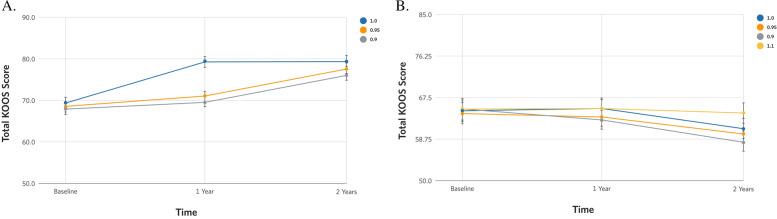
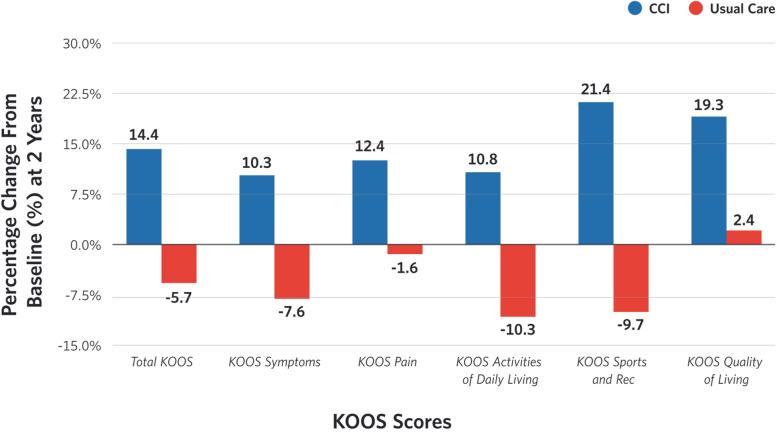
In the primary analysis, CCI participants demonstrated a statistically significant improvement in total KOOS and all KOOS individual subscale scores at 1 year and maintained through 2 years as opposed to UC patients who showed no significant changes from baseline to 2 years. The significant improvement in total KOOS and its individual subscale scores from baseline to 2 years remained relatively stable in CCI in the sensitivity analysis under different missing not at random scenarios confirming the robustness of the findings from the primary analysis. Approximately 46% of the CCI participants met the 10 points minimal clinically important change at 2 years. A reduction in CAF was associated with improvement in total KOOS and KOOS ADL, while a decrease in hsCRP was associated with improvement in KOOS symptoms scores.
CONCLUSION
A very low carbohydrate intervention including nutritional ketosis resulted in significant improvements in knee pain and function among patients with T2D. The improvements in knee function were likely secondary to a reduction in central adiposity and inflammation. Future research on the applicability of this intervention in radiographically confirmed OA patients is important.
TRIAL REGISTRATION
Clinical trial registration: NCT02519309 (10/08/2015).
背景
在之前的一项研究中,我们评估了一种新型的、远程监测的碳水化合物限制饮食方案,该方案包括营养性生酮饮食,用于2型糖尿病患者,并报告了从基线到2年,患者在体重、血糖控制、腹部脂肪和炎症方面有显著改善。膝关节结局指标作为该试验的次要结局进行收集。本研究旨在评估这种干预对膝关节功能评分的影响,并确定体重、腹部中央脂肪(CAF)、血糖状态和高敏C反应蛋白(hsCRP)的变化是否与其改善相关。
方法
这项前瞻性分析纳入了173名连续护理干预(CCI)组和69名常规护理(UC)组的2型糖尿病试验参与者,这些参与者在基线时报告有膝关节疼痛。膝关节结局指标包括膝关节损伤和骨关节炎结局评分(KOOS)的疼痛、症状、日常生活活动(ADL)、运动和娱乐功能以及与膝关节相关的生活质量子量表,并在基线至2年期间评估总KOOS评分。在随机缺失的假设下,使用多重填补法替换每个时间点的缺失数据。为了评估在似是而非的非随机缺失假设下膝关节评分的主要分析是否发生变化,还使用模式混合模型进行了敏感性分析。在CCI组中,我们还评估了与膝关节评分改善相关的因素。
结果
在主要分析中,CCI组参与者在1年时总KOOS及所有KOOS单个子量表评分均有统计学意义的改善,并持续至2年,而UC组患者从基线到2年无显著变化。在不同的非随机缺失情况下的敏感性分析中,CCI组从基线到2年总KOOS及其单个子量表评分的显著改善保持相对稳定,证实了主要分析结果的稳健性。约46%的CCI组参与者在2年时达到了10分的最小临床重要变化。CAF的减少与总KOOS和KOOS-ADL的改善相关,而hsCRP的降低与KOOS症状评分的改善相关。
结论
包括营养性生酮饮食在内的极低碳水化合物干预使2型糖尿病患者的膝关节疼痛和功能有显著改善。膝关节功能的改善可能继发于中央肥胖和炎症的减轻。未来研究这种干预在经影像学证实的骨关节炎患者中的适用性很重要。
试验注册
临床试验注册:NCT02519309(2015年8月10日)。
 Zotero 插件