
纳米孔靶向测序在诊断感染性疾病中的临床性能。
Clinical Performance of Nanopore Targeted Sequencing for Diagnosing Infectious Diseases.
机构信息
Department of Clinical Laboratory, Zhongnan Hospital of Wuhan Universitygrid.49470.3egrid.413247.7, Wuhan, People's Republic of China.
Wuhan Research Center for Infectious Diseases and Cancer, Chinese Academy of Medical Sciences, Wuhan, People's Republic of China.
出版信息
Microbiol Spectr. 2022 Apr 27;10(2):e0027022. doi: 10.1128/spectrum.00270-22. Epub 2022 Mar 30.
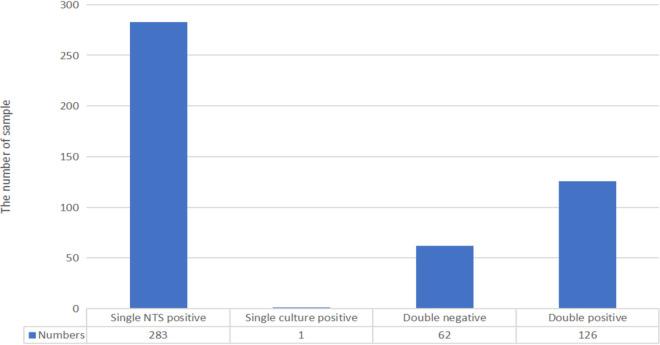
The gold standard for confirming bacterial infections is culture-positive, which has a long sample-to-result turnaround time and poor sensitivity for unculturable and fastidious pathogens; therefore, it is hard to guide early, targeted antimicrobial therapy and reduce overuse of broad-spectrum antibiotics. Nanopore targeted sequencing (NTS) is reported to be advantageous in detection speed and range over culture in prior published reports. However, investigation of the clinical performance of NTS is deficient at present. Thus, we assessed the feasibility of NTS for the first time with cohort and systematic comparisons with traditional culture assays and PCR followed by Sanger sequencing. This retrospective study was performed on 472 samples, including 6 specimen types from 436 patients, to evaluate the clinical performance of NTS designed for identifying the microbial composition of various infections. Of these samples, 86.7% were found to be NTS positive, which was significantly higher than culture-positive (26.7%). A total of 425 significant human opportunistic bacteria and fungi detected by NTS were selected to go through validation with PCR followed by Sanger sequencing. The average accuracy rate was 85.2% (maximum 100% created by Cryptococcus neoformans, the last one 66.7% provided by both Staphylococcus haemolyticus and Moraxella osloensis, minimum 0% produced by Burkholderia cepacia). The accuracy rate also varied with sample type; the highest accuracy rate was found in pleural and ascites fluid (95.8%) followed by bronchoalveolar lavage fluid (88.7%), urine (86.8%), and wound secretions (85.0%), while the lowest was present in cerebrospinal fluid (58.8%). NTS had a diagnostic sensitivity of 94.5% and specificity of 31.8%. The positive and negative predictive values of NTS were 79.9% and 66.7%, respectively. For diagnosis of infectious diseases, the sensitivity was greatly increased by 56.7% in NTS compared with culture (94.5% vs 37.8%). Therefore, NTS can accurately detect the causative pathogens in infectious samples, particularly in pleural and ascites fluid, bronchoalveolar lavage fluid, urine, and wound secretions, with a short turnaround time of 8-14 h, and might innovatively contribute to personalizing antibiotic treatments for individuals with standardized protocols in clinical practices. Nanopore targeted sequencing (NTS) is reported to be advantageous in detection speed and range over culture in prior published reports. Investigation of the clinical performance of NTS is deficient at present. In our study, cohort and systematic comparisons among three assays (culture, NTS, and Sanger sequencing) were analyzed retrospectively for the first time. We found that NTS undoubtedly has incomparable advantages in accurately detecting the causative pathogens in infectious samples, particularly in pleural and ascites fluid, bronchoalveolar lavage fluid, urine, and wound secretions, with a short turnaround time of 8-14 h. For sterile specimens like blood and cerebrospinal fluid (CSF), the NTS outcomes should be validated using other nucleic acid based detection technology. Overall, NTS might innovatively contribute to guiding early, targeted antimicrobial therapy with lower cost and reduce overuse of broad-spectrum antibiotics.
用于确认细菌感染的金标准是培养阳性,但它的样本到结果的周转时间长,并且对不可培养和苛刻的病原体的灵敏度差;因此,很难指导早期的、有针对性的抗菌治疗,并减少广谱抗生素的过度使用。纳米孔靶向测序(NTS)在先前的报道中被报道在检测速度和范围方面优于培养。然而,目前对 NTS 的临床性能的研究还很缺乏。因此,我们首次评估了 NTS 的可行性,并与传统培养检测和 PCR 后 Sanger 测序进行了队列和系统比较。这项回顾性研究对 472 个样本进行了分析,包括 436 名患者的 6 种标本类型,以评估专门设计用于鉴定各种感染微生物组成的 NTS 的临床性能。在这些样本中,有 86.7%的样本 NTS 阳性,明显高于培养阳性(26.7%)。从 NTS 中总共选择了 425 种重要的人类机会性细菌和真菌进行验证,以进行 PCR 后 Sanger 测序。平均准确率为 85.2%(最大值 100%由新型隐球菌创造,最后一个由溶血葡萄球菌和摩拉氏菌提供的准确率为 66.7%,最低为 0%由洋葱伯克霍尔德菌产生)。准确率也随样本类型而变化;胸腔积液和腹水的准确率最高(95.8%),其次是支气管肺泡灌洗液(88.7%)、尿液(86.8%)和伤口分泌物(85.0%),而脑脊液最低(58.8%)。NTS 的诊断灵敏度为 94.5%,特异性为 31.8%。NTS 的阳性预测值和阴性预测值分别为 79.9%和 66.7%。对于传染病的诊断,NTS 的灵敏度比培养提高了 56.7%(94.5%对 37.8%)。因此,NTS 可以在 8-14 小时的短周转时间内准确检测感染样本中的病原体,尤其是在胸腔积液和腹水、支气管肺泡灌洗液、尿液和伤口分泌物中,可能会创新性地为具有标准化方案的个体提供个性化抗生素治疗做出贡献。纳米孔靶向测序(NTS)在先前的报道中被报道在检测速度和范围方面优于培养。目前对 NTS 的临床性能的研究还很缺乏。在我们的研究中,首次对三种检测方法(培养、NTS 和 Sanger 测序)进行了队列和系统比较。我们发现,NTS 在准确检测感染样本中的病原体方面无疑具有无与伦比的优势,尤其是在胸腔积液和腹水、支气管肺泡灌洗液、尿液和伤口分泌物中,其周转时间短至 8-14 小时。对于像血液和脑脊液(CSF)这样的无菌样本,NTS 结果应该使用其他基于核酸的检测技术进行验证。总的来说,NTS 可能会创新性地为早期、有针对性的抗菌治疗提供指导,降低成本,并减少广谱抗生素的过度使用。



 Zotero 插件