
贝伐珠单抗与聚腺苷二磷酸核糖聚合酶抑制剂在新诊断卵巢癌女性中的比较:一项网络荟萃分析。
Bevacizumab versus PARP-inhibitors in women with newly diagnosed ovarian cancer: a network meta-analysis.
机构信息
Department of Biomedical Sciences, Inha University College of Medicine, Incheon, Republic of Korea.
Department of Obstetrics and Gynecology, Inha University hospital, Inha University College of Medicine, 27, Inhang-ro, Sinheung-dong, Jung-gu, Incheon, Republic of Korea.
出版信息
BMC Cancer. 2022 Mar 30;22(1):346. doi: 10.1186/s12885-022-09455-x.
BACKGROUND
In women with newly diagnosed ovarian cancer, bevacizumab and poly (ADP-ribose) polymerase inhibitors (PARPi) exhibit improved progression-free survival (PFS) when administered concurrent with chemotherapy and/or maintenance therapy, but no study has directly compared their effects. Therefore, this study aimed to compare the efficacy and safety of bevacizumab and PARPi in women with newly diagnosed ovarian cancer using a network meta-analysis.
METHODS
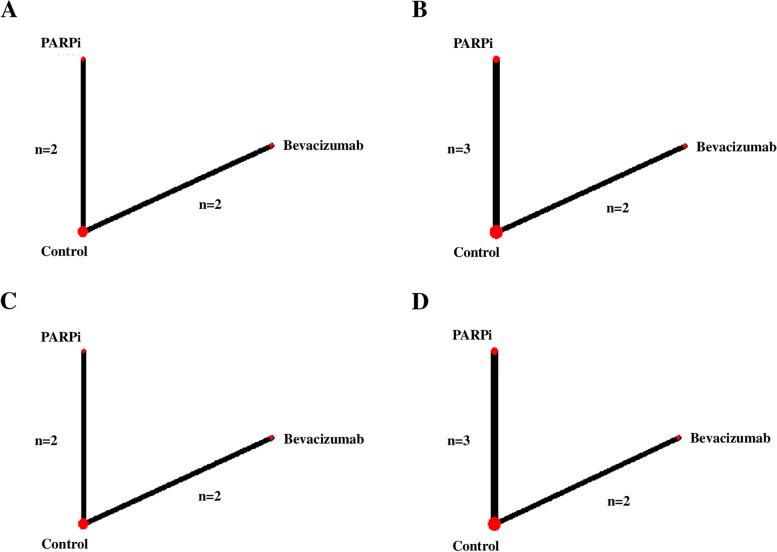
PubMed, Medline, and Embase databases were searched, and five randomized trials assessing PFS in women with newly diagnosed ovarian cancer treated with either bevacizumab, PARPi, or placebo or no additional agent (controls) were identified. PFS was compared in the overall population with ovarian cancer, women with a BRCA1/2 mutation (BRCAm) and women with homologous-recombination deficiency (HRD). Adverse events (grade ≥ 3) were compared in all populations of the included studies.
RESULTS
PARPi improved PFS significantly more than bevacizumab in women with a BRCAm (HR 0.47; 95% CI 0.36-0.60) and with HRD (HR 0.66; 95% CI 0.50-0.87). However, in the overall population with ovarian cancer, no significant difference in PFS was observed between women treated with PARPi and those treated with bevacizumab. PARPi exhibited the highest surface under the cumulative ranking probabilities value as the most effective treatment for PFS (PARPi vs. bevacizumab: 98% vs. 52% in the overall population with ovarian cancer; 100% vs. 50% in women with BRCAm; 100% vs. 50% in women with HRD). For adverse events, the risk of all treatments was similar. However, PARPi had a higher adverse risk than the control group (relative risk 2.14; 95% CI 1.40-3.26).
CONCLUSIONS
In women with newly diagnosed ovarian cancer, PARPi might be more effective in terms of PFS compared to bevacizumab. The risk of serious adverse events was similar for PARPi and bevacizumab.
背景
在新诊断为卵巢癌的女性中,贝伐珠单抗和聚(ADP-核糖)聚合酶抑制剂(PARPi)与化疗和/或维持治疗同时给药时,可改善无进展生存期(PFS),但尚无研究直接比较它们的效果。因此,本研究旨在通过网络荟萃分析比较新诊断为卵巢癌的女性中贝伐珠单抗和 PARPi 的疗效和安全性。
方法
检索 PubMed、Medline 和 Embase 数据库,确定了五项评估新诊断为卵巢癌的女性中贝伐珠单抗、PARPi 或安慰剂或无其他药物(对照组)治疗的 PFS 的随机试验。在卵巢癌总体人群、BRCA1/2 突变(BRCAm)女性和同源重组缺陷(HRD)女性中比较 PFS。比较纳入研究所有人群的不良事件(≥3 级)。
结果
PARPi 在 BRCAm(HR 0.47;95%CI 0.36-0.60)和 HRD(HR 0.66;95%CI 0.50-0.87)女性中显著提高 PFS 优于贝伐珠单抗。然而,在卵巢癌总体人群中,PARPi 治疗组与贝伐珠单抗治疗组的 PFS 无显著差异。PARPi 作为治疗 PFS 最有效的药物,其累积排序概率值最高(PARPi 与贝伐珠单抗:卵巢癌总体人群中为 98%与 52%;BRCAm 女性中为 100%与 50%;HRD 女性中为 100%与 50%)。对于不良事件,所有治疗的风险相似。然而,PARPi 的不良反应风险高于对照组(相对风险 2.14;95%CI 1.40-3.26)。
结论
在新诊断为卵巢癌的女性中,PARPi 在 PFS 方面可能比贝伐珠单抗更有效。PARPi 和贝伐珠单抗的严重不良事件风险相似。


 Zotero 插件