
番茄红素对艾维茵肉鸡生长性能、抗氧化酶活性及信号通路中基因表达的影响
Effect of Lycopene on the Growth Performance, Antioxidant Enzyme Activity, and Expression of Gene in the Signaling Pathway of Arbor Acres Broilers.
作者信息
Wang Sibo, Wu Hongzhi, Zhu Yunhui, Cui Hongxia, Yang Ji, Lu Mingyuan, Cheng Huangzuo, Gu Lihong, Xu Tieshan, Xu Li
机构信息
College of Animal Science and Technology, Northeast Agricultural University, Harbin, China.
Tropical Crop Genetic Resource Research Institute, Chinese Academy of Tropical Agricultural Sciences, Haikou, China.
出版信息
Front Vet Sci. 2022 Mar 14;9:833346. doi: 10.3389/fvets.2022.833346. eCollection 2022.
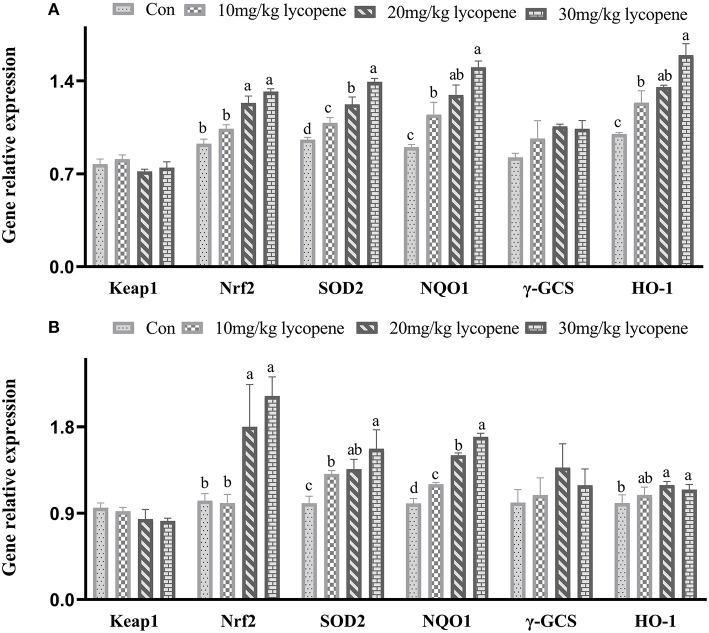
The objective of this study was to determine the effect of dietary lycopene supplementation on the growth performance, antioxidant enzyme activity of serum and liver, and gene expressions associated with Kelch-like ech-associated protein-1 ()/Nuclear Factor E2-related factor 2 () pathway in liver of Arbor Acres broilers. A total of 288 1-day-old male broilers were randomly divided into 4 treatments with 6 replicates and 12 chickens for each replicate. The control group was fed with the basal diet, while the treated groups were fed with the basal diet with 10, 20, and 30 mg/kg lycopene in powder. Feed and water were provided for 42 days. Compared with the control group, (a) the average daily gain increased ( = 0.002 vs. = 0.001) and the feed conversion ratio decreased ( = 0.017 vs. = 0.023) in groups treated with lycopene in the grower and whole phases, and the average daily feed intake was quadratically affected ( = 0.043) by lycopene in the grower phase; (b) the serum superoxide dismutase content was linearly affected ( = 0.035) by lycopene at 21 days; (c) the serum glutathione peroxidase content, superoxide dismutase content, and total antioxidant capability were higher ( = 0.014, = 0.003, and = 0.016, respectively) in the 30 mg/kg lycopene group at 42 days; (d) the liver glutathione peroxidase and superoxide dismutase contents in groups treated with lycopene were higher ( ≤ 0.001 vs. ≤ 0.001) at 21 days; (e) the liver glutathione peroxidase content was higher ( ≤ 0.001) in the 20 and 30 mg/kg lycopene groups, at 42 days; (f) the mRNA expression levels of , and genes were higher (21 days: = 0.042, = 0.021, = 0.035, and = 0.043, respectively; 42 days: = 0.038, = 0.025, = 0.034, and = 0.043, respectively) in the 20 and 30 mg/kg lycopene groups at 21 and 42 days. The 30 mg/kg lycopene concentration improved the growth performance, antioxidant enzyme activity in serum and liver, and gene expression in the signaling pathway of Arbor Acres broilers.
本研究的目的是确定日粮中添加番茄红素对爱拔益加肉鸡生长性能、血清和肝脏抗氧化酶活性以及肝脏中与类 Kelch 样 ECH 相关蛋白 1(KEAP1)/核因子 E2 相关因子 2(Nrf2)通路相关基因表达的影响。总共 288 只 1 日龄雄性肉鸡被随机分为 4 组,每组 6 个重复,每个重复 12 只鸡。对照组饲喂基础日粮,而处理组分别饲喂添加 10、20 和 30 mg/kg 番茄红素粉末的基础日粮。提供饲料和饮水 42 天。与对照组相比,(a)在生长育肥期和全期添加番茄红素的组中,平均日增重增加(生长育肥期:P = 0.002,全期:P = 0.001),饲料转化率降低(生长育肥期:P = 0.017,全期:P = 0.023),并且在生长育肥期番茄红素对平均日采食量有二次效应(P = 0.043);(b)在 21 天时,番茄红素对血清超氧化物歧化酶含量有线性影响(P = 0.035);(c)在 42 天时,30 mg/kg 番茄红素组的血清谷胱甘肽过氧化物酶含量、超氧化物歧化酶含量和总抗氧化能力更高(分别为 P = 0.014、P = 0.003 和 P = 0.016);(d)在 21 天时,添加番茄红素的组肝脏谷胱甘肽过氧化物酶和超氧化物歧化酶含量更高(KEAP1:P ≤ 0.001,Nrf2:P ≤ 0.001);(e)在 42 天时,20 和 30 mg/kg 番茄红素组的肝脏谷胱甘肽过氧化物酶含量更高(P ≤ 0.001);(f)在 21 天和 42 天时,20 和 30 mg/kg 番茄红素组的 Keap1、Nrf2、Gclc 和 Gclm 基因 mRNA 表达水平更高(21 天时:分别为 P = 0.042、P = 0.021、P = 0.035 和 P = 0.043;42 天时:分别为 P = 0.038、P = 0.025、P = 0.034 和 P = 0.043)。30 mg/kg 番茄红素浓度改善了爱拔益加肉鸡的生长性能、血清和肝脏中的抗氧化酶活性以及 Nrf2 信号通路中的基因表达。
 Zotero 插件