
心脏磁共振成像和超声心动图用于杜氏肌营养不良男孩心肌病的早期诊断:一项横断面研究
Cardiac MRI and Echocardiography for Early Diagnosis of Cardiomyopathy Among Boys With Duchenne Muscular Dystrophy: A Cross-Sectional Study.
作者信息
Prakash Nidhi, Suthar Renu, Sihag Bhupendra Kumar, Debi Uma, Kumar Rohit Manoj, Sankhyan Naveen
机构信息
Pediatric Neurology Unit, Department of Pediatrics, Post Graduate Institute of Medical Education and Research (PGIMER), Chandigarh, India.
Department of Cardiology, Post Graduate Institute of Medical Education and Research (PGIMER), Chandigarh, India.
出版信息
Front Pediatr. 2022 Mar 14;10:818608. doi: 10.3389/fped.2022.818608. eCollection 2022.
BACKGROUND
Cardiomyopathy is an important cause of morbidity and mortality in boys with Duchenne muscular dystrophy (DMD). Early diagnosis is a prerequisite for timely institution of cardioprotective therapies.
OBJECTIVE
We compared cardiac MRI (CMRI) with transthoracic echocardiography (TTE) including tissue Doppler imaging (TDI) and speckle tracking echocardiography (STE) for diagnosis of cardiomyopathy in early ambulatory boys with DMD.
METHODOLOGY
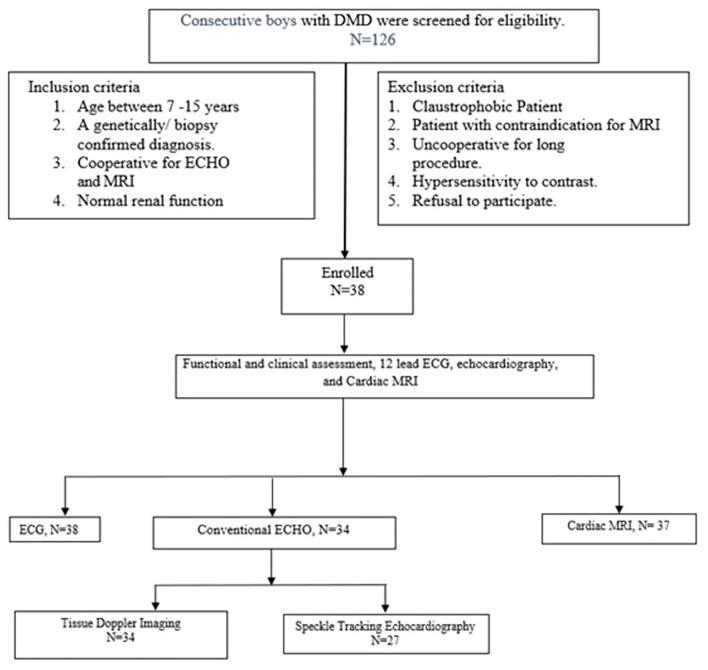
This cross-sectional study was conducted between June 2018 and December 2020. Consecutive boys between 7 and 15 years of age with DMD were enrolled. Percentage ejection fraction (EF), fractional shortening, wall motion abnormalities, early diastolic mitral annulus velocity (Ea), medial mitral annulus ratio (E/Ea), and global strain were measured with STE. CMRI-derived EF, segmental hypokinesia, and late gadolinium enhancement (LGE) were studied and compared.
RESULTS
A total of 38 ambulatory boys with DMD were enrolled. The mean age was 8.8 ± 1.6 years, and none had clinical features suggestive of cardiac dysfunction. In the TTE, EF was ≤55% in 5 (15%), FS was ≤28% in 3 (9%), and one each had left ventricular wall thinning and wall hypokinesia. In TDI, none had diastolic dysfunction, and STE showed reduced global strain of < 18% in 3 (9%) boys. CMRI-derived EF was ≤55% in 20 (53%) boys and CMRI showed the presence of left ventricular wall hypokinesia in 9 (24%) and LGE in 4 (11%) boys.
CONCLUSION
Cardiomyopathy remains clinically asymptomatic among early ambulatory boys with DMD. A significantly higher percentage of boys revealed early features of DMD-related cardiomyopathy in CMRI in comparison with echocardiography.
背景
心肌病是杜氏肌营养不良症(DMD)男孩发病和死亡的重要原因。早期诊断是及时采取心脏保护治疗的前提条件。
目的
我们比较了心脏磁共振成像(CMRI)与经胸超声心动图(TTE),包括组织多普勒成像(TDI)和斑点追踪超声心动图(STE),用于诊断早期能行走的DMD男孩的心肌病。
方法
这项横断面研究于2018年6月至2020年12月进行。纳入7至15岁连续的DMD男孩。用STE测量射血分数(EF)百分比、缩短分数、室壁运动异常、二尖瓣环舒张早期速度(Ea)、二尖瓣环内侧比值(E/Ea)和整体应变。研究并比较CMRI得出的EF、节段性运动减弱和延迟钆增强(LGE)。
结果
共纳入38名能行走的DMD男孩。平均年龄为8.8±1.6岁,均无提示心脏功能障碍的临床特征。在TTE中,5名(15%)男孩的EF≤55%,3名(9%)男孩的FS≤28%,各有1名男孩出现左心室壁变薄和室壁运动减弱。在TDI中,无人有舒张功能障碍,STE显示3名(9%)男孩的整体应变降低<18%。CMRI得出的EF在20名(53%)男孩中≤55%,CMRI显示9名(24%)男孩存在左心室壁运动减弱,4名(11%)男孩存在LGE。
结论
在早期能行走的DMD男孩中,心肌病在临床上仍无症状。与超声心动图相比,CMRI显示有更高比例的男孩存在DMD相关心肌病的早期特征。

 Zotero 插件