
嵌合抗原受体(CAR)在癌症免疫疗法中的竞赛:从 CAR T、CAR NK 到 CAR 巨噬细胞疗法。
CAR race to cancer immunotherapy: from CAR T, CAR NK to CAR macrophage therapy.
机构信息
Vanderbilt University, 2201 West End Ave, Nashville, TN, 37235, USA.
Brigham and Women's Hospital, Harvard Medical School, Boston, MA, USA.
出版信息
J Exp Clin Cancer Res. 2022 Mar 31;41(1):119. doi: 10.1186/s13046-022-02327-z.
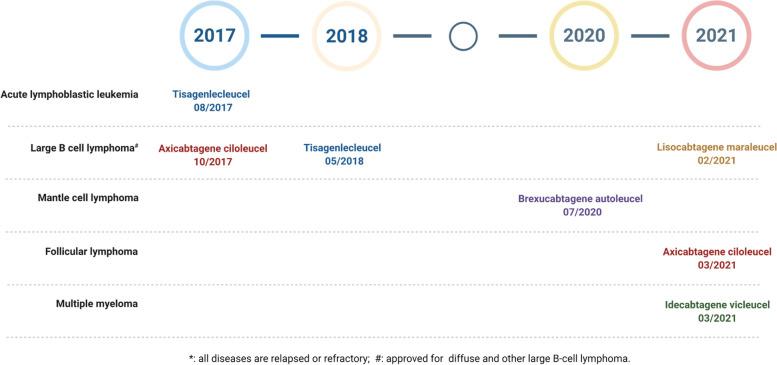
Adoptive cell therapy with chimeric antigen receptor (CAR) immunotherapy has made tremendous progress with five CAR T therapies approved by the US Food and Drug Administration for hematological malignancies. However, CAR immunotherapy in solid tumors lags significantly behind. Some of the major hurdles for CAR immunotherapy in solid tumors include CAR T cell manufacturing, lack of tumor-specific antigens, inefficient CAR T cell trafficking and infiltration into tumor sites, immunosuppressive tumor microenvironment (TME), therapy-associated toxicity, and antigen escape. CAR Natural Killer (NK) cells have several advantages over CAR T cells as the NK cells can be manufactured from pre-existing cell lines or allogeneic NK cells with unmatched major histocompatibility complex (MHC); can kill cancer cells through both CAR-dependent and CAR-independent pathways; and have less toxicity, especially cytokine-release syndrome and neurotoxicity. At least one clinical trial showed the efficacy and tolerability of CAR NK cell therapy. Macrophages can efficiently infiltrate into tumors, are major immune regulators and abundantly present in TME. The immunosuppressive M2 macrophages are at least as efficient as the proinflammatory M1 macrophages in phagocytosis of target cells; and M2 macrophages can be induced to differentiate to the M1 phenotype. Consequently, there is significant interest in developing CAR macrophages for cancer immunotherapy to overcome some major hurdles associated with CAR T/NK therapy, especially in solid tumors. Nevertheless, both CAR NK and CAR macrophages have their own limitations. This comprehensive review article will discuss the current status and the major hurdles associated with CAR T and CAR NK therapy, followed by the structure and cutting-edge research of developing CAR macrophages as cancer-specific phagocytes, antigen presenters, immunostimulators, and TME modifiers.
嵌合抗原受体 (CAR) 免疫疗法的过继细胞疗法取得了巨大进展,美国食品和药物管理局 (FDA) 已批准了五种 CAR T 疗法用于治疗血液恶性肿瘤。然而,CAR 免疫疗法在实体瘤中的应用仍存在很大的障碍。CAR 免疫疗法在实体瘤中面临的一些主要障碍包括 CAR T 细胞的制造、缺乏肿瘤特异性抗原、CAR T 细胞向肿瘤部位的转移和浸润效率低下、免疫抑制性肿瘤微环境 (TME)、治疗相关毒性和抗原逃逸。与 CAR T 细胞相比,CAR 自然杀伤 (NK) 细胞具有几个优势,因为 NK 细胞可以从现成的细胞系或同种异体 NK 细胞制造,这些细胞系或细胞不匹配主要组织相容性复合物 (MHC);可以通过 CAR 依赖性和 CAR 非依赖性途径杀死癌细胞;而且毒性较小,特别是细胞因子释放综合征和神经毒性。至少有一项临床试验表明了 CAR NK 细胞疗法的疗效和耐受性。巨噬细胞可以有效地浸润肿瘤,是主要的免疫调节剂,在 TME 中大量存在。免疫抑制性 M2 巨噬细胞在吞噬靶细胞方面的效率至少与促炎 M1 巨噬细胞一样高;并且可以诱导 M2 巨噬细胞向 M1 表型分化。因此,人们对开发用于癌症免疫治疗的 CAR 巨噬细胞产生了浓厚的兴趣,以克服与 CAR T/NK 治疗相关的一些主要障碍,尤其是在实体瘤中。然而,CAR NK 和 CAR 巨噬细胞都有其自身的局限性。这篇全面的综述文章将讨论 CAR T 和 CAR NK 疗法的现状和主要障碍,然后讨论开发作为肿瘤特异性吞噬细胞、抗原呈递细胞、免疫刺激剂和 TME 调节剂的 CAR 巨噬细胞的结构和前沿研究。


 Zotero 插件